
The launch video is finished, the data sheet is laid out and the LinkedIn ads are ready. Then the comments arrive: the product manager wants a figure changed, legal asks for proof behind a comparison, and the managing director has not opened the email yet. A B2B campaign has to win over several people on the buyer’s side, and it has to get past several people on your own side first.
Below you will find five B2B campaign examples, what made each one work and what gets reviewed before a B2B campaign goes live.
What makes a good B2B campaign?
A good B2B campaign shows the value of an offer that needs explaining, without asking anyone to understand the technology behind it. It does that with one idea that every person involved in the purchase can repeat. Five criteria help you judge the examples and your own drafts:
| Criterion | Question to ask |
|---|---|
| Visible benefit | Does the campaign show what the product does instead of claiming it? |
| One idea | Can you tell the campaign in a single sentence? |
| Several decision-makers | Does it speak to the specialist, the budget holder and management? |
| Credibility | Does it rest on a real test, a real customer or a clear position? |
| Staying power | Does the idea work across formats and years? |
5 B2B campaign examples and what each one shows
The five examples come from Volvo Trucks, IBM, Salesforce, Mailchimp and GoDaddy and span more than two decades, from a newspaper series to a Super Bowl spot. Each one links to a source that documents it.
1. Volvo Trucks “The Epic Split”: a steering system you can see
Volvo Trucks wanted to show how precisely its Volvo Dynamic Steering works. In “The Epic Split”, released in November 2013, Jean-Claude Van Damme does the splits between two Volvo FM trucks as they reverse side by side, a stunt Volvo says the steering system made possible (Transport Engineer, 2013).
By June 2014 the film had more than 73 million views on YouTube, and Volvo’s “Live Test” series had won 20 awards at Cannes Lions, among them two Grand Prix, according to the Volvo Trucks press release, 2014. Volvo’s own release adds that, according to a survey it does not name, almost half of the truck buyers who had seen the launch videos said they were now more likely to choose Volvo for their next truck.
What made it work: A technical feature turned into one image that needs no explanation. The film was made for truck buyers, yet people far outside the industry watched and shared it.
2. IBM “Smarter Planet”: one idea for a whole portfolio
IBM introduced Smarter Planet with a speech by its chairman Sam Palmisano at the Council on Foreign Relations on 6 November 2008. The idea was that the world’s systems, from energy and food to healthcare and government, are increasingly connected and can be made smarter. Weekly “op-ads” in national newspapers followed, which an IBM marketing vice president described as not meant to be overtly commercial (Trellis, 2008).
What made it work: A B2B brand can sell a point of view that many separate offers fit under. Buyers in energy, logistics or healthcare could each find their own problem in it.
3. Salesforce “No Software”: a clear opponent
Salesforce opened in 1999 and, as its own company story puts it, started with “a radical idea: no software” (Salesforce, Our story). Salesforce delivered CRM through the cloud, at a time when, as the same page says, enterprise software was complex to deploy and expensive to maintain. From it came the NO SOFTWARE logo and the mascot SaaSy (Salesforce blog, 2024). The marketing also took on an established rival; diginomica recalls the young company “piggybacking onto Siebel Systems events with advertising stunts outside” (diginomica, 2024).
What made it work: An opponent makes a new model quick to understand. Salesforce turned a cost buyers knew from their own budgets into the thing to fight.
Try it yourself: In the demo you work in a real draftgo workspace with sample data.
4. Mailchimp “Did You Mean MailChimp?”: a misheard name becomes a campaign
In 2014 a speaker in a Mailchimp ad on the podcast Serial read the name as “MailKimp”, and the ad went viral (Slate, 2014).
Mailchimp kept the joke. “Did You Mean MailChimp?”, which Adweek calls the company’s first major ad work, came from the agency Droga5 and launched in January 2017 with films named after misheard versions of the brand, such as MailShrimp and KaleLimp (shots, 2017). It won a Cyber Grand Prix at Cannes Lions 2017 (Adweek, 2019).
What made it work: A B2B brand is allowed to be funny. Mailchimp gave a moment its audience already knew a second life, so anyone who remembers the joke remembers the name.
5. GoDaddy “Act Like You Know”: the product proves the claim
GoDaddy launched “Act Like You Know” on 5 February 2025 as a Super Bowl ad for GoDaddy Airo, its AI tool for small businesses. Walton Goggins plays roles he could never do for real, then shows his own eyewear brand, for which Airo created a logo, website and social content (GoDaddy press release, 2025). In June 2025 the campaign won the Grand Prix of the Creative B2B Lions at Cannes, out of 417 entries, and jury president Wendy Walker praised its “pure B2B creativity” (Cannes Lions, 2025).
What made it work: The ad backs its promise with the work of a real small business, and the famous face draws the attention to it.
What these B2B marketing campaigns have in common
The five campaigns differ in budget and channel, but they share four patterns:
- One idea, one picture: two reversing trucks, a smarter planet, a crossed-out word, a misheard name, an actor who admits he has no idea.
- Benefit before function: none of them explains the technology. They show what changes for the customer.
- A position you can recognise: an opponent, a vision or a joke.
- More than one level: specialists recognise the benefit, and management recognises the stance.
To plan your own campaign, our guide on how to create a marketing campaign takes you through eight steps from goal to launch and report.
What gets reviewed and approved in a B2B campaign
A B2B campaign is checked for its claims, the data behind them, the brand, the fit with sales and the legal risk. Each check belongs to a different person, so the order of reviewers matters as much as the content.
| Step | Who | What gets checked |
|---|---|---|
| 1. Idea and message | Marketing lead | Does the idea fit the strategy and the brand? |
| 2. Claims and data | Product management | Are features, figures and benchmarks correct? |
| 3. Brand | Brand or design lead | Logo, colours, tone of voice |
| 4. Sales fit | Sales | Can the team use it with customers? |
| 5. Legal | Legal counsel | Can every claim be backed up? |
| 6. Sign-off | One named person | Approves the final version |
For the brand step, use a short checklist per asset type, as in our guide to brand compliance.
Claims and comparisons need particular care. In the US, the FTC’s guide for advertisers says a company must have a “reasonable basis” for its claims before an ad runs (FTC, Advertising FAQs, 2025). In the UK, the ASA states that business-to-business marketing has to comply with the Business Protection from Misleading Marketing Regulations 2008 as well as the CAP Code (ASA, Misleading advertising, 2026). This article is general information, not legal advice.
Three rules keep the review moving: everyone comments on the file itself, legal comes in once the facts are settled, and one named person settles conflicts. A content review with named reviewers gives each person one question.
Practical example: a launch campaign for a software client
Take a six-person agency running a launch campaign for a B2B software client: a 45-second video, three LinkedIn ads, a PDF data sheet and a landing page. Before the first draft goes out, the account lead agrees the order with the client’s CMO: an internal check, then product management, sales and legal, and finally the CMO’s sign-off.
The product manager marks an outdated benchmark in the data sheet and a wrong feature name at 0:12 in the video. Legal asks where a comparison in the second ad comes from, and the agency replaces it with a claim the client can document. The CMO approves the final versions, and the record shows who approved which version and when.
How it works in draftgo
In draftgo, a B2B campaign lives in one project, and each review stage runs as its own approval loop.
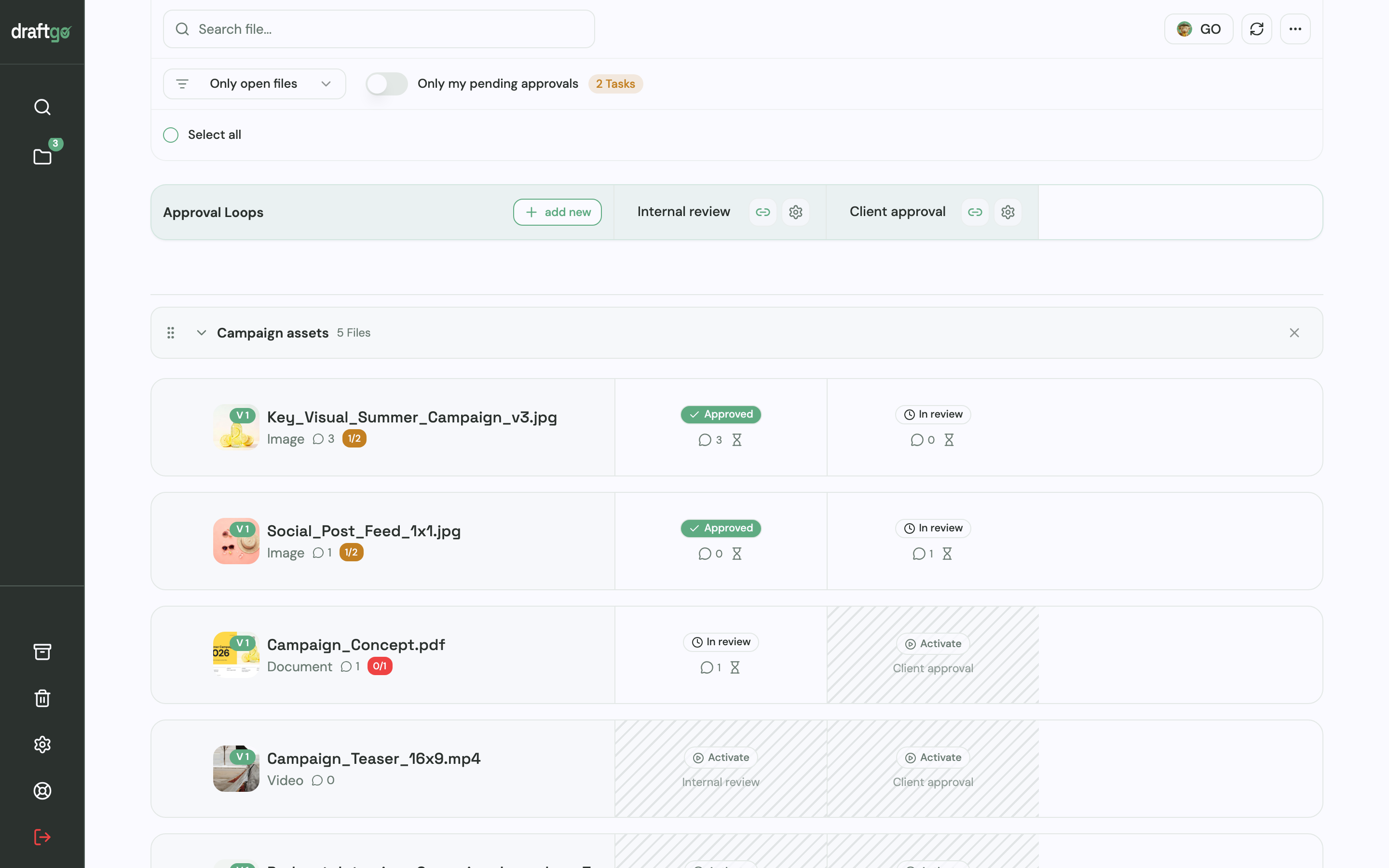
- One project for the campaign: upload the video, ads, PDFs and social posts, and capture the landing page with “Scan website”.
- One loop per review stage: for example “Internal review”, “Product and legal” and “Final sign-off”, each with its approvers and a rule: all of them, a set number or any one of them. A project holds one loop on Free, three on Freelancer and as many as you need on Agency and Team (plans and prices).
- Files move on when you decide: once a file has passed one stage, someone on your team activates it in the next loop.
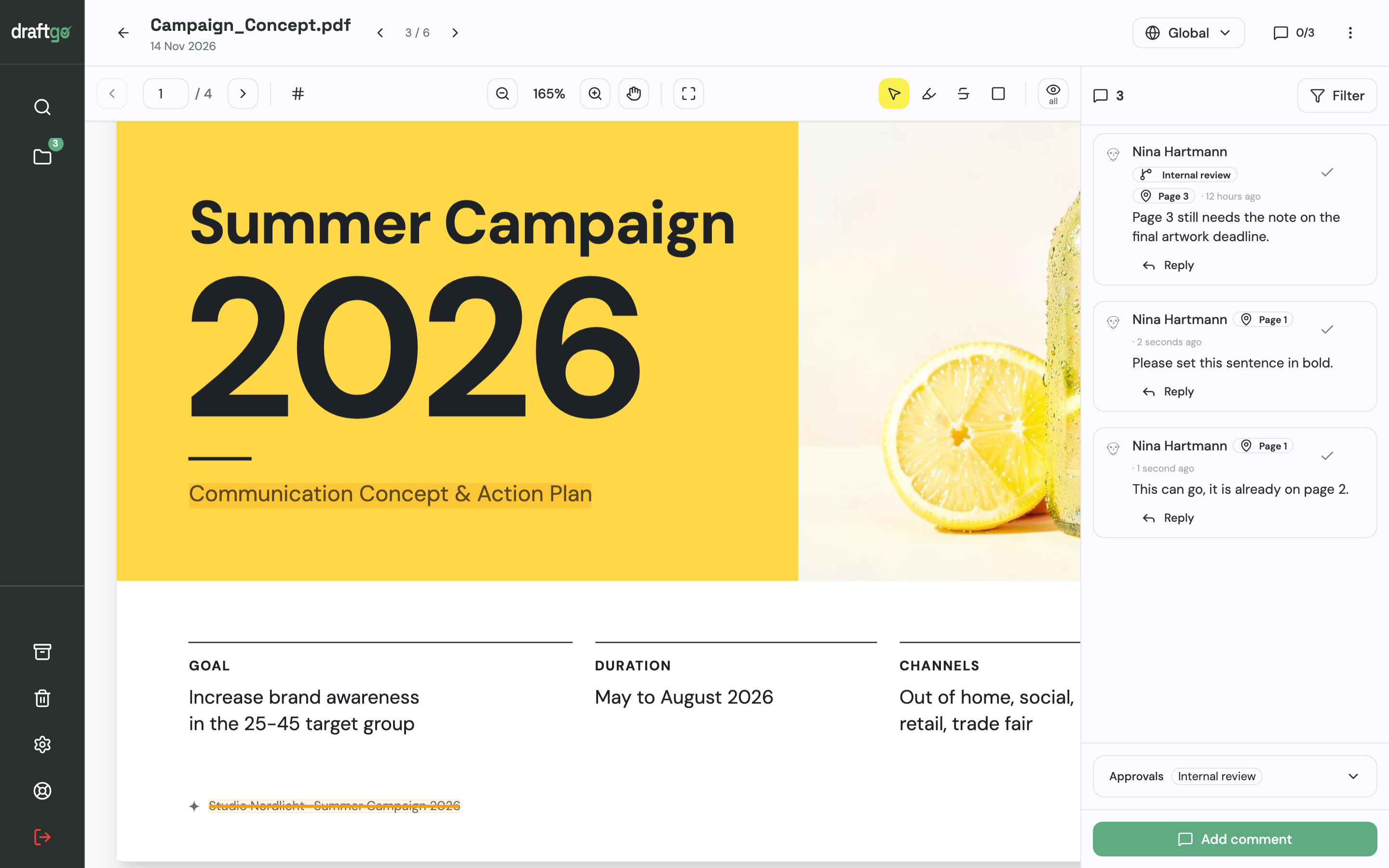
- Comments at the exact spot: a pin on an ad, a highlight in the PDF, a comment at the timecode in the video. A corrected file goes up as a new version, and the loop’s approvals start again.
- Client stakeholders without an account: an approver link is personal and lets that person approve; a viewer link is shared and lets people comment.
- Typos caught early: you can start the AI review on PDFs, images and social posts. Its comments carry the name of our AI agent “GO” and point out typos, cut-off text or very small type; a monthly page allowance comes with the plans from Freelancer on.
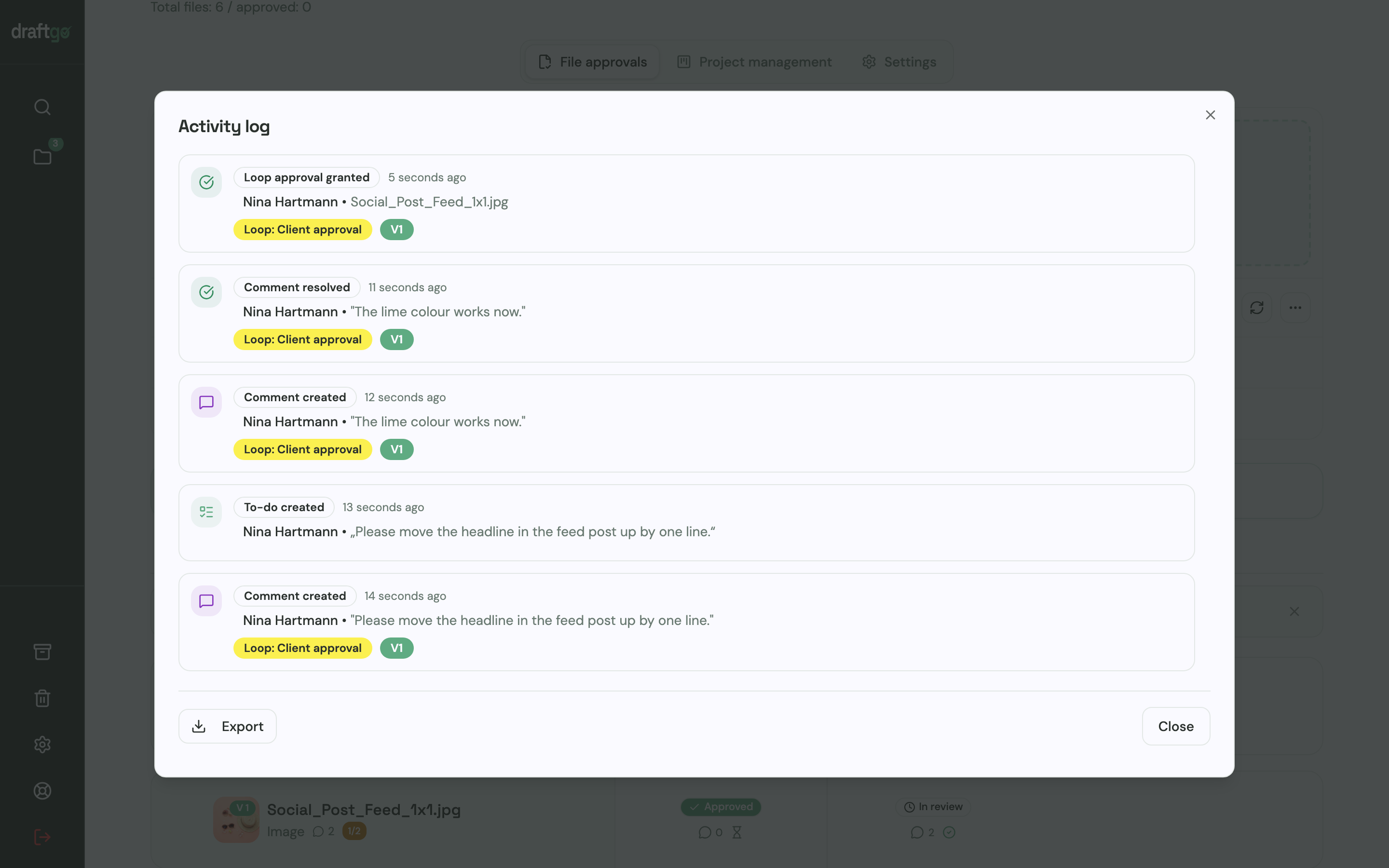
- A record of every approval: draftgo logs approvals, comments and versions with person and time, and you export the activity log as CSV, JSON or PDF. Our guide to the approval audit trail explains what such a record needs.
draftgo shows who approved which version; whether a claim holds up legally stays with your legal team.
The page draftgo for in-house teams shows approvals across departments, and our guide to online proofing covers the basics.
FAQ
What is the difference between a B2B and a B2C campaign?
A B2B campaign speaks to several decision-makers in one company and supports a buying decision that takes longer. A B2C campaign speaks to one person who buys for themselves.
Can a B2B campaign be funny or emotional?
Yes. Mailchimp and GoDaddy both use humour, and Volvo Trucks turned a product test into a spectacle. What counts is that the joke or the emotion carries the benefit of the product.
Who should approve a B2B campaign?
One named person signs off the final version, for example the CMO. Product management, brand, sales and legal review their parts before that, so nobody has to guess who has the last word.
Where can I find more B2B campaign examples?
Award winners are a good start. Cannes Lions shows a selection of Creative B2B Lion winners on its B2B spotlight page, and trade titles such as Adweek report on them.
Conclusion
Each of the five campaigns rests on one idea you can say in a single sentence, and each shows the benefit instead of the technology. Write that sentence down for your next campaign, then decide who reviews what, in which order, and who signs off.
Try it free – draftgo is free for 14 days, no credit card needed.
Written by
Emilia
Content Producer
Ready to streamline your approval processes?
Get started with draftgo today and see how easy professional collaboration can be.