
The client's sales team sends out a pitch deck with last year's logo. The agency's banner uses a green that is a shade too yellow, the new LinkedIn carousel sounds nothing like the website, and the event flyer still carries the old disclaimer. Nobody would stop a launch over one of these slips. Together they make the brand look as if four different companies stood behind it.
What is brand compliance?
Brand compliance means that every asset a company publishes follows its brand guidelines, whoever made it and whichever channel it runs on. The guidelines set the rules; brand compliance is the routine that checks them in daily work and decides who fixes what.
For marketing and agency teams, that routine usually sits in the review process: someone holds the draft against the guidelines before it goes to the client or the final approver. Online brand compliance applies the same check to what you publish on the web, from website pages and social posts to ads and newsletters, where content goes live quickly and passes through many hands.
Why brand compliance breaks down
Most brand slips trace back to the way content gets made. Four causes come up again and again:
- Many people create content. Marketing, sales, the agency and freelancers all produce material, and without a shared checklist each develops their own reading of the brand.
- Old files stay in circulation. Whoever needs a logo in a hurry takes the one on their desktop, so outdated templates and colour values survive for years.
- Nobody owns the check. If it is unclear who looks at a flyer for brand fit before print, the check happens by chance or not at all.
- Deadlines win. The day before launch, the last look at fonts and wording is the first thing to go.
Try it yourself: In the demo you work in a real draftgo workspace with sample data.
Brand compliance checklist: what to check on every asset
A brand compliance check runs a draft through a short list of rules taken from the guidelines. Shorten the list below for small formats and extend it for brochures or packaging.
Logo use
- the current logo file from the official source, not a copy from an old deck
- clear space and minimum size as defined
- the approved variant for the background: full colour, single colour or reversed
- no stretching, recolouring, shadows or cropping
Colours
- exact values for the medium: HEX or RGB on screen, CMYK or Pantone in print
- primary and accent colours in the set proportions
- no shades picked with an eyedropper from a compressed image
Typography and imagery
- brand fonts, plus the approved fallback fonts for slide decks and email
- sizes, weights and line spacing according to the type hierarchy
- photos in the described style, icons and illustrations from the brand's own set
Tone of voice
- wording that fits the voice: formality, how you address readers, words the brand avoids
- product names, capitalisation and the tagline exactly as approved
- one spelling standard throughout, US or UK English
Legal lines
- trademark symbols where the guidelines require them
- disclaimers, copyright line and contact details in the current approved wording
The rules behind trademark symbols differ by market. In the US, the USPTO says to use the ® symbol once it has registered your mark, and only with the goods or services listed in that federal registration; before that, “TM” or “SM” can be used (USPTO). In the UK, section 95 of the Trade Marks Act 1994 makes it an offence to present a mark as registered when you know, or have reason to believe, that it is not. What a disclaimer must say is for your legal team to decide; the brand check makes sure the approved line is there. This article is general information, not legal advice.
Accessibility
- text contrast: WCAG 2.2 (W3C, 2023) asks for a contrast ratio of at least 4.5:1 for normal text and 3:1 for large text (18 point, or 14 point bold) at level AA
- alt text for images on the website and in social posts
- no information carried by colour alone, for example in charts
Brand colours that look strong as a background often fail as a text colour. Guidelines that list approved pairs of text and background colour save everyone from measuring contrast for each post.
How to build brand compliance into your approval process in 6 steps
A brand check works once it has a source, a checklist, an owner and a fixed stage before approval. These six steps set it up with the people you already have.
1. Keep one source for guidelines and files
Decide where the current guidelines, logo files, templates and approved images live, and make that the only valid source. A brand portal or a shared drive will do, as long as old versions are removed instead of kept “just in case”.
2. Turn the guidelines into a checklist per asset type
For the check itself, derive a short list per asset type from the areas above: a social post needs fewer checkpoints than a catalogue. Short lists keep the check fast, and two people checking the same asset come to the same result more often.
3. Put the brand rules into the brief
Every brief names the guidelines, the files to use and the checklist that applies, and our creative brief template has room for this. Agencies collect the client's guidelines, logo files and legal lines at the start; our guide to client onboarding for agencies shows where that step fits.
4. Give the brand check an owner and a fixed stage
Name one person who checks every asset against the checklist and approves it for the next stage: the brand manager in an in-house team, the lead designer or account lead in an agency. The brand check comes before the content approval by the client or department, so the final approvers discuss the message instead of the logo. For print work, it also comes before the technical prepress checks of the print file.
5. Comment on the asset and name the rule
“The logo looks off” starts a discussion. “Clear space around the logo is below the minimum in the guidelines, section 2.3” gets fixed in one round. Comments on the file itself, at the exact spot, are the core of online proofing.
6. Audit live channels and update the checklist
After each campaign, compare a sample of live website pages, social posts, ads and sales decks with the guidelines. A slip that keeps coming back becomes a new line on the checklist or a topic when you brief new colleagues and partners.
| Role | Task | When |
|---|---|---|
| Creator (team member, agency, freelancer) | builds the asset from current files and runs the checklist | while drafting |
| Brand owner (brand manager, lead designer, account lead) | checks against the checklist, comments at the spot, approves | before content approval |
| Legal, where needed | reviews claims and disclaimers | before final approval |
| Client or department lead | approves the content and gives the final sign-off | after the brand check |
Common brand compliance mistakes and better practice
Each of these mistakes has a simple counter:
| Mistake | Better practice |
|---|---|
| Logo files live in inboxes and on desktops | one source, linked in every brief |
| The guidelines exist only as a long PDF | a short checklist per asset type |
| The brand check depends on who happens to look | a named owner and a fixed stage before approval |
| Feedback arrives by email without a reference | a comment on the asset that names the rule |
| A corrected file goes out without a second look | every new version passes the brand check again |
Practical example: a spring campaign with outside contributors
A five-person agency produces a client's spring campaign: six social posts, a carousel and a flyer. A freelance copywriter writes the texts, a photographer delivers the images, and the agency's lead designer owns the brand check against the client's guidelines.
All drafts go into one project, where the lead designer runs each file through the checklist and comments at the spot. Slide four of the carousel uses an older green, the copywriter has shortened the tagline, the flyer carries last year's disclaimer and one post sets white text on a light photo. Each comment names its rule, the corrected versions pass the brand check again, and only then does the client's marketing manager see them for content approval.
The client comments on the offer and the headline, and the logo never comes up. Afterwards, the agency adds “tagline only in full” and “check text contrast on photos” to the checklist. For the social posts in particular, our guide to choosing a social media approval tool goes deeper.
How it works in draftgo
In draftgo, the brand check is its own approval loop ahead of the client approval, and each file shows its status in both loops.
- Two loops for two stages: Create a loop “Brand check” and a loop “Client approval” in the project. For each loop, a rule sets whether all approvers, a set number or any one of them must approve, separately for team and guests. In the “Brand check” loop, the brand owner is the approver.
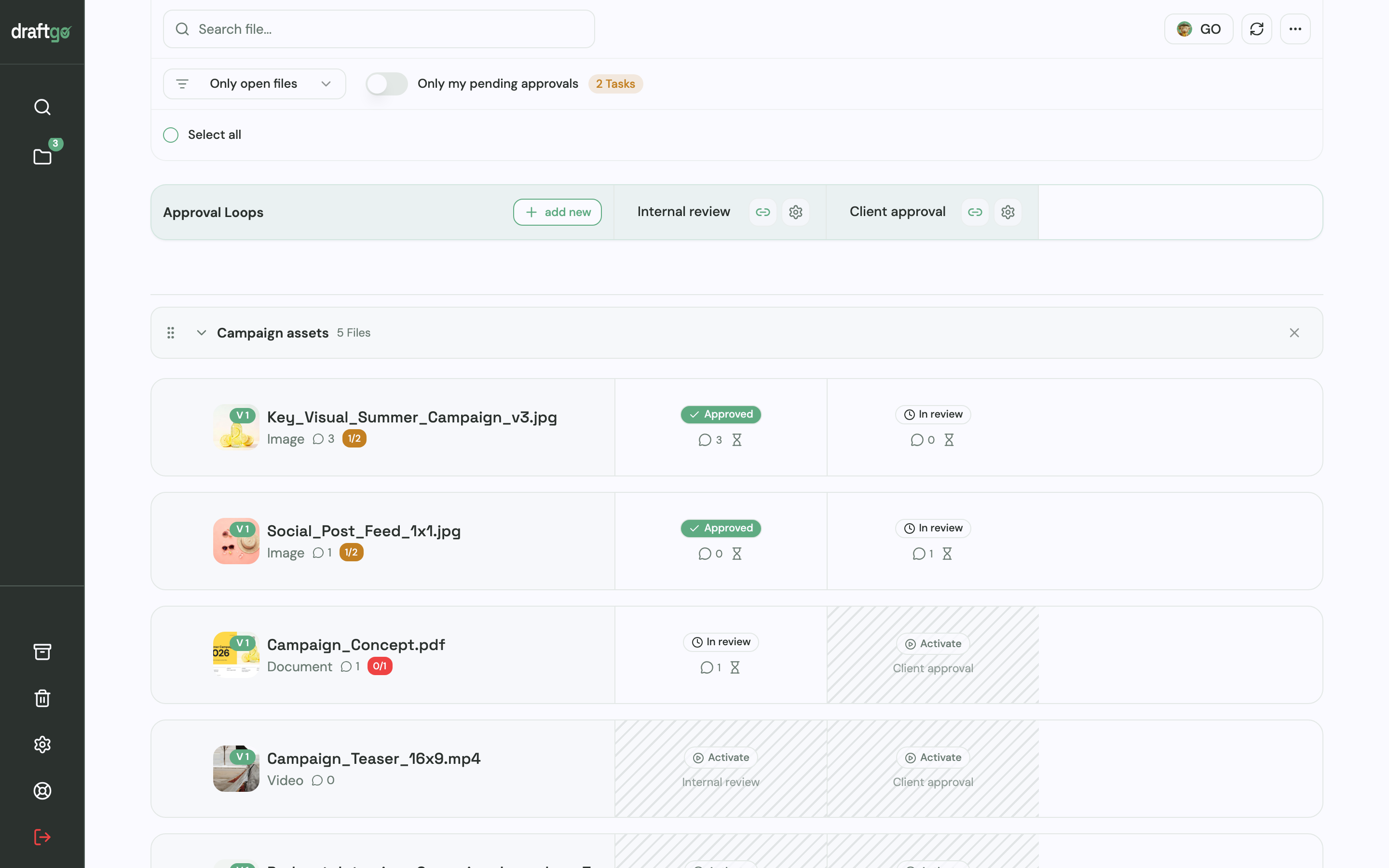
- Partners deliver into the same project: Freelancers and partner agencies join through a guest link without an account, and per loop you can allow guests to upload their own files.
- Feedback at the exact spot: The brand owner places a pin or draws a rectangle on the image or PDF page, or highlights text in a PDF, and names the rule in the comment. Once a point is fixed, its comment is marked as resolved.
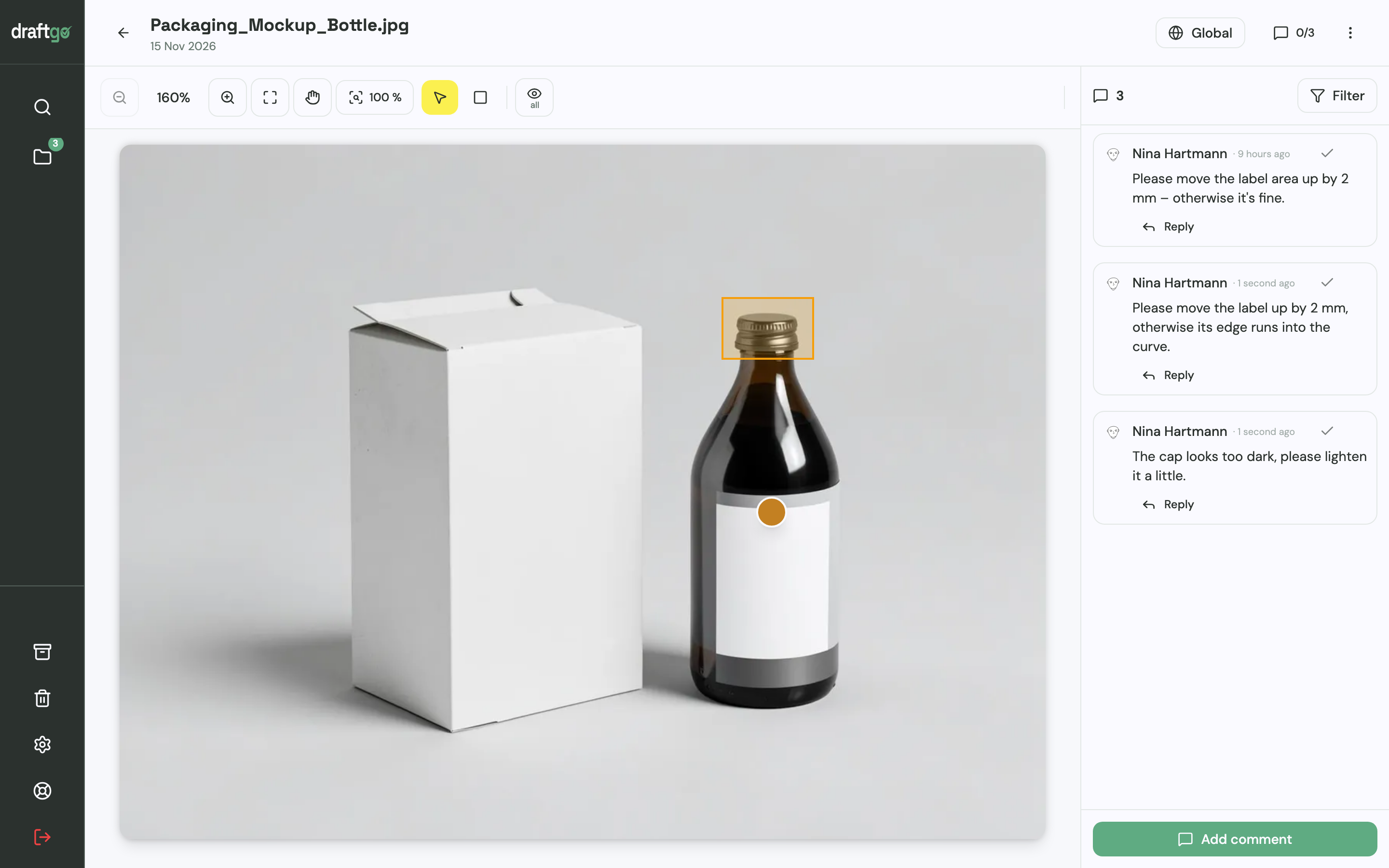
- New version, new check: The corrected file goes up as a new version of the same file. Comments stay with their version, and the new version restarts the approvals, so it passes the brand check again.
- Client approval: Once a file has passed the brand check, you activate it in the client loop. The client opens it from a link without an account, comments and approves.
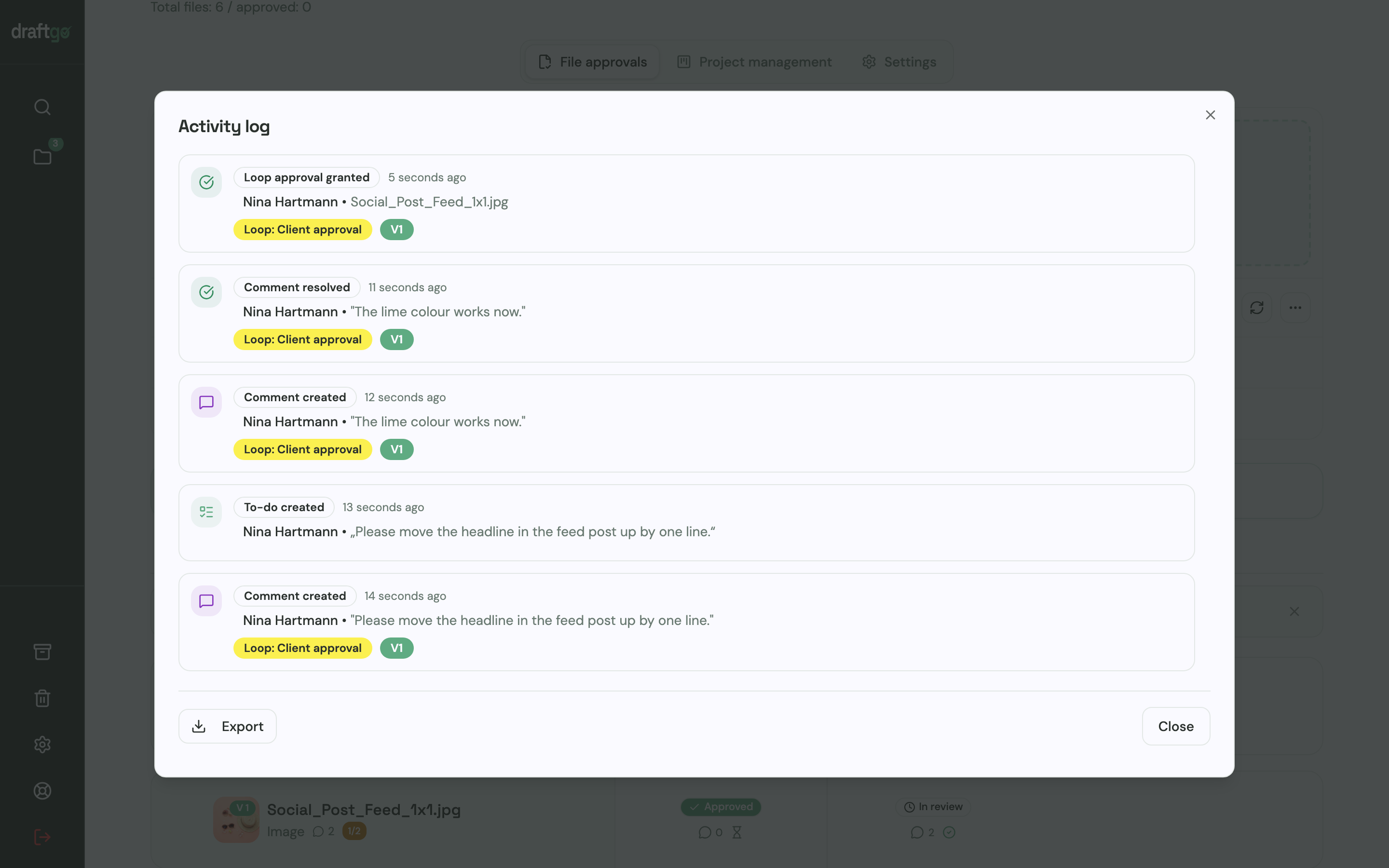
- A record of every approval: The activity log lists approvals, comments and versions with person and time, and you can export it as CSV, JSON or PDF.
Before the brand check, our AI agent “GO” can run an AI review of PDFs, images and social media posts and comment on errors such as typos, cut-off text or very small type. It does not check against your own brand guidelines, so the brand check itself stays with a person. The page draftgo for in-house teams shows how in-house marketing teams run approvals with many stakeholders.
FAQ
What is the difference between brand guidelines and brand compliance?
Brand guidelines are the rulebook: they define how the brand looks and sounds. Brand compliance is the process that checks in daily work whether assets follow that rulebook. Without the process, even good guidelines stay a document nobody opens.
Who is responsible for brand compliance?
Usually marketing or brand management owns it, and everyone who creates content contributes. One role should run the brand check and have the final word on brand questions, in agencies often the lead designer working from the client's guidelines.
How do you measure brand compliance?
The simplest way is a regular spot check: review a sample of live assets against the same checklist. Note how many pass without changes and which checkpoints fail most often, because those show where the checklist, the templates or the briefing need work.
Is brand compliance the same as regulatory compliance?
No. Brand compliance checks assets against your own guidelines, while regulatory compliance checks advertising against laws and industry rules, such as health or financial claims. Both can run in the same approval process, with a different reviewer for each.
Conclusion
Brand compliance comes down to one valid source for files, a short checklist per asset type and a named owner who checks every asset before approval. Start with the workflow that produces the most assets, often social posts, and add the brand check there first. Try it free – draftgo is free for 14 days, no credit card needed.
Written by
Emilia
Content Producer
Ready to streamline your approval processes?
Get started with draftgo today and see how easy professional collaboration can be.