
When client campaigns combine generated visuals, voiceovers, and synthetic b-roll, creative teams face a sudden compliance challenge. Regulators and digital platforms increasingly require clear disclosure whenever media could be mistaken for authentic reality, yet project timelines leave little room for guesswork. Missing a required tag risks platform penalties, demonetisation, or regulatory fines under emerging laws.
This article is general information, not legal advice.
Understanding AI labelling requirements requires looking at two distinct layers: statutory regulation in the jurisdiction where your audience lives, and the community terms of the social networks hosting your files. If your agency publishes work that touches the European Union, the primary statutory baseline is Regulation (EU) 2024/1689, commonly known as the EU AI Act. Combining legal thresholds with practical workflow checks lets your team deliver creative work without risking compliance disputes. For broader advertising regulations, our guide on marketing compliance explains how regulatory frameworks intersect with campaign delivery.
Where labelling duties come from
Labelling duties come from both statutory legislation in the audience's market and the platform policies where content is published. Even if your agency operates entirely from the United States or the United Kingdom, statutory rules can still reach you if your media is distributed to European consumers.
Under Article 2(1)(c) of the EU AI Act, the regulation governs both providers and deployers of AI systems outside the European Union whenever the output produced by the system is used within the EU. That means an agency based in New York or London delivering a global social media campaign for an international brand must adhere to EU disclosure standards for any assets targeted at EU member states.
Beyond legislation, major digital networks enforce their own terms of service. Social platforms often demand disclosure on realistic synthetic media regardless of geographic borders. To keep clients safe, your review process must evaluate both legal liability and platform-level distribution rules before any asset leaves the staging environment. Teams managing high-volume channels can see how structured workflows operate in our overview of social media approval tools.
EU AI Act transparency rules: providers and deployers
The EU AI Act separates transparency obligations between providers who build artificial intelligence models and deployers who use those models in professional workflows. According to the EU AI Act timeline, statutory transparency obligations apply from 2 August 2026.
Under transparency provisions of the EU AI Act, providers of AI systems that generate synthetic audio, image, video, or text must ensure that outputs are marked in a machine-readable format and detectable as artificially generated. For systems already placed on the market prior to 2 August 2026, transitional provisions under the EU AI Act grant providers until 2 December 2026 to bring their tools into full compliance.
Deployers, on the other hand, represent the agencies, marketing departments, and production studios that apply these systems to commercial work. Under statutory rules for deployers, deployers carry their own legal duty to inform viewers whenever specific synthetic outputs are shown to the public. If a professional fails to honour these transparency rules, Article 99(4) of the EU AI Act authorises administrative fines of up to EUR 15 million or 3 % of total worldwide annual turnover, whichever is higher.
Try it yourself: In the demo you work in a real draftgo workspace with sample data.
What must be labelled: deep fakes and public-interest text
Not every visual or paragraph created with artificial intelligence requires a public disclosure label under statutory law. The EU AI Act targets specific categories of media where synthetic generation could mislead viewers about authenticity or distort public discourse.
Under statutory rules for deployers, deployers must disclose deep fakes. A deep fake is defined as any generated or manipulated image, audio, or video that resembles existing persons, places, objects, or events and would falsely appear to a person to be authentic or truthful. If your creative team creates a photorealistic scene depicting a real city undergoing an event that never occurred, or uses synthetic audio imitating a known spokesperson, a clear label is mandatory.
The law includes a proportionate concession for creative industries: where the work is evidently artistic, creative, satirical, or fictional, disclosure must still take place, but it may be presented in an appropriate manner that does not hamper the display or enjoyment of the work.
The regulation also requires disclosure when synthetic text is published to inform the public on matters of public interest. However, an explicit exemption applies: if the AI-generated text has undergone human review or editorial control, and a natural or legal person holds editorial responsibility for publication, no public AI label is mandatory under this clause. For agencies, having an editor verify factual statements and assume formal responsibility satisfies this exemption.
In terms of timing, statutory timing provisions stipulate that disclosures must be clear, distinguishable, and presented at the latest at the time of the first interaction or exposure. A disclosure hidden deep within a website footer or buried at the end of terms and conditions does not meet this threshold.
Platform rules: the YouTube example
Digital video platforms have established their own self-regulatory disclosure toggles to flag synthetic content directly to viewers. YouTube's disclosure guidelines illustrate how platforms evaluate realism and user deception.
YouTube requires creators to disclose realistic content that is generated or meaningfully altered with artificial intelligence. Specifically, creators must declare media that makes a real person appear to say or do something they did not do, alters real footage of an actual event or location, or depicts a realistic-looking scene that never took place.
Conversely, YouTube does not require creators to disclose:
- Clearly unrealistic animations, such as fantasy creatures or stylised cartoons
- Minor technical adjustments, such as colour grading, contrast adjustments, or beauty retouching filters
- Production assistance, such as using generative tools to brainstorm script outlines or generate project ideas
When uploading, channel managers declare synthetic components under the "AI use" settings in YouTube Studio. When declared, YouTube adds a visible label in the expanded video description or across the video player. Crucially, YouTube notes that adding this label does not restrict the video's reach or impede channel monetisation. Platforms can also detect embedded provenance data, such as C2PA metadata, to append labels automatically.
Austria and Switzerland
Understanding cross-border nuances across central Europe helps international agencies maintain compliant delivery pipelines. While Austria and Switzerland share linguistic markets, their legal frameworks treat synthetic media disclosure differently.
Austria
As an EU member state, Austria is directly bound by the EU AI Act (Regulation (EU) 2024/1689). Austrian enforcement falls under the direct authority of domestic market surveillance bodies established in accordance with the Act. Agencies targeting Austrian consumers must adhere strictly to statutory disclosure rules for deep fakes and public-interest communications starting August 2026. Domestic unfair competition laws (UWG) also penalise deceptive advertising where synthetic imagery falsely portrays product characteristics.
Switzerland
Switzerland is not an EU member state and is therefore not directly subject to the EU AI Act. Swiss media law and the Federal Act on Unfair Competition (UWG) currently govern commercial disclosures, penalising misleading or deceptive marketing practices rather than enforcing a dedicated AI labelling code. However, Swiss agencies and global brands marketing to EU consumers remain subject to the EU AI Act under Article 2(1)(c) because the final output reaches the European market. If your assets cross borders into neighbouring Austria or Germany, EU labelling rules apply. When handling cross-border assets that contain sensitive corporate information, teams should also review our guide on how to share confidential files safely.
5 steps to build labelling into the approval
Building compliance into your daily production workflow prevents last-minute panics before campaign distribution. Follow these five practical steps to keep your team and clients aligned.
1. Document AI involvement during asset intake
Begin tracking generative components the moment work starts on a creative brief. When copywriters, video editors, or designers submit their initial drafts, require them to log whether synthetic generation tools contributed to the asset. Note whether the tool provided ideation, full visual synthesis, synthetic voice generation, or minor image clean-up.
2. Determine whether the asset qualifies as a deep fake or editorial text
Review the draft against statutory and platform definitions. Ask two core questions: Does this visual or audio resemble a real person, location, or historical event in a manner that viewers could reasonably perceive as authentic? Or is this unedited text addressing a topic of public interest? If the answer to either is yes, mark the asset as requiring formal disclosure.
3. Apply the label to the file or prepare platform metadata
If statutory or creative guidelines call for an on-screen note, integrate the text directly into the draft. Use clear, legible copy such as "Synthetically generated imagery" placed where viewers encounter it naturally. For social video channels, prepare the appropriate platform tags (such as toggling "Altered content" in video studio dashboards) so publishing teams complete the upload accurately. When producing dynamic video cuts, pairing this step with a dedicated video feedback tool keeps timing decisions documented.
4. Run an internal compliance check
Before showing the asset to external clients, route the draft through an internal review loop. A designated compliance lead or creative director checks that the disclosure matches the chosen distribution channel and that visual stamps or captions remain distinguishable. Resolving internal queries beforehand protects your agency's professional standing during client review.
5. Secure client sign-off and log the decision
Send the prepared asset to the client through a dedicated review link. The client approver evaluates both the creative execution and the proposed transparency disclosure. Once the client approves the asset, store the sign-off record, showing the exact version, user identity, and timestamp. This audit log proves your agency acted responsibly if a platform algorithm or regulatory body questions the asset later.
Mistakes and better practice
Creative teams often stumble when applying compliance rules to rapid production schedules. The table below highlights common errors and practical approaches to resolve them.
| Common mistake | Why it causes issues | Better practice |
|---|---|---|
| Omitting labels on photorealistic synthetic b-roll | Viewers and platforms may treat the setting as an authentic documentary record. | Label realistic scenes clearly as synthetic whenever real-world locations or events are depicted. |
| Labelling simple grammar assistance or colour correction | Over-labelling clutters campaigns and desensitises audiences to genuine deep fake notices. | Reserve public disclosures for synthetic assets that alter meaning, portray realism, or generate core content. |
| Hiding required disclaimers in distant footer links | Regulators require disclosures to appear at the latest at the point of first user exposure. | Display visual or audio notices directly alongside or within the primary creative asset. |
| Relying on unrecorded email agreements for sign-off | Email chains get lost, leaving the agency without proof of who approved the labelling strategy. | Maintain an immutable activity log linking the client's approval to the exact asset version. |
| Forgetting platform-level upload toggles | Platform algorithms can flag unlabelled synthetic video, triggering sudden reach restrictions. | Add platform-specific upload checkboxes to your publishing checklist alongside creative assets. |
Practical scenario: how an agency labels campaign assets
Consider a digital agency producing a recruitment campaign for a national transport operator. The creative concept features a series of short social video reels depicting commuters travelling through a futuristic transport terminal. The production team uses a generative tool to create hyper-realistic terminal architecture, combining synthetic crowds with filmed footage of an authentic company spokesperson.
During the initial asset intake, the lead motion designer flags the clip as containing synthetic backgrounds that resemble real urban infrastructure. Because a viewer might reasonably assume this modern station already exists, the agency marks the asset as requiring a disclosure under both platform standards and the EU AI Act deep fake rules.
The designer adds a discreet, legible caption in the lower third during the opening seconds: "Architectural concept created with synthetic media." During the internal review stage, the agency's creative director verifies that the text remains distinguishable across mobile screens without obscuring the spokesperson.
Next, the agency shares the file with the transport operator's marketing director using an external review link. The marketing director inspects the wording, confirms that the legal disclosure fits the brand tone, and records formal approval. When the social media manager schedules the video on YouTube, they check the "Altered content" box in YouTube Studio. The agency archives the approval record, ensuring complete protection if regulatory surveillance requests documentation of the project workflow.
How it works in draftgo
Managing transparency approvals requires a structured environment where feedback, file versions, and sign-offs remain tied together. draftgo provides this structure without forcing external clients to register an account.
You begin by uploading your campaign files, whether they are high-resolution PDFs, images, or video clips. When reviewing an asset containing generative elements, team members add feedback directly on the canvas. On images and PDF pages, you can place a precise pin or draw a rectangle around synthetic elements. For video assets, comments snap to the exact second on the timeline, allowing editors to verify the precise timing of on-screen disclaimer cards.
Our AI agent “GO” answers questions about a chosen loop or file and can evaluate uploaded assets. When requested, GO performs an AI review on PDFs, images, and social media posts, checking text formatting, contrast, and layout issues to catch errors before assets go to the client.

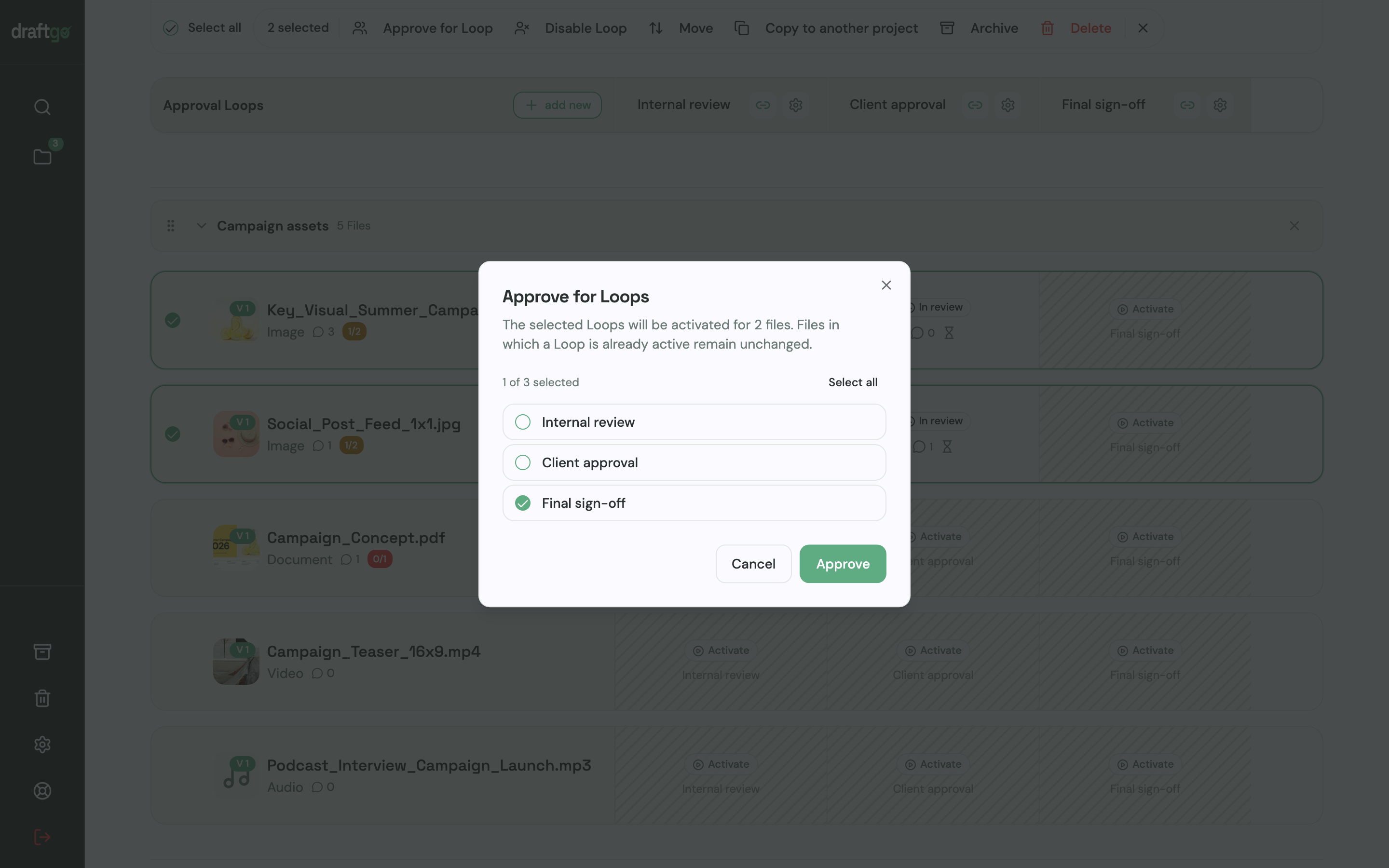
To keep regulatory sign-offs organised, draftgo routes files through sequential review loops. You can set up an initial loop for internal creative and compliance staff, followed by an automated client loop. In the loop settings, you establish clear rules specifying whether all approvers or any single reviewer must sign off before the file advances. Clients open the file through a personal approver link in their web browser, allowing them to review disclaimers, suggest wording edits, and confirm sign-off without creating an account.
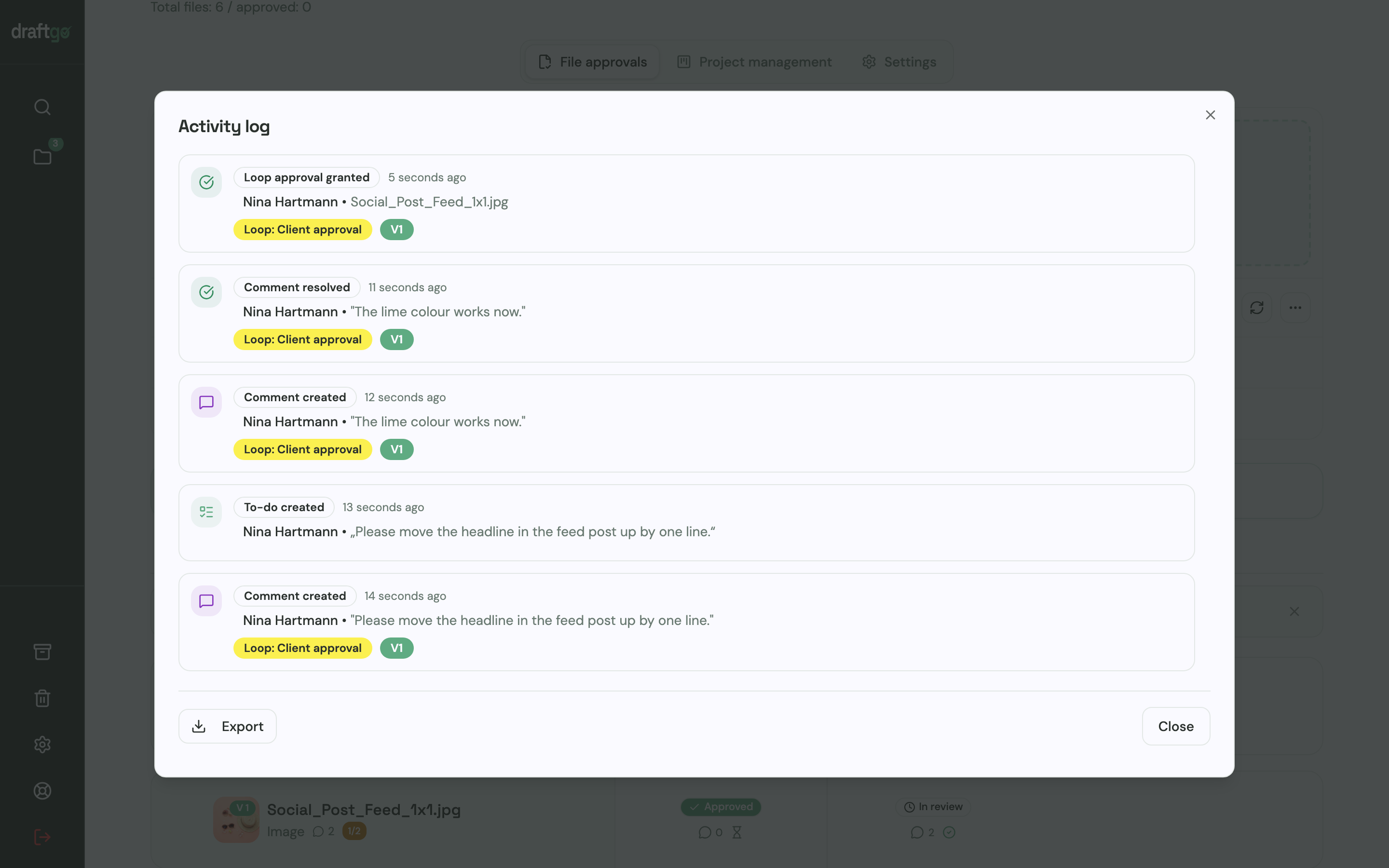
Every interaction is captured within draftgo's activity log. The system logs who approved which version, the exact timestamp of the action, and every comment exchanged during the review. When a project wraps, you can export this log as a CSV or PDF document, providing an audit trail for your agency's compliance records. Stored data is kept on EU servers in the Frankfurt data centre. If your agency handles personal information alongside marketing assets, you can review our checklist on cloud data privacy for complementary security practices, or explore our dedicated legal compliance solutions.
FAQ
Does every AI-generated marketing image require a public label under the EU AI Act?
No. The EU AI Act specifically requires deployers to label deep fakes – synthetic media that depicts real persons, places, or events in a way that viewers would reasonably mistake for authentic reality. Evident artwork, obvious fantasy illustrations, or abstract marketing graphics that do not deceive viewers about real-world facts do not trigger mandatory disclosure under Article 50(4).
Does ticking the AI disclosure box on YouTube hurt video reach?
No. YouTube states that disclosing realistic altered or synthetic content in YouTube Studio does not restrict a video's reach, algorithmic distribution, or advertising monetisation. The disclosure exists to maintain viewer trust, though failing to disclose realistic content when required can lead to platform strikes or manual labelling by YouTube.
Who is legally responsible for labelling AI content: the agency or the client?
Under the EU AI Act, responsibility rests on the deployer, which includes any natural or legal person using an AI system under their professional authority. In practice, both agencies and brand clients share exposure. Setting up clear approval workflows ensures both parties agree on disclosure classifications before public dissemination.
When do the EU AI Act transparency rules come into force?
The statutory transparency provisions apply from 2 August 2026. Providers of AI systems placed on the market before that date have until 2 December 2026 to ensure their software outputs detectable markers. Agencies should adapt their internal review habits ahead of this statutory milestone.
Conclusion
Establishing clear protocols for AI labelling requirements protects your agency against regulatory penalties and safeguards client credibility across digital platforms. By categorising synthetic elements early, placing legible disclosures where viewers encounter them, and securing documented client sign-off, your team can harness generative tools with complete confidence. Try it free – draftgo is free for 14 days, no credit card needed.
Written by
Emilia
Content Producer
Ready to streamline your approval processes?
Get started with draftgo today and see how easy professional collaboration can be.