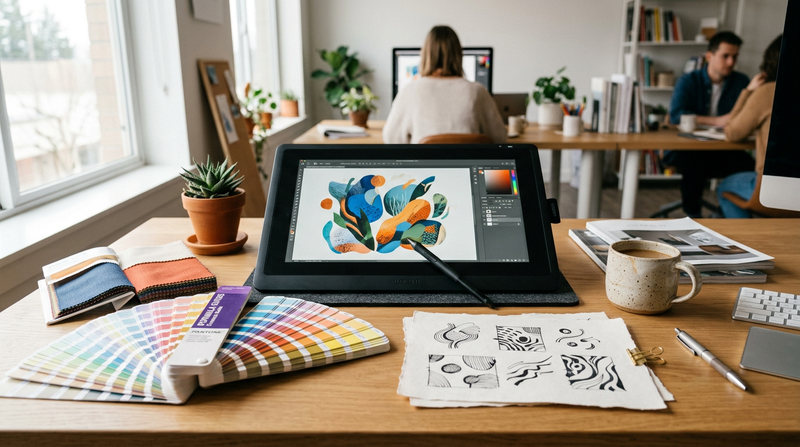
Your client needs twenty hero visuals for a product launch next month. Generating them with an artificial intelligence tool takes an afternoon instead of three weeks of photoshoots, and the initial renders look sharp. But before you add those assets to a campaign deck, deliver final web graphics, or invoice your client, a fundamental legal question arises: can you use AI images commercially without exposing your agency or your client to severe liability?
This article is general information, not legal advice.
Commercial use of an image means using it directly or indirectly for commercial gain, advertising, merchandising, marketing campaigns, website layouts, or paid deliverables. When dealing with generative image tools, commercial permission involves two distinct pillars: whether the generator's terms grant you commercial exploitation rights, and whether the resulting work enjoys intellectual property protection that you can legitimately transfer to a client.
Are AI images protected by copyright?
Raw AI outputs are not protected by copyright under United States law. The statutory framework established by the Copyright Act requires a human author, meaning an algorithm cannot hold copyright or be registered as a creator.
The US Copyright Office confirmed this position in its report Copyright and Artificial Intelligence, Part 2: Copyrightability (29 January 2025). The report, summarised in Copyright Office NewsNet 1060, concluded that AI outputs qualify for protection only when a human author has determined sufficient expressive elements. Providing text prompts, no matter how detailed or iterative, is not enough to constitute human authorship. The Office determined that existing legal principles remain flexible enough to address generative technology without creating new statutory protections.
Federal courts have consistently supported this standard. In Thaler v. Perlmutter (No. 23-5233, decided 18 March 2025), the US Court of Appeals for the D.C. Circuit affirmed the Copyright Office's refusal to register an image where the sole identified author was an autonomous computer system. The US Supreme Court declined to review the case on 2 March 2026 (Docket 25-449).
Human authorship can still exist if a human-authored work remains perceptible within the final piece. Protection may also cover original arrangements of generated elements or substantial modifications created through traditional creative techniques. If you use AI merely as an assistive tool within a broader creative pipeline, copyright protection is not barred for those human-made contributions.
Why AI images become a risk in client work
When agencies supply client assets, contracts usually demand warranties of non-infringement and exclusive transfers of intellectual property. Raw generative images destabilise both expectations.
AI image generation
       │
       ▼
┌──────────────────────────────────────────────┐
│  Is there substantial human expression?     │
└──────────────────────┬───────────────────────┘
                       │
         ┌─────────────┴─────────────┐
         ▼                           ▼
       [ NO ]                      [ YES ]
  Public domain status        Copyrightable elements
  No exclusivity for client   Limited protection
  Competitors may copy        Requires documentation
The primary commercial vulnerability stems from the absence of exclusivity. If your team cannot obtain copyright in raw AI generations, you cannot assign exclusive ownership to your client. Any third party or competitor could legally duplicate the identical generation or replicate the asset without committing copyright infringement.
Further legal hazards arise before the image is even delivered:
- Platform terms of service: Free or basic subscriptions of image generators frequently prohibit commercial use or retain broad licences over outputs. Paid tiers often grant commercial exploitation rights, but terms shift quickly.
- Third-party copyright and trademark infringement: Generative models are trained on billions of scraped web images. An engine may inadvertently spit out recognisable cartoon characters, brand logos, proprietary packaging, or distinctive architectural designs.
- Right of publicity: If a generated persona closely resembles a living person or celebrity, deploying that graphic commercially without a signed model release violates state-level privacy statutes. As detailed by the Legal Information Institute at Cornell Law, the right of publicity protects individuals against unauthorised commercial exploitation of their name, image, or likeness.
- Cross-border transparency rules: If your campaign reaches European audiences, regulatory compliance becomes broader. Under Article 50(4) of the EU AI Act, deployers who generate or manipulate image content constituting an artificial depiction resembling real persons or places (deep fakes) must disclose that the content has been artificially generated. According to Article 2(1)(c) of the EU AI Act, these obligations apply from 2 August 2026 to deployers established outside the EU whenever the output produced by the system is used within the European Union.
To navigate these regulatory frameworks, agencies should align creative sign-offs with established marketing compliance procedures and review statutory AI labelling requirements before asset delivery.
Try it yourself: In the demo you work in a real draftgo workspace with sample data.
5 steps to use AI images commercially with less risk
Agencies that establish strict vetting routines can leverage generative tools without gambling with client confidence. Here are five practical steps to manage legal exposure.
1. Verify the AI tool's commercial licence terms
Never assume that a tool operating on your browser allows client work. Examine the platform's paid commercial terms and archive a copy of the licence agreement as it existed on the generation date. Ensure the agreement confirms that you own the output or possess an unrestricted, perpetual commercial licence.
2. Audit the image for third-party rights and recognisable likenesses
Run a rigorous manual check on every visual intended for public release. Inspect backgrounds for registered trademarks, brand marks, and copyrighted art elements that the model might have reconstructed. If the image depicts an authentic-looking human face, ensure it does not duplicate a public figure, or obtain a release just as you would when managing UGC usage rights.
3. Add substantive human creative expression
To build defensible copyright protection, treat generative software as a starting canvas rather than the finished product. Combine several outputs, build original digital collages, integrate custom photography, and paint over details by hand in graphic software. The more independent human creative choices you document in the final piece, the stronger the argument for copyrightable human expression.
4. Document prompts, versions and editing steps
Maintain a traceable digital file trail for every asset. Keep a record containing the tool name, subscription tier, exact generation prompts, initial seed outputs, and subsequent design files. If a client faces an ownership dispute or the US Copyright Office evaluates a registration filing, your archive proves where the machine output ended and where human craftsmanship began.
5. Establish transparent client sign-off and usage scope
Integrate clear asset disclosure directly into your project approval routine. Let clients choose which parts of their brand identity may contain generative components. A social media background banner carries less risk than a core brand logo or trademarked package design.
What to tell the client
Transparency during early stages prevents contract disputes later. Clarify your agency’s use of generative software directly during your client onboarding and within statement-of-work documentation.
Distinguish between brand-critical assets and secondary marketing materials. A brand mark or corporate logo should never rely on raw generative output, because your client cannot register exclusive trademark and copyright ownership over an unprotectable image. Conversely, supporting editorial graphics, ephemeral social posts, or background mood textures present fewer commercial hazards.
State clearly in your client agreements what rights are being assigned. If an asset includes AI components, explain that while the client receives the completed design and unrestricted permission to use it commercially, exclusive copyright in raw algorithmically produced segments cannot be warranted.
Mistakes and better practice
| Mistake | Practical risk | Better practice |
|---|---|---|
| Using a free platform account for commercial deliverables | Violates platform terms of service; licence revoked | Upgrade to a commercial enterprise or pro subscription and store the terms with the project files |
| Generating a corporate logo with pure text prompts | Logo cannot be protected by copyright or registered exclusively | Design corporate identities manually, using software algorithms solely for moodboards |
| Promising the client exclusive intellectual property rights | Client cannot enforce copyright against copycats; agency faces breach-of-contract claims | Limit contractual warranties to human-created components and disclose synthetic elements |
| Neglecting face and brand audits in generated backgrounds | Potential right of publicity lawsuits or trademark infringement notices | Check every visual manually for brand motifs, protected characters, and likenesses |
| Storing only the final flattened JPEG export | Inability to prove human creative authorship in any legal dispute | Retain project layers, raw prompt logs, revision rounds, and timestamps |
Legal situation in Austria and Switzerland
Understanding cross-border copyright becomes relevant whenever creative assets circulate internationally. Both Austria and Switzerland follow civil law traditions that closely mirror the human authorship doctrine applied in the United States.
Austria
Under the Austrian Copyright Act (Urheberrechtsgesetz, UrhG), copyright protection requires an individual human intellectual creation (eigentümliche geistige Schöpfung). Pure machine output created by an algorithm does not meet this threshold, as there is no human creator. However, human creators in Austria who use generative algorithms as mere instruments to manifest their personal vision can claim copyright in the final output, provided their personal creative choices dominate the finished work.
Switzerland
In Switzerland, the Federal Act on Copyright and Related Rights (Urheberrechtsgesetz, URG) specifies that a work must be an intellectual creation with individual character (geistige Schöpfung mit individuellem Charakter) produced by a natural person. Pure algorithmic outputs remain unprotectable in Switzerland. Commercial deployers must ensure that substantial human editing or deliberate composition transforms the output into an individually characterised human work.
A practical agency scenario
A branding studio is hired to produce a national promotional campaign for a boutique outdoor apparel brand. The concept requires a series of hyper-realistic mountain landscapes populated by stylised hikers. Producing on-location photography within the tight four-week delivery window would exceed the client's production budget.
The design team decides to generate the landscape backgrounds using a commercial generative engine. Instead of handing over raw image files, the agency’s retouchers blend elements from four different image generations, integrate the client’s real jacket designs using actual studio product photography, and paint distinctive weather effects manually across the composition.
During internal review, the agency flags an initial render that placed a recognisable national park landmark and an authentic hiker face in the frame. The design lead marks the face for replacement, ensuring no right of publicity issue exists. When sharing the files with the client, the studio documents which parts are photographic and which are synthetic. The client signs off on the composite imagery with complete visibility into its structure, and the assets enter production without unforeseen ownership hurdles.
How it works in draftgo
Managing compliance across dozens of campaign visuals demands a structured approval workflow. Reviewing intellectual property risks inside email threads leads to missed red flags and zero legal accountability.
Teams use draftgo to separate compliance checks from client presentations. You upload your drafts and initiate an internal review loop with your art director and legal counsel before any client sees the files. Reviewers place precise pins and rectangle marks directly onto the image canvas to highlight potential copyright, trademark, or likeness concerns.
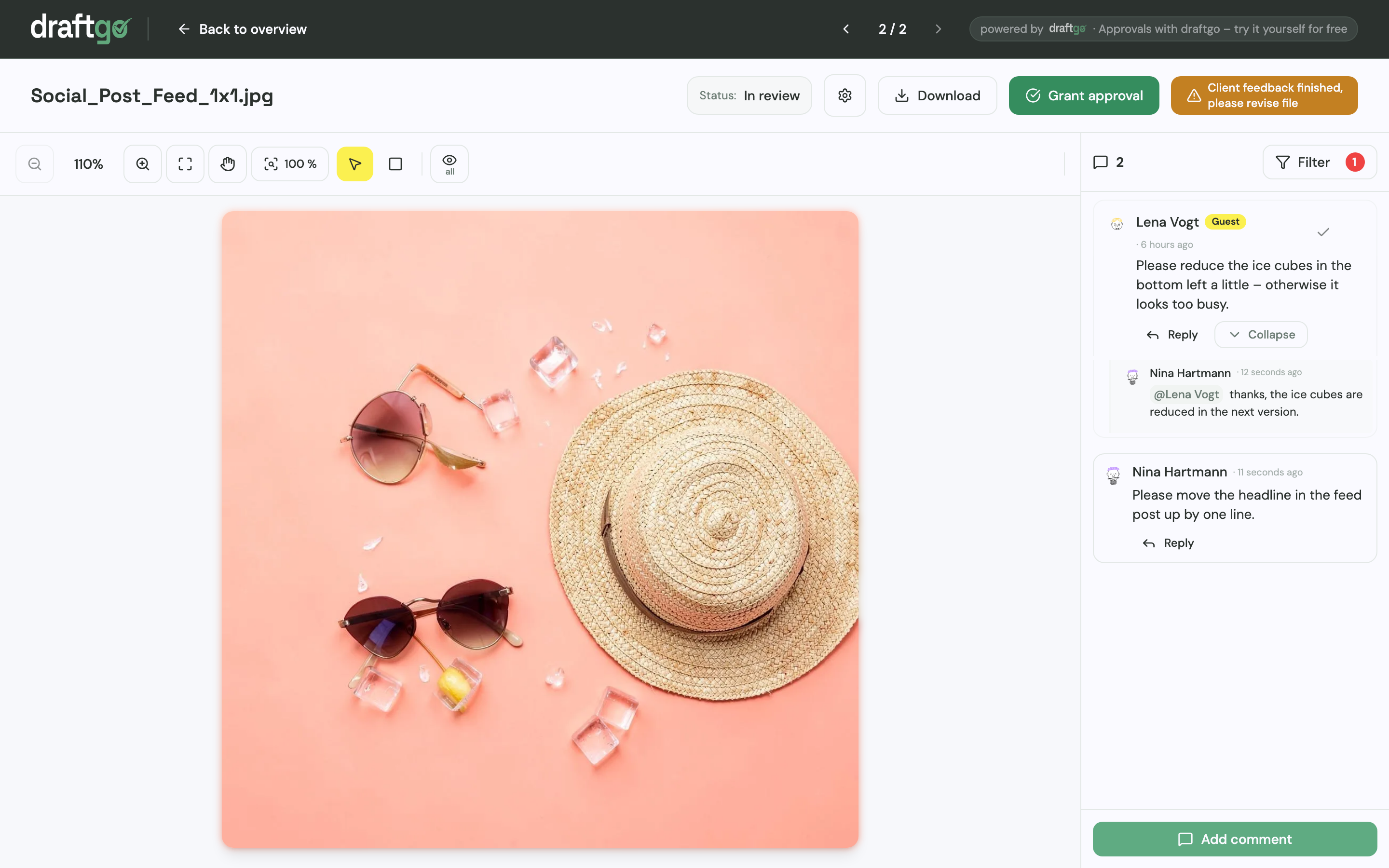
Once the internal team clears the artwork, the file advances to the client approval loop. Clients access the assets through a personal approver link without creating an account or logging into complex software. They view the visual in full resolution, read your disclosure notes, and leave their decisions directly on the file.
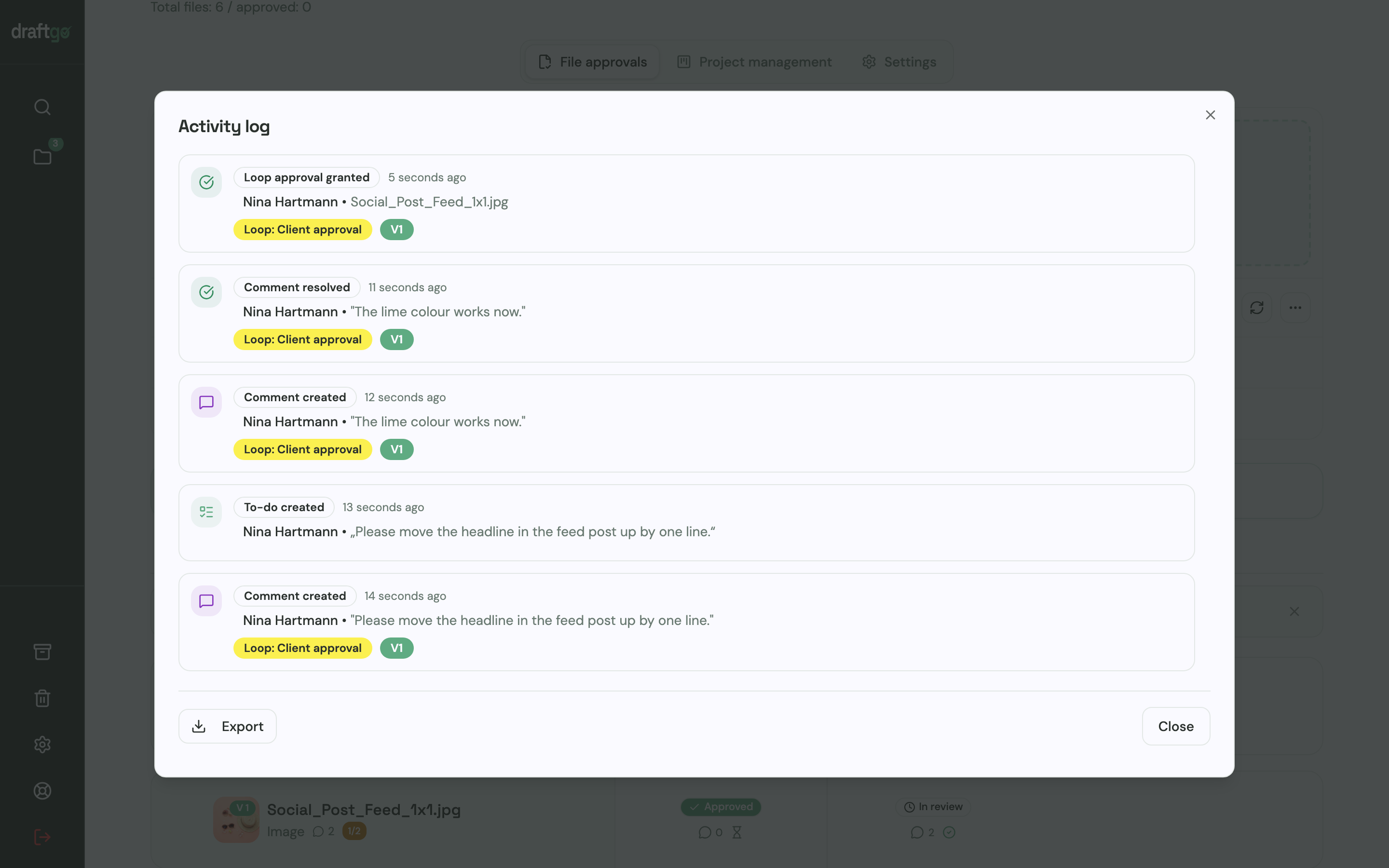
Every interaction is tracked chronologically. The activity log documents when the file was uploaded, which team member completed the internal check, and precisely when the client approved the final version. You can export this audit record as a PDF, CSV, or JSON file to preserve a permanent compliance history for your contracts.
Our AI agent “GO” assists your team during the review stage. In any active loop, GO inspects uploaded graphics and PDFs for visual mistakes, low resolution, and formatting oversights, reporting findings directly in the thread. GO answers questions regarding loop progress and file history. Stored data is kept on EU servers in the Frankfurt data centre.
For teams handling delicate campaign launches or sensitive assets, draftgo prevents unapproved files from leaking into the market. With the watermark switch enabled, guest reviewers can download preliminary drafts only as watermarked reference copies until the final sign-off is logged. To establish structured oversight across your design pipeline, explore our solutions for legal and compliance teams.
FAQ
Can I sell digital products made with AI images?
You can sell digital products containing AI images if the generator's terms permit commercial use. However, because raw outputs lack copyright protection, you cannot stop purchasers or competitors from redistributing the raw images unless you have contributed significant human creative modifications.
What happens if an AI tool replicates a copyrighted image?
If an algorithm generates an output substantially similar to an existing protected work, distributing or selling that visual can constitute copyright infringement. Liability typically rests with the entity that publishes or exploits the infringing asset commercially, regardless of whether the duplication was intentional.
How much human editing is required to gain copyright?
US authorities have not set a mathematical percentage. Copyrightability requires that human creative choices determine the expressive elements of the resulting image, such as through complex manual arrangement, extensive digital overpainting, or substantial integration into a larger human-authored design.
Do I need to disclose AI images to my clients?
Disclosing AI usage is strongly recommended to avoid breach of contract claims regarding exclusivity. Many client contracts require you to warrant that delivered assets are original works capable of exclusive copyright assignment, a standard raw AI visuals cannot satisfy.
Can you use AI images commercially for client logos?
Using raw AI visuals for client logos is inadvisable. Logos require exclusive trademark and copyright protection to defend the client's brand identity, neither of which can be guaranteed when relying on unprotectable, machine-generated outputs.
Conclusion
Using AI images commercially offers substantial production efficiencies, provided you understand the boundaries of intellectual property law. Raw algorithmic outputs cannot be owned exclusively, meaning client safety relies on thorough rights clearance, extensive human design contributions, and transparent contractual sign-offs. Establish structured review workflows that audit third-party rights and record client sign-offs before any campaign asset goes live.
Try it free – draftgo is free for 14 days, no credit card needed.
Written by
Emilia
Content Producer
Ready to streamline your approval processes?
Get started with draftgo today and see how easy professional collaboration can be.