
Three months after a campaign ends, the client’s data protection officer asks you to confirm that the photos of their customers are gone from your tools. You find them in a shared drive folder whose link still opens, in a transfer service a freelancer used and in old email threads. Two of those tools have no signed data processing agreement, and none of them records who downloaded the files.
Cloud data privacy is the part of data protection that covers personal data held in online services. It asks what personal data sits in the tool, who processes it for you under which contract, and who can reach it. Creative files hold more of it than they seem to. The European Data Protection Board counts names, email addresses and photos, videos and audio recordings of people among its examples of personal data (EDPB, guide for SMEs).
Who is responsible for data in a cloud tool?
You are, as long as you decide what happens to the data, and the provider processes it on your behalf. The UK GDPR says a controller may only use processors that give sufficient guarantees of appropriate technical and organisational measures, under a contract that binds the processor (UK GDPR, Article 28).
An agency can sit in the middle. When you process personal data on a client’s behalf, the same article binds you as the processor: you may not bring in another processor without the client’s prior specific or general written authorisation, and you pass the same obligations on to it by contract (UK GDPR, Article 28(2) and (4)).
Which rules apply in the UK, the EU and the US?
The law depends on where you, your client and the people in the files are. This article is general information, not legal advice.
United Kingdom
Article 28(3) of the UK GDPR lists what the processor contract must set out, from the purpose and duration of the processing to the types of personal data, and requires the processor to act only on documented instructions, keep staff bound to confidentiality and allow audits (UK GDPR, Article 28).
For US providers, the government’s factsheet on the UK-US data bridge says that from 12 October 2023 UK businesses can transfer personal data to US organisations certified to the UK Extension to the EU-US Data Privacy Framework without further safeguards. Other US recipients need another route, such as the International Data Transfer Agreement, the UK Addendum to the EU Standard Contractual Clauses or a derogation under Article 49 of the UK GDPR (GOV.UK, UK-US data bridge factsheet, 2023).
European Union
The GDPR can reach UK and US businesses too. The EDPB’s guide for small businesses says it may apply to an organisation outside the EEA whose products or services are offered to individuals in the EEA or which monitors their behaviour there, and in the same way to a sub-contractor processing personal data on an organisation’s behalf (EDPB, data protection basics).
The EDPB’s guide explains that personal data may only leave the EEA under the conditions in Chapter V of the GDPR, in principle on the basis of an adequacy decision or appropriate safeguards, and that a processor outside the EEA still needs a contract (EDPB, international data transfers). For the US, the European Commission’s adequacy decision for the EU-US Data Privacy Framework lets personal data flow freely to US companies that take part in the framework (European Commission, EU-US data transfers).
United States
The US has no single comprehensive federal consumer privacy law. A Congressional Research Service report notes that Congress has instead passed privacy statutes for particular industries and types of data, and that at least 19 states adopted comprehensive consumer privacy laws between 2018 and the time of writing (CRS, Preemption and Privacy Law, 2025).
The FTC often charges violations of Section 5 of the FTC Act, which bars unfair and deceptive practices, and takes action when companies that tell consumers they will safeguard their personal information do not keep that promise (FTC, privacy and security enforcement). What you publish about data protection should match what your tools do.
California’s CCPA applies to for-profit businesses that do business in California and meet one of the thresholds the Attorney General lists, based on revenue or on the personal information of California residents or households they buy, sell or share (California Attorney General, CCPA). Under the CCPA regulations, a contract with a service provider must among other things forbid selling or sharing the personal information and name the specific business purposes, and a service provider that subcontracts needs a contract with the subcontractor that meets the same requirements (California Privacy Protection Agency, CCPA regulations, § 7051, 2026).
Try it yourself: In the demo you work in a real draftgo workspace with sample data.
Where cloud data privacy breaks down in creative work
The gaps open where files move between people. If your team mostly sends large files, the comparison of tools for sending and reviewing files helps you pick one that also handles feedback.
| Common gap | Better practice |
|---|---|
| One folder link for the whole project, open for months | A link per file or per review, switched off when the work is done |
| Email attachments to everyone on the client side | One copy in the tool, opened by link |
| Names and screenshots spread across mail, chat and marked-up PDFs | Comments on the file itself |
| A tool added by one designer without anyone reading its terms | A data processing agreement and sub-processor list on file for every tool |
| Nobody knows who downloaded or approved which version | A log that shows who approved and downloaded each version |
6 checks before client files go into a cloud tool
Run these checks for every tool that holds client files, and write each answer down with a reference to the contract, a setting or the provider’s documentation. Add the result to your client onboarding pack for the next questionnaire.
1. Map the personal data in files and comments
List what a typical project puts into the tool: faces in photos and videos, names and email addresses of reviewers, comments that mention people. Leave out what reviewers do not need, such as the real customer list behind a mailing mock-up.
2. Get the data processing agreement and the sub-processor list
Ask each provider for its data processing agreement before the first upload and compare it with what the law of your market requires. Then read the sub-processor list, which names the companies that handle the data for the provider, such as hosting or email services.
3. Find out where data is stored and where it travels
The location of the data centre answers half the question, because support, email delivery or AI features can involve other countries. Ask which transfers happen and on which basis, and look a US recipient up on the Data Privacy Framework List.
4. Give access per file and per person
Share single files or one review instead of whole folders. The person who signs off gets a personal link, everyone else a link that can only view and comment. If a client’s policy requires single sign-on or a certification, ask every provider before you commit. draftgo offers no single sign-on (SSO, SAML) with a company’s identity provider and has no certification such as ISO 27001 or SOC 2.
5. Keep a record of approvals and downloads
A client may ask months later who approved or downloaded a file. Check that the tool records approvals, comments, versions and downloads with person and time, and that you can export it. The guide to an approval audit trail explains what that record should contain.
6. Plan the end of the project
Decide at the start what happens to the files afterwards. Under the UK GDPR, the processor contract has to oblige the processor to delete or return all personal data at the controller’s choice once the service ends (UK GDPR, Article 28(3)(g)). Put a date in the project plan for switching off links and deleting or archiving files.
Practical example: launch files under embargo
Take a twenty-two-person design agency that keeps the launch files for a consumer electronics client: product renders, lifestyle photos with models, packaging PDFs and a launch film. Everything is under embargo until the announcement, and the client’s legal team asks for a list of every tool that holds the files, the data processing agreement for each and a record of who approves or downloads what.
The agency maps the data first. The photos and the film show models and the comments name the client’s reviewers, so all of it counts. It stops sending previews through a transfer service, where copies end up in inboxes nobody tracks, and moves every review into one online proofing tool. For each of the three tools it keeps, the data processing agreement goes into the project file.
The client’s head of product marketing signs off the launch and gets a personal approver link. The product manager, the legal reviewer and the regional teams use the shared viewer link, so they comment without approving. On announcement day the agency switches the links off, exports the activity log for the legal team and archives the project.
How it works in draftgo
In draftgo, client review runs through links instead of email attachments, and clients need no account. Stored data is kept on EU servers in the Frankfurt data centre. Every customer receives a data processing agreement under Art. 28 GDPR, which lists the sub-processors.
One project instead of a mail thread. Images, PDFs, videos and audio files go into a project, and a correction arrives as a new version of the same file instead of another attachment.
Who decides, who comments. In a loop’s settings you invite whoever signs off as an approver guest, with name and email address, and they approve through their personal link. People who should only comment open the loop’s viewer link, which cannot approve.
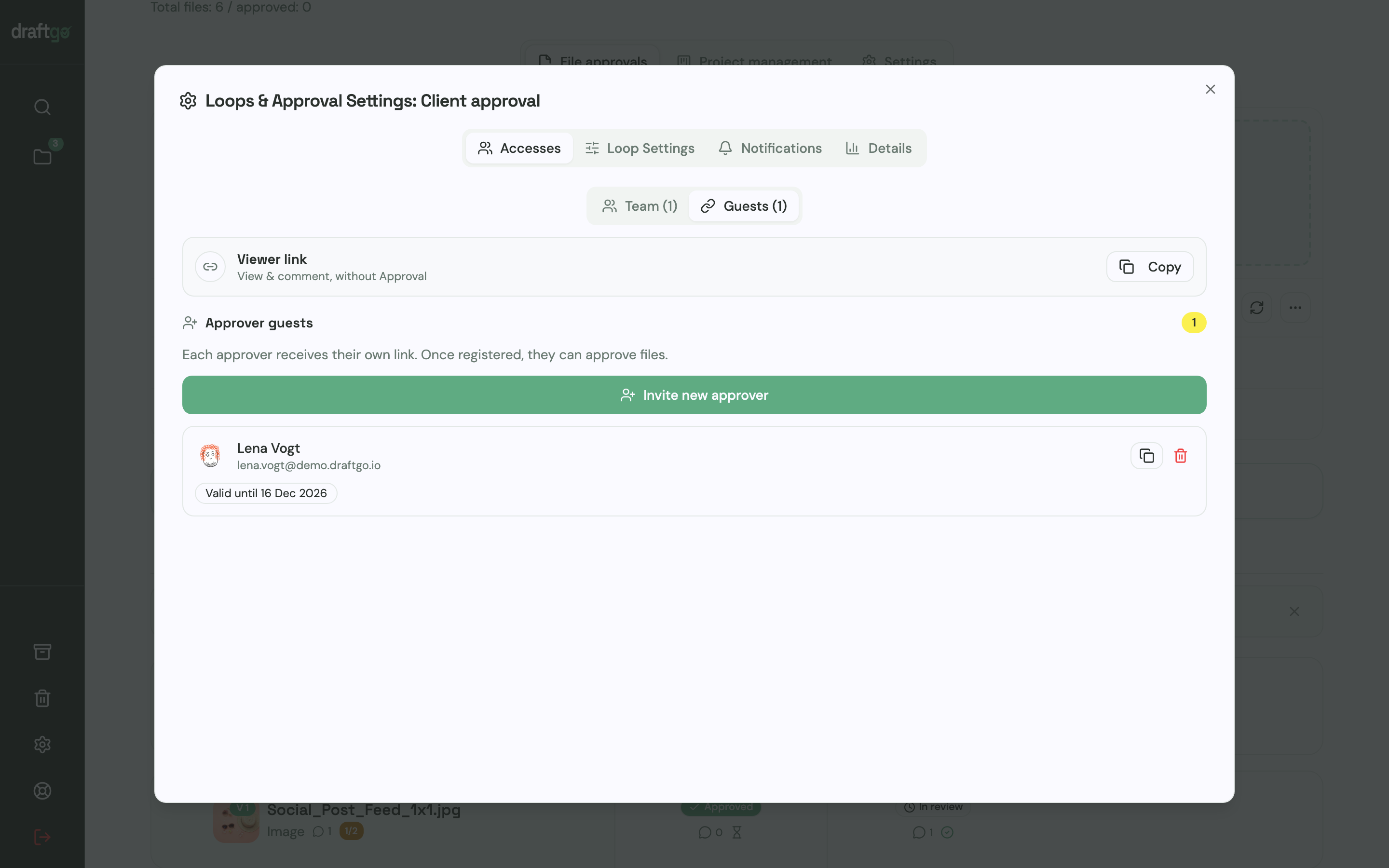
Access that ends. You can switch off any link. Approver links expire after 90 days without use, and viewer links stay valid until you switch them off, so close them when the project is done.
A record you can hand over. The activity log lists approvals, comments, versions and downloads with person and time, and you export it as CSV, JSON or PDF.

Guests are unlimited from the Freelancer plan; plans and limits shows the rest, and draftgo for agencies shows how agencies run client approvals.
FAQ
Is EU hosting enough for cloud data privacy?
No. The location of the data centre is one part of the answer. You also need a contract with the provider, a valid route for any transfer of personal data out of the UK or the EEA, and control over who can open which file.
Do I need a data processing agreement for every cloud tool?
Under the UK GDPR, you need a contract whenever a provider processes personal data on your behalf (UK GDPR, Article 28). In creative work that includes names in comments and people in photos.
Does the GDPR apply to a US agency?
It can. The EDPB says the GDPR may apply to an organisation outside the EEA that offers products or services to individuals in the EEA or monitors their behaviour there (EDPB, data protection basics). A US agency that runs campaigns for people in the EU should clarify this with its client.
Conclusion
Cloud data privacy rests on written answers about what personal data the files hold, which contract covers each tool, where the data goes and who can open it. Start with the tool that holds most of your client files, run the six checks this week and file the answers with your client documents.
Try it free – draftgo is free for 14 days, no credit card needed.
Written by
Emilia
Content Producer
Ready to streamline your approval processes?
Get started with draftgo today and see how easy professional collaboration can be.