
This article is general information, not legal advice.
A design studio completes a visual rebrand, or a commercial photographer delivers promotional images for a local campaign. Six months later, the client features those same photographs on nationwide billboards and prints the custom illustrations onto retail merchandise. When the creator asks for additional licensing compensation, the client responds that paying the project invoice granted them total ownership.
Unclear agreements over usage rights frequently lead to damaged client relationships, disputed invoices and expensive legal conflict. When you deliver creative work, misunderstandings arise when neither side defines what the client is actually permitted to do with the assets.
Copyright and usage rights: the difference
Copyright represents the exclusive legal ownership of an original creative work, whereas usage rights are the specific permissions granted to another party to exploit that work under agreed terms. When you create an original design, illustration or photograph, you hold the exclusive bundle of rights automatically under US copyright law.
Under this statutory framework, the bundle grants the copyright owner the sole authority to:
- Reproduce the copyrighted work in copies or phonorecords
- Prepare derivative works based upon the original creative work
- Distribute copies of the work to the public by sale, rental, lease or lending
- Display or perform the work publicly
When a client pays an agency or freelancer, they rarely purchase the underlying copyright itself unless the contract explicitly transfers it. Instead, they buy usage rights, which take the legal form of a licence. Under statutory copyright definitions, a nonexclusive licence does not constitute a transfer of copyright ownership. You can specify whether the licence covers digital channels, print runs, geographic regions or set periods of time, allowing you to tailor the price to the commercial value of that specific deployment. Similar licensing rules apply when repurposing creator assets, as explained in our guide on UGC usage rights.
Try it yourself: In the demo you work in a real draftgo workspace with sample data.
Who owns commissioned work: work made for hire and assignments
Commissioned work belongs to the person who created it unless a formal legal exception or written assignment transfers ownership to the client. Under US copyright law, the individual creator is considered the author and initial copyright owner from the moment a work is fixed in a tangible medium.
Clients frequently believe that paying for a creative deliverable automatically turns it into a work made for hire. Under statutory copyright provisions, the work made for hire doctrine applies automatically to full-time employees creating materials within the scope of their employment. For independent contractors, design studios and freelance photographers, commissioned work only qualifies as a work made for hire if it meets two strict legal criteria detailed in the Copyright Office circular on works made for hire:
- The work must fall into one of nine statutory categories, such as a contribution to a collective work, a part of a motion picture or other audiovisual work, a translation, a supplementary work, a compilation, an instructional text, a test, answer material for a test, or an atlas.
- Both parties must expressly agree in a written instrument signed by them that the work shall be considered a work made for hire.
Standard freelance deliverables like standalone corporate logos, individual brand photos or marketing posters rarely fit into these nine categories. Even if a contract uses the phrase "work made for hire", the clause is ineffective if the asset falls outside the statutory list. In those circumstances, the creator retains the copyright unless they sign a written transfer of ownership under statutory transfer rules. Addressing these ownership definitions during client onboarding avoids misunderstandings later. Similarly, if your deliverables incorporate generated elements, reviewing whether you can use AI images commercially clarifies how human authorship affects copyright claims.
6 steps to agree usage rights in a project
Agreeing on usage rights requires a transparent process embedded into your regular project workflow from proposal to delivery. Following six sequential steps ensures both your team and your client understand the legal boundaries of every deliverable.
1. Define the scope of use in the initial proposal
Clarify the intended use of the assets before starting design work or scheduling a photoshoot. Ask the client where the deliverables will appear, who will see them and what business purpose they serve. Defining these parameters early allows you to quote an appropriate fee based on the commercial exposure rather than just hourly production effort.
2. Specify media formats, term and territory
Establish precise boundaries for where and how long the client may deploy the assets. Your agreement should name:
- Media formats: Print collateral, digital advertising, websites, social media channels, television broadcast or out-of-home billboards.
- Territory: Local distribution, a single country, regional markets or worldwide deployment.
- Term: A finite duration such as twelve months, or an indefinite duration for ongoing brand assets like core logos.
3. Clarify exclusivity and adaptation rights
State whether the granted licence is exclusive or nonexclusive. An exclusive licence bars you from licensing the asset to any other entity, whereas a nonexclusive licence permits you to license identical or similar work to other parties. Furthermore, state explicitly whether the client has the right to edit, crop, recolour or build derivative designs from your layered source files.
4. Tie licence activation to full payment
Protect your work by including a clause stating that the grant of usage rights takes effect only upon full payment of the project invoice. If a client receives finished files but defaults on payment, they have not acquired the licence and any commercial publication constitutes copyright infringement.
5. Maintain an internal asset and licence register
Track every third-party component used in a project alongside your proprietary design files. Document font names, stock photo purchase IDs and music licences in a central project folder. Decide in advance whether third-party licences should be purchased in the client's name or sublicensed through your studio.
6. Schedule a rights review before final approval
Incorporate a mandatory rights verification step before releasing finished files for print or launch. Review every layer, font and stock element to ensure the licence scope matches the client's deployment plan. Agencies managing large image catalogues often streamline this verification alongside creative review using dedicated photo proofing software.
Third-party rights: stock, fonts, music and people
Creative deliverables rarely consist solely of original artwork; they frequently incorporate third-party assets that carry separate contractual restrictions. An agency remains responsible for verifying that all fonts, stock libraries, music tracks and depicted individuals are cleared for the client's planned use.
- Stock images, illustrations and video clips: Standard stock licences typically cap print runs at a set number of copies and prohibit use on items manufactured for resale. Projects requiring packaging, merchandise or high-volume advertising require extended or custom enterprise licences.
- Font licensing: Purchasing a desktop font licence permits your team to design static graphics, but it does not permit web embedding, mobile application integration or server-side rendering. Clients publishing digital applications or hosting custom fonts online must secure separate webfont or app licences.
- Commercial music tracks: Synchronising music with promotional video requires specific commercial synchronisation and master rights. Background tracks licensed for organic social media videos frequently exclude paid digital ads or broadcast television.
- Recognisable people and the right of publicity: Under US law, the right of publicity protects individuals against the unauthorised commercial exploitation of their name, image, voice or likeness. Because this is primarily state law, recognised in roughly half of the states across the US, statutory protections and common-law remedies vary by jurisdiction. Whenever you produce imagery featuring recognisable models, employees or bystanders for commercial marketing, you must secure a signed model release before publication.
For broader operational guidance on advertising regulations across regulated industries, consult our guide on marketing compliance or explore our legal compliance solutions.
Usage rights in Austria and Switzerland
Cross-border creative projects involving Austria and Switzerland require a different licensing approach than US-style contracts. Under Austrian and Swiss copyright legislation, the creator principle applies, meaning original copyright remains inalienably tied to the individual author.
In Austria, creators do not transfer copyright ownership. Instead, agreements grant either a non-exclusive permission to use (Werknutzungsbewilligung) or an exclusive right of use (Werknutzungsrecht). Similarly, Swiss copyright law protects the author's moral rights while allowing exploitation rights to be licensed or assigned contractually. For agencies delivering work across the DACH region, contracts should specify exact parameters for media, geographic territory and duration rather than relying on US-style work made for hire clauses, which have no legal validity in Austria or Switzerland.
Mistakes and better practice
Overlooking licensing details creates avoidable legal exposure for creative teams. The table below highlights frequent mistakes alongside better operational practices.
| Common mistake | Operational risk | Better practice |
|---|---|---|
| Relying on verbal agreements or informal email threads | Terms cannot be proven; exclusive rights fail without a signed written instrument | Document media, territory, term and exclusivity in a written agreement signed by both parties |
| Assuming "work made for hire" covers all freelance deliverables | Clause is legally invalid if the work does not fit the nine statutory categories for commissioned work | Use an express copyright assignment or grant an exclusive licence with defined scope |
| Granting unconditional usage rights prior to invoice settlement | Client uses assets commercially while delaying or defaulting on final payment | State in contracts that the licence becomes active only after full invoice settlement |
| Using standard desktop fonts for client website embeddings | Font foundry audits lead to costly licensing retro-charges and infringement notices | Audit typography licences and require clients to purchase direct webfont licences |
| Publishing recognisable individuals without signed model releases | Lawsuits alleging right of publicity violations and immediate campaign takedowns | Require signed model releases for every recognisable person before final sign-off |
Practical scenario: how a design project manages rights
A boutique branding studio takes on a brand identity and seasonal campaign for a regional beverage brand. During the initial scoping conversation, the studio outlines the project parameters: the client receives a perpetual, exclusive licence to the brand logo, but the promotional campaign photography is licensed strictly for digital advertising across North America for twelve months.
As production begins, the team creates a rights register. The project uses custom typography alongside commercial lifestyle photography shot on location. For the typography, the studio purchases desktop licences to create the campaign lockups and instructs the client's development team to license the corresponding webfonts directly under the client company's legal name.
During the photoshoot, the producer collects digital model releases from every featured actor, confirming permissions for digital commercial advertising. Before exporting the final campaign assets, the studio lead checks the asset register against the contract terms:
- The logo assignment agreement is prepared for signature upon receipt of final payment.
- The model releases are paired with the relevant image frames.
- The twelve-month digital licence boundary is reiterated in the delivery handover document.
Because every usage tier was specified in advance, the client understands that expanding the campaign to retail packaging or European markets next season will require an agreed licensing extension.
How it works in draftgo
Managing rights reviews within draftgo keeps legal verifications connected directly to the creative deliverables rather than scattered across email threads. Creative teams establish a structured workflow by setting up an internal review loop dedicated to rights and licensing checks before opening the client review loop.
In the internal review loop, your art director, account manager or legal lead reviews the assets alongside their licensing documentation. You can upload licence PDFs, stock receipts and signed model releases directly as attachments on comments placed on the file. If an asset uses a restricted font or requires a model release verification, team members discuss the point in threaded comments or assign internal to-dos to retrieve missing paperwork.
The actual master licences, foundry contracts and releases remain stored securely in your company's own licence management system; the file in draftgo carries the exact verification record that belongs to that revision. Once the internal rights loop is approved, the asset advances to the client approval loop.
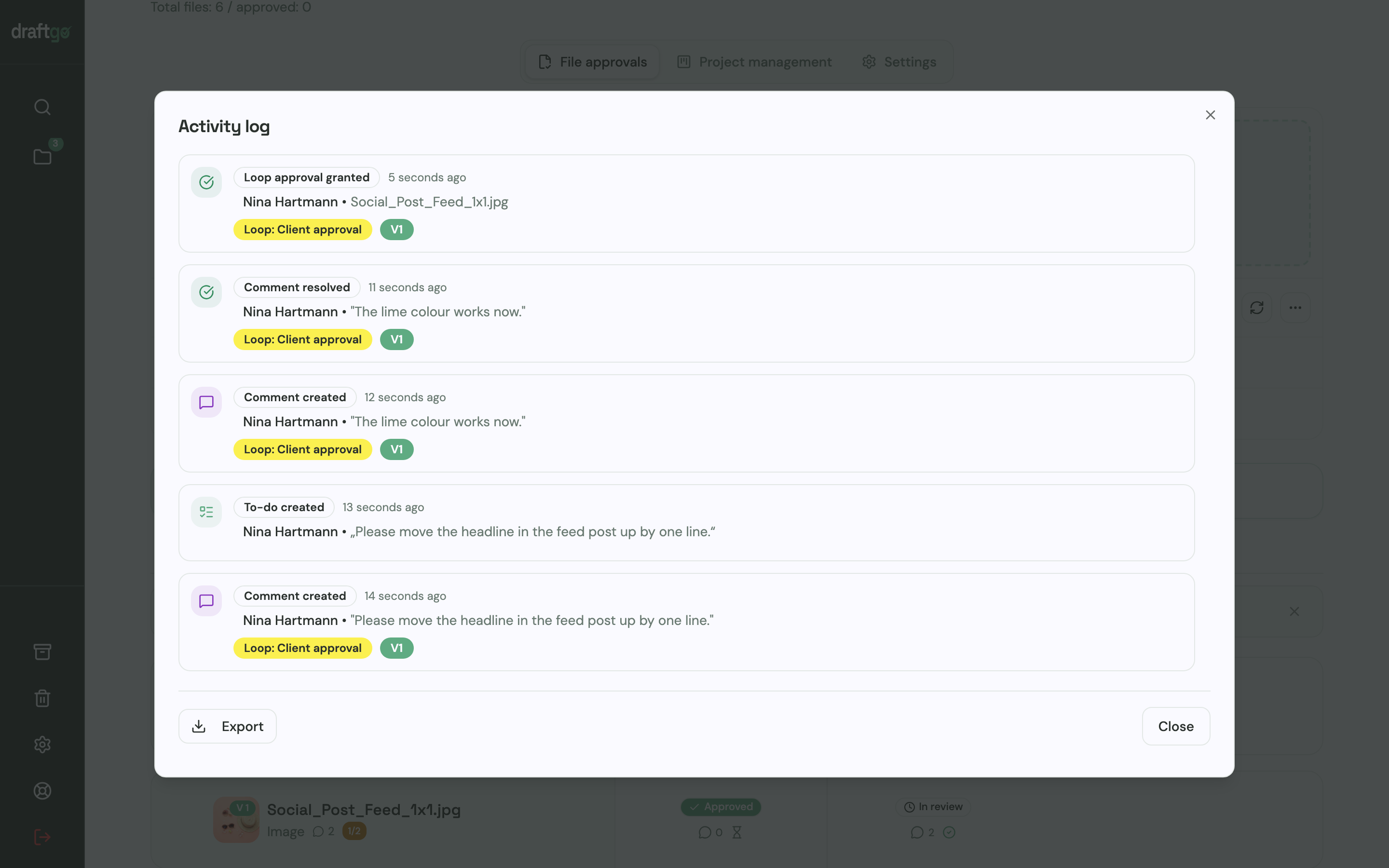
The activity log records every approval, comment, version update and download with the relevant user name and timestamp. You can export this audit record at any time as a CSV, JSON or PDF file to maintain verifiable proof of which asset version received sign-off. Stored data is kept on EU servers in the Frankfurt data centre. If team members have questions about feedback on a file, our AI agent “GO” can answer questions about the selected loop or deliverable.
FAQ
What is the difference between an assignment and a licence of usage rights?
An assignment transfers the full legal ownership of the copyright permanently from the creator to the client, leaving the original creator with no residual rights. A licence grants permission to use the creative work under defined conditions (such as specific media, territories or timeframes) while the creator retains underlying copyright ownership.
Can a client use my design work on retail merchandise without extra permission?
A client may only use your work on retail merchandise if their licensing agreement expressly includes commercial reproduction for sale. Standard design agreements covering promotional marketing or brand identity do not automatically grant retail merchandising rights unless specifically negotiated.
Why are font licences a frequent source of infringement claims?
Font software is protected by copyright, and desktop licences usually permit only static image creation on licensed workstations. When clients or agencies embed font files into websites, mobile apps or broadcast templates without extended webfont or enterprise licences, font foundries issue compliance notices demanding substantial licensing fees.
Does paying an invoice automatically transfer copyright under US law?
Paying an invoice does not automatically transfer copyright ownership under US law. Under statutory copyright law, a valid copyright transfer or exclusive licence requires a written instrument signed by the copyright owner.
Conclusion
Agreeing on clear usage rights prevents commercial disputes and protects the value of your creative deliverables. Define media formats, geographic territories, licence terms and payment dependencies in writing before production begins, and conduct a structured rights audit on all fonts, stock files and model releases prior to final client sign-off.
Try it free – draftgo is free for 14 days, no credit card needed.
Written by
Emilia
Content Producer
Ready to streamline your approval processes?
Get started with draftgo today and see how easy professional collaboration can be.