
The email for the spring membership offer promises “your first month free”. The landing page it links to says the offer ended on Sunday, and the small print under the sign-up button names a minimum term the email never mentions. Each piece was reviewed at some point, just never in the version that went out.
Marketing compliance succeeds or fails at this point, with the question of who reviews which version and whether a change after sign-off goes back for another look.
This article is general information, not legal advice. For a binding assessment of your campaigns, talk to your legal team or a lawyer who specialises in advertising law.
What is marketing compliance?
Marketing compliance means that every piece of marketing follows the laws, regulations and industry codes that apply in the markets where it runs, from ads and emails to social posts, landing pages and sales material.
It is a different check from brand compliance, which holds assets against your own guidelines for logo, colour and tone.
Which advertising rules apply in the US and the UK?
In both markets, an ad must not mislead, and you need evidence for its claims before it runs. The details differ.
United States
The FTC Act gives the Federal Trade Commission the power to prevent “unfair or deceptive acts or practices in or affecting commerce”, as the FTC’s page on the Act puts it. Its Advertising FAQs for small business (2001, edited 2025) spell out what that means for ads: they must be truthful and not deceptive, a company needs a “reasonable basis” for a claim before the ad runs, the same law applies in every medium from radio to online, and fine print cannot contradict other statements in the ad.
For endorsements, the FTC’s Endorsement Guides FAQ says a connection between endorser and brand that a significant minority of consumers would not expect, and that could change how they weigh the endorsement, should be disclosed clearly and conspicuously, where users are not likely to miss it. Our guide to reviewing influencer content shows where that check fits.
For email, the FTC’s CAN-SPAM Act compliance guide (2023) says the law covers all commercial messages, with no exception for business-to-business email. Among other things, it asks you to identify the message as an ad, say where you are located, explain how to opt out and honour an opt-out within 10 business days.
United Kingdom
For non-broadcast ads, sales promotions and direct marketing, the rule book is the CAP Code, which all advertisers, agencies and media must follow and the Advertising Standards Authority enforces. Section 3 of the Code says marketing must not materially mislead (rule 3.1), marketers must hold documentary evidence for objective claims before the ad goes out (rule 3.7), and qualifications may clarify a claim but must not contradict it (rule 3.9).
Alongside the Code, the CMA’s guidance on unfair commercial practices (2025) explains the unfair commercial practices rules of the Digital Markets, Competition and Consumers Act 2024, which apply to commercial practices from 6 April 2025 and ban 32 practices in all circumstances. According to the guidance, breaching a banned practice can lead to civil action and monetary penalties of up to the higher of £300,000 or 10% of worldwide turnover.
Marketing email to individuals falls under the Privacy and Electronic Communications Regulations. Regulation 22 of PECR allows it with the recipient’s prior consent, or where you collected their details during a sale or sale negotiations, market only your own similar products and services, and offered a simple way to refuse at collection and in every message since. Since 5 February 2026, charities have a route of their own under regulation 22(3A).
Financial services marketing compliance
Financial services marketing adds sector rules to the general advertising rules.
In the US, FINRA Rule 2210 requires communications of FINRA’s member firms to be fair and balanced and bans false, exaggerated, unwarranted, promissory or misleading statements. Information may go into a legend or footnote only if that does not hinder an investor’s understanding. Under paragraph (b)(1)(A), each retail communication needs the approval of an appropriately qualified registered principal before the firm first uses it or files it with FINRA; the rule lists exceptions. What a firm then has to keep is covered in our article on the approval audit trail.
In the UK, the CAP Code’s section on financial products points marketers to the financial promotion rules of the Financial Conduct Authority, for example for banking, investments, mortgages and insurance. Its own rules cover financial ads the FCA does not regulate, and every financial ad stays subject to the Code’s rules on non-technical points, for example the truthfulness of claims that do not relate to specific characteristics of financial products.
Try it yourself: In the demo you work in a real draftgo workspace with sample data.
Where marketing compliance breaks down in the workflow
Compliance slips start where the reviewed file and the published file drift apart. Here are five such gaps and how to close them:
| Gap | What happens | Better practice |
|---|---|---|
| Legal reviews a PDF sent by email | Design keeps editing, so the reviewed copy is outdated | Everyone reviews the same file in one place |
| A rate, price or end date changes after sign-off | The live version was never reviewed | Every new version goes back to legal |
| The evidence for a claim sits in an inbox | Nobody finds it when a regulator asks | Attach the evidence to a comment on the claim |
| A misleading headline gets a footnote | The footnote contradicts the claim | Change the claim, then check the small print |
| Legal sees the campaign the day before launch | Changes come too late | Plan legal review as a fixed stage |
How to build marketing compliance into your approval process in 5 steps
A legal check holds up when one person owns it and it sits at a fixed point before launch, late changes included.
1. List the rules per channel and market
Note for each channel (email, paid social, print, partner posts) and each market which rules apply and who checks them. A campaign in the US and the UK needs both columns, because CAN-SPAM and regulation 22 of PECR set different conditions for the same email.
2. Name the legal reviewer for each campaign
Decide who gives the legal approval: in-house counsel, the compliance team or an outside lawyer. Put the name in the brief and make that person an approver, not someone who reads along in copy.
3. Keep the evidence next to the claim
When the copywriter writes an objective claim, such as a rate or a comparison with a competitor, they add the evidence while drafting. The reviewer checks both together, and the evidence exists before the ad runs, as the FTC and the CAP Code expect.
4. Schedule the legal review after content approval
Run the legal review once message and layout are agreed internally and before the final sign-off. The reviewer comments on the claim inside the file, so the designer sees exactly which line has to change.
5. Send every change back and keep the record
A change after legal approval creates a new version, and that version needs its own approval; our guide to document version control shows how to keep versions apart. At the end of the campaign, store the record of who approved which version and when.
Practical example: an auto loan campaign at a credit union
Take a credit union with a nineteen-person marketing team. For a summer auto loan campaign, it produces a direct mail piece as a PDF, three social posts and a short streaming video. Its own policy says that every asset naming a rate or loan terms needs the approval of the compliance officer, who works in a separate department.
The campaign runs in one draftgo project with two loops. In “Content review”, the marketing director and the campaign lead approve; in “Compliance review”, the compliance officer approves through her personal approver link. Branch managers get the shared viewer link and comment on local details without approving anything.
The compliance officer highlights “as low as” in the mailer and asks for the qualifying conditions next to the rate, and she flags that the end card of the video shows the rate without them. The designer uploads version 2 of both files, and their approvals start again. Two days later the product team lowers the rate, so the mailer goes up as version 3 and back to the compliance officer instead of going to print with her approval of version 2. When internal audit later asks how the mailer was approved, the team exports the activity log.
How it works in draftgo
In draftgo, the legal check is an approval loop of its own, and every approval belongs to one version of one file.
A loop for legal review. In the campaign project, you create a loop such as “Legal review” next to your content review. Its rule sets whether all approvers, a set number or any one of them must approve, separately for team and guests. Free allows one loop per project, Freelancer three, and Agency and Team have no loop limit (compare the plans).
Files enter the legal loop once the content is agreed. When a file has passed the content review, someone on your team selects it in the file list and activates it in the legal loop.
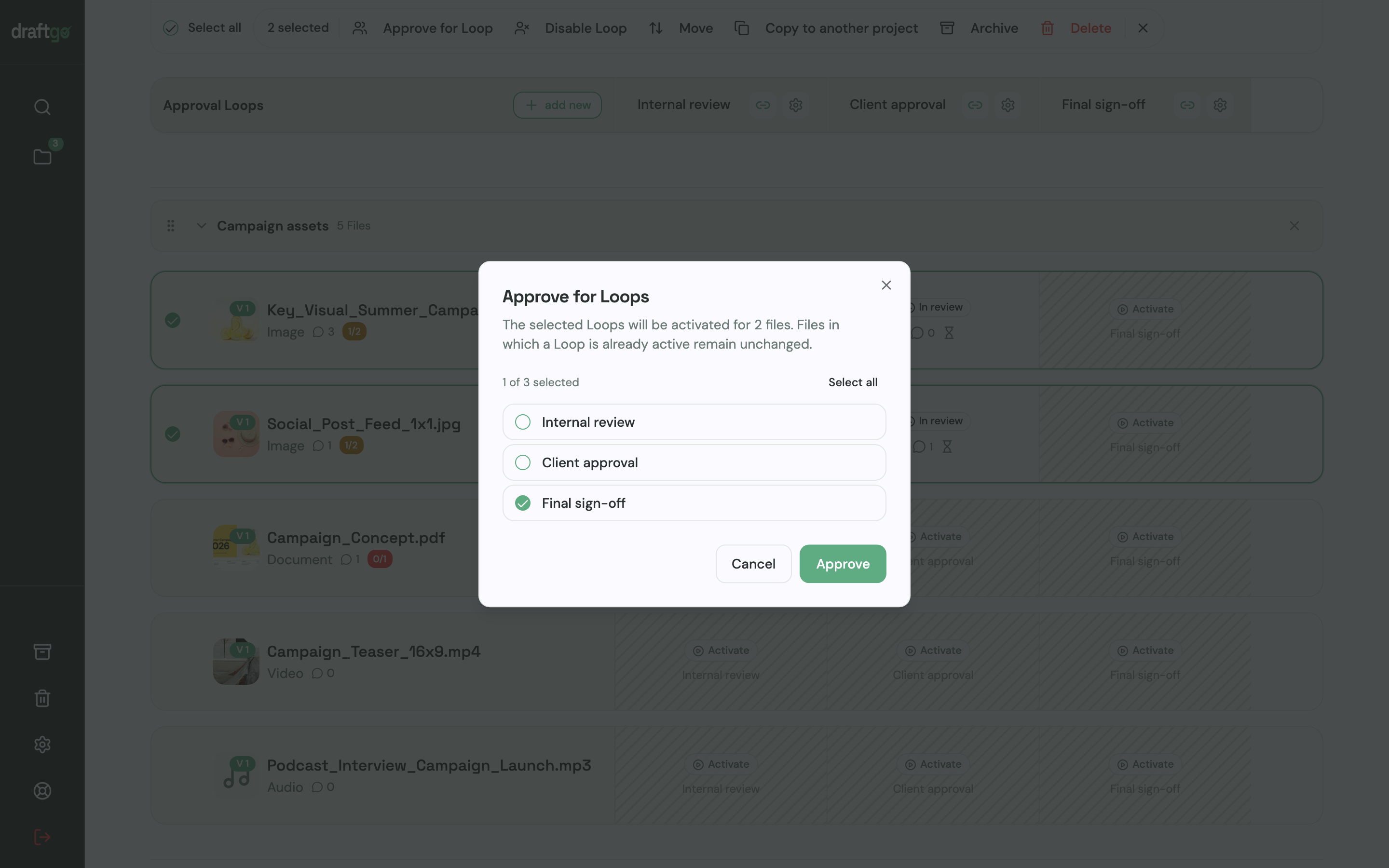
Reviewers inside and outside the company. The legal reviewer can be a team member or a guest. A guest approves through a personal approver link and needs no account; people who should only comment get the shared viewer link, which cannot approve.
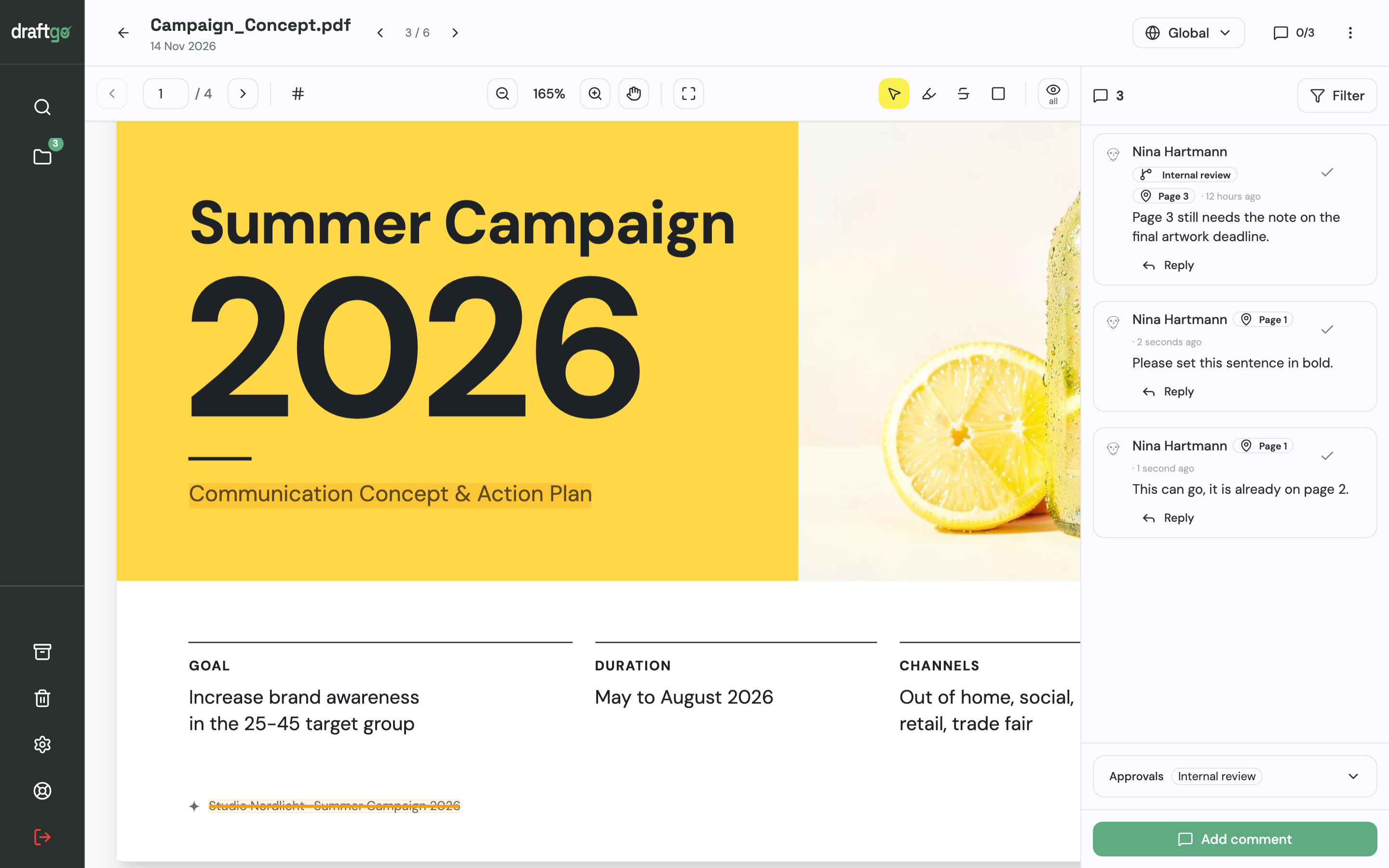
Comments on the claim itself. The reviewer highlights or strikes through a line in the PDF, sets a pin or rectangle on an image, or comments at a timecode in a video.
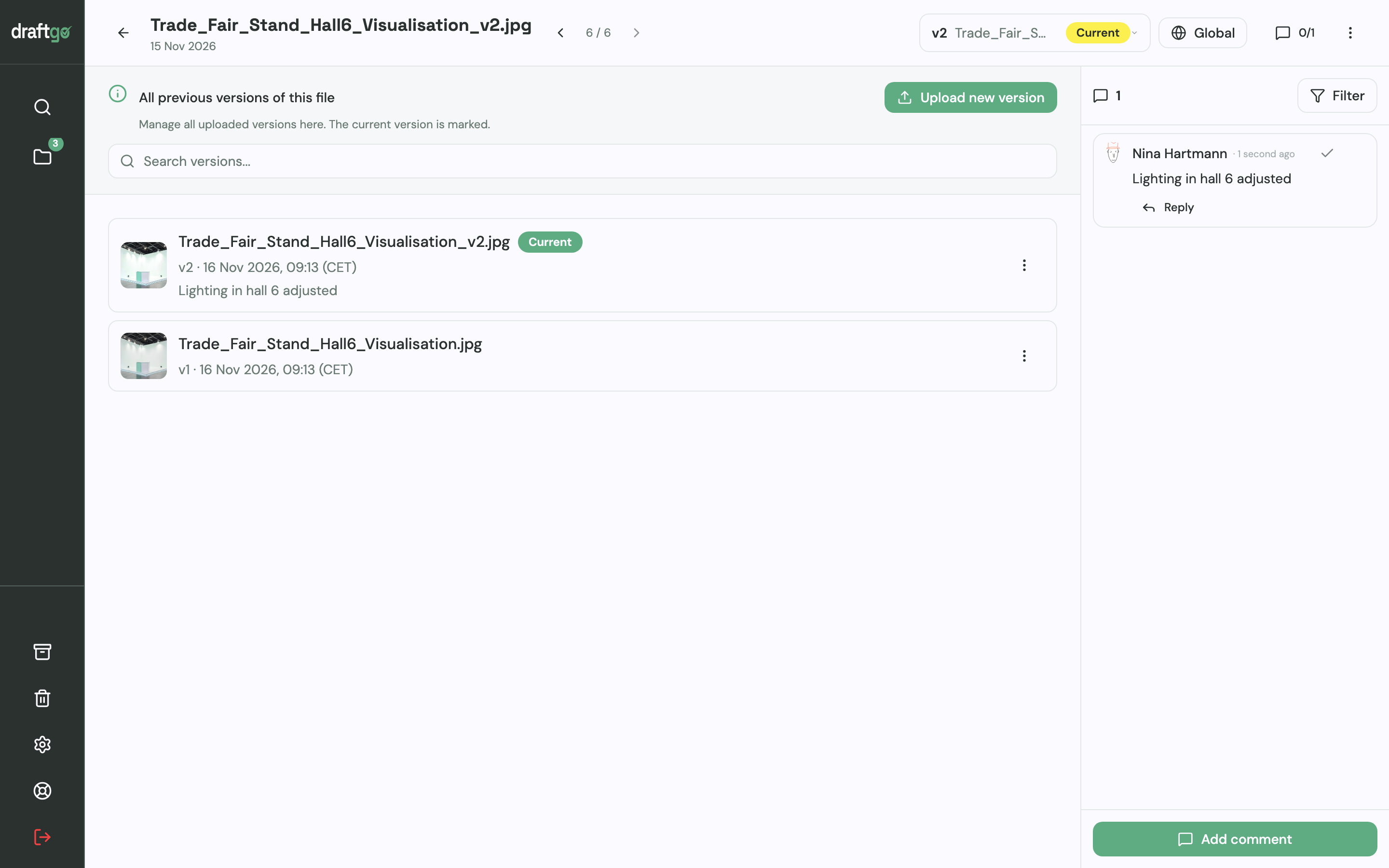
A new version needs a new approval. The designer uploads the corrected mailer to the same file instead of creating a new one. Earlier versions and their comments remain available, and the loop’s approvals reset, so legal signs off on the version that will actually run.
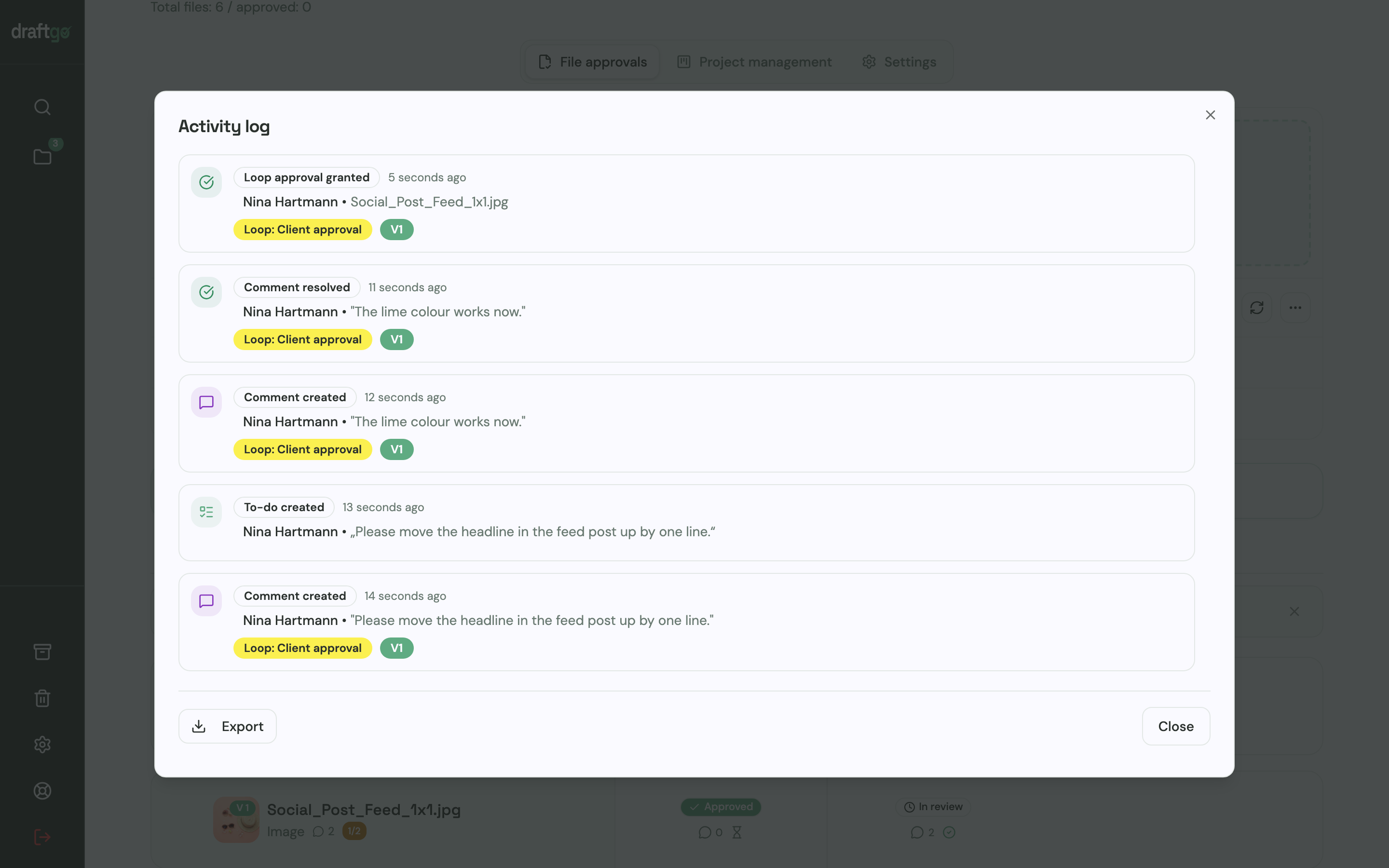
The record of each approval. The activity log lists approvals, comments, versions and downloads with the person and the time. Export it as a PDF for internal audit, or as CSV or JSON for your own records.
draftgo records who approved which version and when; whether a claim is lawful stays your reviewer’s decision. Setups with legal and management stages are described on draftgo for legal and compliance teams.
FAQ
What is the difference between marketing compliance and brand compliance?
Marketing compliance checks marketing against laws, regulations and industry codes, such as the FTC Act in the US or the CAP Code in the UK. Brand compliance checks it against your own brand guidelines. The two can have different reviewers: legal or compliance for the first, brand or design for the second.
Does a disclaimer make a misleading claim acceptable?
No. The FTC’s Advertising FAQs say fine print cannot contradict other statements in an ad, and rule 3.9 in section 3 of the CAP Code says qualifications may clarify a claim but must not contradict it. Fix the claim itself, then check that the small print fits it.
Do email marketing rules apply to B2B emails?
In the US, the FTC’s CAN-SPAM guide says the law makes no exception for business-to-business email. In the UK, the consent rule in regulation 22 of PECR applies to individual subscribers. Ask your legal team which rules apply to the business addresses on your list.
Conclusion
Marketing compliance holds when the legal review is a fixed stage with a named reviewer, the evidence sits next to each claim and every new version needs a new approval. Take your next campaign, write down which rules apply per channel and market, and name the person who approves before the first draft goes out.
Try it free – draftgo is free for 14 days, no credit card needed.
Written by
Emilia
Content Producer
Ready to streamline your approval processes?
Get started with draftgo today and see how easy professional collaboration can be.