
You have spent three months preparing a comprehensive rebrand or an unannounced product campaign. The launch date is set, the press release is scheduled, and creative assets are finally moving through stakeholder review. Then an unapproved packshot surfaces on an industry forum or a competitor launches a matching feature before your press release even goes out.
When agencies and marketing teams share confidential files across distributed teams, external freelancers, and client stakeholders, the review phase is when assets are most vulnerable. File attachments get forwarded, open links circulate outside the core team, and people who left the project weeks ago still retain access to shared folders. Keeping unreleased work under wraps requires a structured review workflow that combines clear organisational rules with technical access controls.
This article is general information, not legal advice.
The 5 usual ways campaigns leak early
Leaks rarely happen through sophisticated cyberattacks. In creative production, confidential assets almost always escape through ordinary day-to-day convenience, sloppy file-handling habits, or untracked distribution channels.
- Forwarded email attachments: A team member emails a PDF draft or video cut to a client lead. The client forwards the email internally for quick opinions, and a junior colleague forwards it to an external media agency or printer. Within a short time, dozens of people hold local copies on unmanaged devices without anyone tracking who received the file.
- Open cloud folder links: To avoid file size limits, teams often generate cloud storage links set to "Anyone with the link can view". These links are pasted into chat channels or calendar invites. Because the link has no expiry date or recipient tracking, anyone who discovers the URL can view or download the files indefinitely.
- Screenshots from chat channels: Slack or Teams channels make informal feedback fast, but they encourage stakeholders to take quick mobile screenshots of work in progress to show colleagues. These unmonitored images lack context, watermarks, or accountability, and they easily end up in WhatsApp groups or personal photo libraries.
- Oversized distribution lists: Approvals frequently involve people who do not need to see early creative concepts. When review invitations include entire departments rather than designated sign-off leads, the attack surface expands unnecessarily.
- Suppliers and freelancers without confidentiality agreements: External retouching artists, voiceover talent, translators, and staging partners frequently handle raw campaign assets. If an agency brings them on board without a signed non-disclosure agreement (NDA), there is no clear legal boundary or shared understanding of secrecy.
Try it yourself: In the demo you work in a real draftgo workspace with sample data.
6 organisational safeguards for confidential reviews
Restricting file access is not merely a technical setting; it starts with how you organise project teams and manage client communication. Establishing strict procedures before uploading assets significantly lowers the risk of human error.
1. Enforce strict need-to-know access
Limit asset access exclusively to individuals who must actively review or approve the current draft. An unreleased campaign does not belong in an all-agency channel or a shared team drive accessible to every employee. Establish a tight list of named reviewers for each stage of production.
2. Set phase-based distribution lists
A campaign passes through distinct production phases: early conceptual sketches, internal agency polishing, client stakeholder approval, and final pre-press production. Maintain separate distribution lists for each phase. A print supplier or media planner should only receive assets when files reach the technical preparation stage, not during initial creative ideation. Integrating these boundaries into your client onboarding workflow ensures clients understand from day one who receives work and when.
3. Require NDAs for all external contributors
Never supply unannounced campaign materials to freelancers, contractors, or print shops without a signed non-disclosure agreement. Your contract should explicitly state that campaign materials cannot be used in portfolios, case studies, or social media teasers prior to official public release.
4. Use internal code names
Give high-profile campaigns, product launches, and pitch projects internal code names. Ensure that file titles, loop names, and folder structures use this pseudonym rather than the client’s real brand or unannounced product name. If a notification email or file name is accidentally glimpsed on a screen in public transit, the underlying project remains unidentifiable.
5. Ban raw file attachments in email
Establish a strict team policy: never attach sensitive artwork, video files, or presentation decks directly to an email. When files live as static email attachments, you lose the ability to revoke access, update versions, or see who downloaded them. All reviews must happen through managed review links or central review workspaces.
6. Revoke access immediately when project phases conclude
Project staffing fluctuates. Freelancers complete their assignments, client contacts change roles, and pitch partners conclude their involvement. Conduct a regular review audit at the end of each sprint to remove inactive users, deactivate guest links, and ensure past contributors can no longer open working drafts.
Technical measures and what to look for in tools
Relying entirely on team discipline is risky. Your software stack should enforce confidentiality through deliberate permission layers and visible audit trails. When you evaluate platforms to share confidential files for sign-off, look for these protective mechanisms.
Personal access over generic links
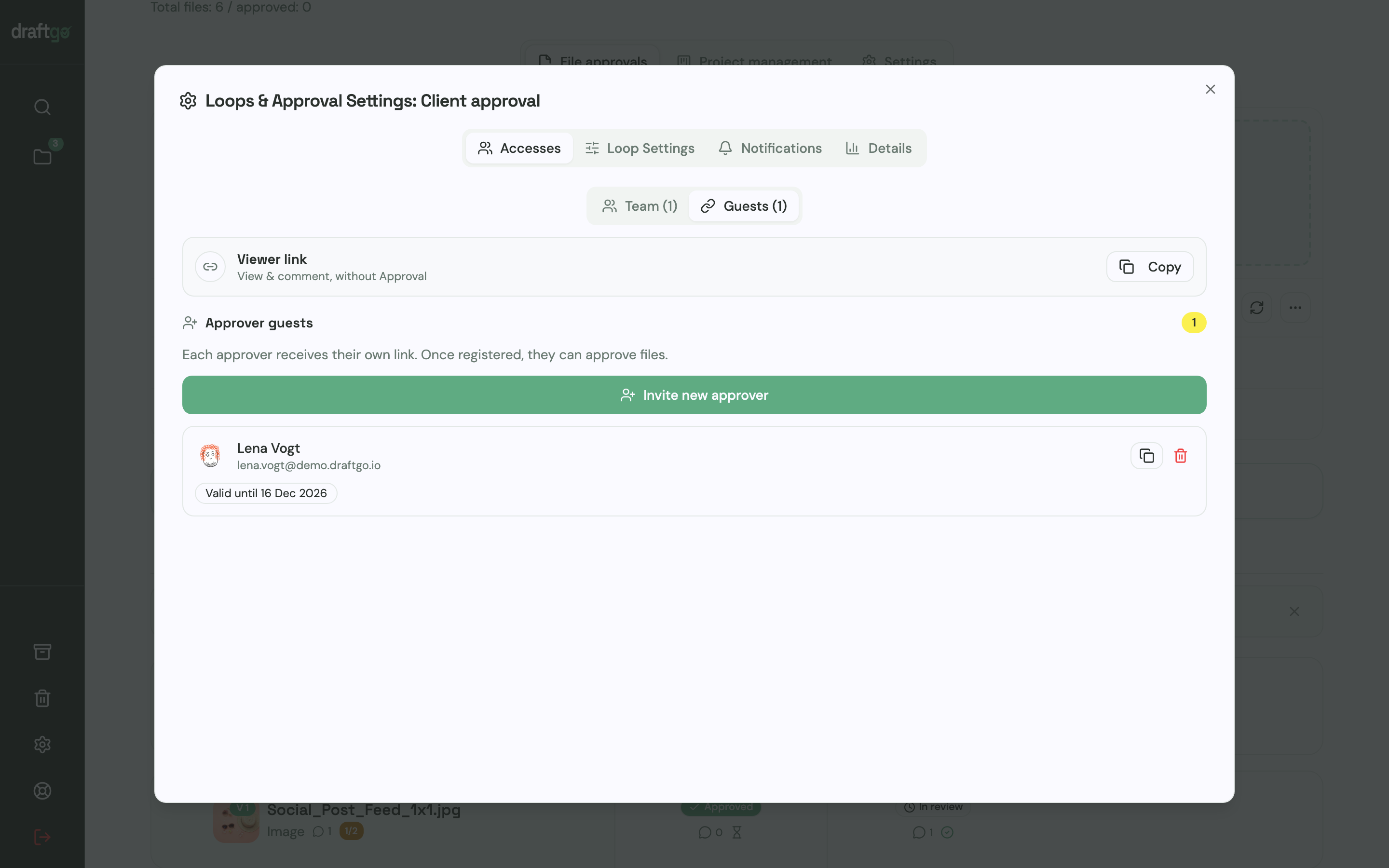
Generic, shared URLs invite unchecked forwarding. Secure review workflows rely on personalised links tied to a specific name and email address. When each reviewer receives an individual entry point, the system attributes every comment, view, and sign-off directly to that person.
View and comment permissions without unrestricted downloads
Not every reviewer needs an offline copy of a master file. In creative proofing, stakeholders usually need to evaluate layout, copy, and timing. Platforms that allow stakeholders to annotate directly on the asset in their web browser eliminate the need to distribute high-resolution master files to personal hard drives.
Automatic link expiration and instant deactivation
Review links should not remain live indefinitely. Tools should provide links that expire automatically after a set period of inactivity, as well as an administrative kill switch that lets you deactivate any active guest link instantly if team composition changes.
Complete activity logging
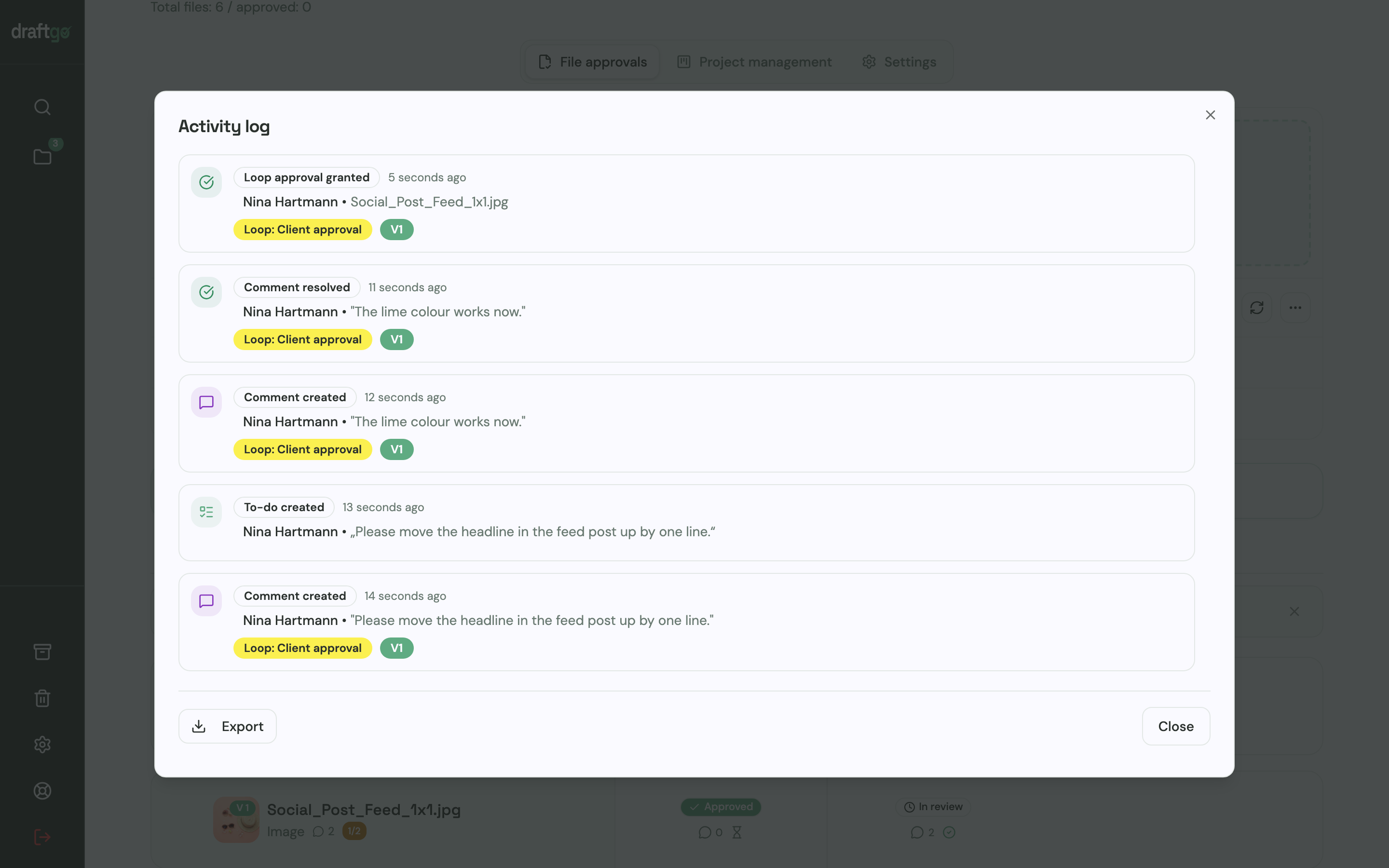
To satisfy compliance standards and maintain project security, you must know who accessed which asset. An activity log that records uploads, comments, version switches, and sign-offs with exact timestamps gives agencies clear visibility over file interactions.
Legal considerations: Trade secrets and data breaches
Protecting unreleased work is not just good agency practice; it has direct legal implications under trade secret and data privacy legislation.
Reasonable measures under trade secret law
In the United States, unreleased creative campaigns, product specifications, and pitch proposals can qualify as trade secrets under the Defend Trade Secrets Act. However, information only receives legal protection as a trade secret if the owner has taken reasonable measures to keep it secret (18 U.S. Code on trade secrets).
If an agency shares confidential files over public cloud links without access restrictions or sends sensitive concepts without confidentiality agreements, courts may conclude that the owner failed to take reasonable protective measures. Documenting your access controls, using signed NDAs, and logging reviewer identity are vital steps to prove that reasonable safeguards were maintained.
Personal data breaches under the GDPR
Campaign assets frequently contain personal data, such as identifiable photography of brand ambassadors, customer testimonials, employee portraits, or contact lists. For agencies and brands handling personal data of individuals in the European Union, an unauthorised release of these files can constitute a personal data breach under European privacy rules.
Under European privacy rules (GDPR breach notification requirements), in the case of a personal data breach, the controller must notify the competent supervisory authority without undue delay and, where feasible, within 72 hours of becoming aware of it, unless the breach is unlikely to result in a risk to the rights and freedoms of individuals. Agencies evaluating cloud platforms should review their cloud data privacy setup and ensure their tools comply with international data standards such as Schrems II.
Austria and Switzerland
For campaigns operating in Austria or Switzerland, parallel statutory standards apply. In Austria, the GDPR applies directly across all federal states alongside national trade secret provisions under the Act Against Unfair Competition (UWG). In Switzerland, the revised Federal Act on Data Protection (FADP) establishes strict breach handling duties, alongside Swiss unfair competition law protecting commercial secrets. Across all these jurisdictions, whether in the EU, Switzerland, or North America, taking structured organisational precautions is essential to enforce trade secrecy and meet statutory compliance obligations. You can explore structured compliance frameworks further on our legal compliance solutions page.
If something leaks: immediate steps and notification duties
Even with robust safeguards, human error can happen. If confidential campaign materials escape before launch, prompt and structured intervention limits commercial and legal fallout.
- Deactivate links and revoke access immediately: Shut down all active guest links, archive the project files, or toggle user permissions in your review tool. Terminate the leak path at the source before further copies circulate.
- Establish the exact scope and source: Check your activity logs. Determine which file version got out, whose link was used to view or download it, and the precise timestamps involved. Establishing whether one person or fifty opened the link dictates your next response.
- Notify the client and affected stakeholders: Inform your internal project leads and the client lead promptly. Transparent reporting with factual log data builds credibility and allows the client's PR team to adjust launch timetables or prepare public responses.
- Assess statutory notification duties: If the leak involves personal data, determine whether supervisory notifications under European privacy rules or relevant regional data protection laws are triggered within the statutory 72-hour window.
- Remediate the underlying vulnerability: Identify why the breakdown happened. Update your agency distribution lists, revise permissions, and reinforce team review guidelines to prevent recurrence.
Common mistakes and better practice
| Area | Common mistake | Better practice |
|---|---|---|
| File delivery | Sending high-res PDFs and raw video files as direct email attachments | Reviewing assets inside a controlled proofing workspace via browser |
| Link sharing | Generating perpetual "anyone with the link" cloud storage links | Issuing personal approver links tied to specific names and emails |
| Project visibility | Naming folders after the client's unannounced product | Using internal project code names for files, loops, and folders |
| Contractors | Onboarding freelance artists or voice actors on verbal trust | Requiring signed NDAs before granting access to unreleased creative drafts |
| Audit readiness | Relying on chat histories and email threads to check who saw what | Maintaining an exportable activity log recording all views and sign-offs |
| Offboarding | Leaving project access open after an external review round finishes | Deactivating guest links and revoking editor access as soon as reviews close |
A realistic scenario: Handling a confidential launch review
Consider an independent digital agency preparing a confidential brand refresh for a consumer electronics client. The project involves packaging renders, product photography, and promotional social video clips.
Instead of emailing file batches or creating an open folder link, the agency account team sets up two separate review stages. The first loop involves three senior internal art directors. Once internal adjustments are resolved, the agency generates personal guest links for two client brand managers. Files are evaluated as browser previews where clients leave pinned annotations directly on the layout. External print suppliers only receive final, signed-off files days later through an isolated production loop.
When a temporary copywriter leaves the agency midway through the campaign, the administrator removes their editor seat with a single click. Because no raw assets were distributed as email attachments, the agency maintains clear control over where drafts reside, ensuring the campaign remains confidential until its official reveal.
How it works in draftgo
draftgo provides creative teams with a focused environment to review and approve assets without requiring external clients to register an account.
You upload your images, PDFs, videos, or audio files into a dedicated project and organise them into structured review loops. To share confidential files with external stakeholders, you generate personal approver links. Each approver receives an individual link tied to their name and email address, allowing them to view files and approve them directly in their browser. Alternatively, you can issue viewer links that permit commenting but prevent final approval.
Review links expire automatically after 90 days without use, and team administrators can deactivate any link at any moment. Stored data is kept on EU servers in the Frankfurt data centre, and every customer receives a data processing agreement, which lists the sub-processors.
During the entire review, draftgo records every comment, file version, download, and sign-off in an activity log with precise timestamps, which you can export as a PDF or CSV document whenever you need an audit trail.
FAQ
Does an NDA replace technical access controls?
No, an NDA provides a legal framework and contractual remedies, but it cannot technically stop an email from being forwarded or a file from leaking. Effective leak prevention pairs legal agreements with technical controls like personal review links and view-only permissions.
What should we do if an external reviewer shares their link with someone else?
Personal approver links are tied to the recipient's name and email address. If an unauthorised person uses that link, the activity log records actions under the original recipient's credentials. If you suspect a link was shared improperly, deactivate it immediately and issue fresh individual links to the correct stakeholders.
Are cloud storage links safe enough for unannounced marketing campaigns?
Open cloud storage links set to public access present a high security risk because anyone who receives or discovers the URL can view and download the content. For confidential pre-launch campaigns, you should always use personalised review links with activity tracking, defined permissions, and the ability to revoke access on demand.
How quickly must a data breach be reported if campaign assets leak?
If unreleased files contain personal data and the leak presents a risk to individuals, European data protection rules require controllers to notify the supervisory authority without undue delay and, where feasible, within 72 hours of becoming aware of the breach.
Conclusion
Protecting unreleased creative work requires a deliberate balance of clear organisational rules and secure technical boundaries. By replacing open file attachments and public cloud links with tracked review loops, personal guest links, and signed confidentiality agreements, you protect your client's trade secrets and your agency's professional reputation.
Try it free – draftgo is free for 14 days, no credit card needed.
Written by
Emilia
Content Producer
Ready to streamline your approval processes?
Get started with draftgo today and see how easy professional collaboration can be.