
You send the first draft of a campaign to the client on Monday and hear nothing for three days. Then the feedback arrives all at once: two emails, a Slack message and a phone call, and the marketing manager and the product manager want opposite things from the headline. A week before launch, the managing director sees the campaign for the first time and asks for a new visual. Nobody told these people when their feedback was due, where it should go or whose word counts at the end. Stakeholder communication settles those questions before the first draft goes out.
What is stakeholder communication?
Stakeholder communication is the planned way you involve everyone with a stake in a project’s result: who gives feedback and when, who decides, and who only needs to know what is happening. In a creative project, that means the designers and copywriters, the project lead, the client’s marketing team, legal or compliance, senior management and, where facts need checking, a product expert.
It is the part of stakeholder management that runs every day of the project. You assess who has influence once, at the start. Communication then decides what each person receives, through which channel and by which date. Done well, feedback arrives in one round instead of in pieces, and the person who owns the decision settles conflicting requests.
Who gives feedback, who decides and who is only informed
At the start of the project, give every stakeholder one of four roles. One model for this is the RACI matrix (Mindtools, 2024), short for Responsible, Accountable, Consulted and Informed, with only one person accountable for each task. In a review, the roles look like this:
| Role | What they do in a review | Example |
|---|---|---|
| Responsible | does the work and uploads each new version | designer, copywriter, editor |
| Accountable | gives the final approval and settles conflicts | the client’s head of marketing |
| Consulted | comments on their own area before approval | legal, product manager, HR |
| Informed | gets status updates but is not asked for feedback | sales, senior management |
If two people believe they are accountable, your team gets two sets of instructions and no decision. If nobody is, the review drags on round after round. Name the accountable person for each stage in writing, and send informed people a short status after each round, so that nobody turns up in the final week with a new opinion.
Six stakeholder types in creative reviews
These six types describe how people behave in review rounds, and the same client can be a silent reviewer in one project and a perfectionist in the next.
1. The silent reviewer
How to spot them: They say little during the rounds and object only when the work is nearly finished.
What works:
- Ask specific questions instead of “Does this work for you?”, such as “Is the product name in line two correct?”
- Agree on a date for their feedback, and mention them directly at the spot where their expertise is needed.
2. The perfectionist
How to spot them: In round seven they still move elements by a few pixels, although the concept was approved weeks ago.
What works:
- Agree up front how many rounds there are and give each one a focus: “Please comment on the copy only. The layout is final.”
- Explain politely what further changes mean for the schedule and the budget.
3. The late responder
How to spot them: Their points are useful, but they arrive when the next version is already in progress.
What works:
- Put a feedback date on every draft and set yourself a calendar reminder to check in the day before.
- Say at the start that late feedback moves into the next round and can push the schedule back.
4. The late decision-maker
How to spot them: A senior person who was never involved sees the work shortly before launch and overturns weeks of work with one comment. Some teams call this the HiPPO, the highest paid person’s opinion.
What works:
- Find out at the start who has the final say, and bring that person in at the concept stage.
- Have interim stages approved, such as the concept or the rough cut. A staged content review process with named reviewers for each stage helps here.
Try it yourself: In the demo you work in a real draftgo workspace with sample data.
5. The vague reviewer
How to spot them: “It doesn’t pop yet” or “Make it more modern.” Their comments leave your team guessing.
What works:
- Ask back: “What do you mean by modern? Can you send an example you like?”
- Ask them to put the comment on the exact spot in the draft, and offer two variants that read it in different ways.
6. The channel hopper
How to spot them: Feedback arrives by email, in chat, on the phone and as tracked changes in a Word file, and important points get lost on the way.
What works:
- Agree on one place for all feedback before work starts.
- Copy anything that arrives elsewhere into that place yourself, and ask them kindly to use it directly next time.
A simple stakeholder communication plan
A stakeholder communication plan is a short table that says, for each person, what they receive, through which channel and by which date you need their answer. One page is enough for a small agency project. Fill it in at the kick-off, when you agree contacts and access during client onboarding, and send it with the brief. Here is an example for a product brochure:
| Stakeholder | Role | Receives | Channel | Feedback by |
|---|---|---|---|---|
| Client’s marketing manager | Accountable | every draft, final file | review link | 2 working days per draft |
| Product manager | Consulted | drafts with product facts | review link, direct question | 2 working days, rounds 1 and 2 |
| Legal adviser | Consulted | final copy | review link | 3 working days, one round |
| Managing director | Accountable for the concept, then Informed | concept, status per round | meeting, status email | concept approval in week 1 |
| Designer and copywriter | Responsible | all feedback by round | review tool | next version in 3 working days |
The “Feedback by” column turns a vague “as soon as possible” into a date the reviewer can plan around.
Five rules that bring feedback in on time and in one place
Write these five rules into the brief and repeat them in the first email of the project, so every stakeholder knows them before the first draft.
- Name one decision-maker per stage. Write down in your creative brief who approves the concept and who approves the final file. When feedback conflicts, that person decides.
- Agree the rounds and their focus. Two or three rounds with one subject each, such as concept, copy and details, keep a project from drifting. Agree up front how you charge for extra rounds.
- Put a feedback date on every draft. Feedback after that date moves into the next round.
- Collect all feedback in one place. Comments on the draft replace the mix of emails, chats and calls, and our guide to feedback management shows how to sort and settle them.
- Record every approval. If a new stakeholder appears just before launch, an audit trail of approvals shows who signed off which version and when.
Practical example: a recruitment video with five stakeholders
Take a four-person video agency that produces a recruitment film for a mid-sized manufacturer. Five people on the client side want a say: the marketing manager, the head of HR, the managing director, an in-house legal adviser and a freelance copywriter who writes the voice-over. Without a plan, feedback would come in by email, phone and voice message, and the managing director would first see the film after round three.
So the agency puts the roles into the brief. The managing director is accountable for the concept and the rough cut and approves both in a short meeting. The marketing manager is accountable for the final cut, HR and legal are consulted, the copywriter is responsible for the voice-over script, and everyone comments on the video at the timecode.
In round two, HR wants a voice-over line to stress flexible hours, while legal wants the same line shorter. Both comments sit on the same second of the film, the marketing manager settles it in a ten-minute call, and the editor makes one change instead of two.
How it works in draftgo
In draftgo, every stakeholder gets one place for feedback and access that matches their role:
- Upload your drafts to a project: images, PDFs, videos, audio files or social media posts. Each new version goes onto the same file, and earlier versions stay available.
- Set up loops in the order of your plan, for example “Internal review” and then “Client approval”. For each loop you decide whether all approvers, a set number or any one of them must approve, separately for team and guests. A project holds 1 loop on Free, 3 on Freelancer and as many as you need on Agency and Team.
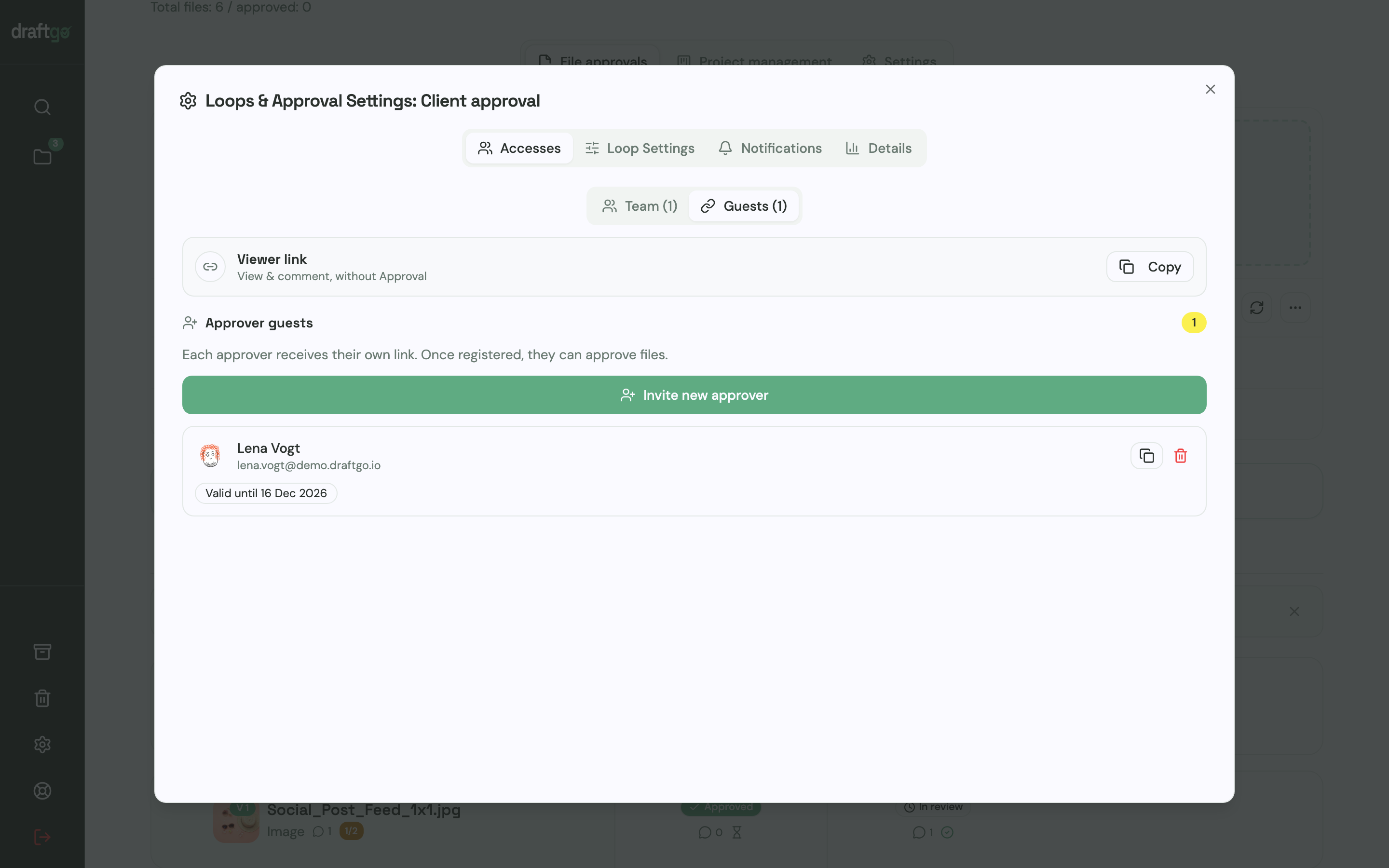
- Add the accountable person as an approver guest with name and email address: they get a personal link and may approve. Consulted people get the loop’s shared viewer link to comment without approving, and informed people can use it to follow along. Nobody needs an account.
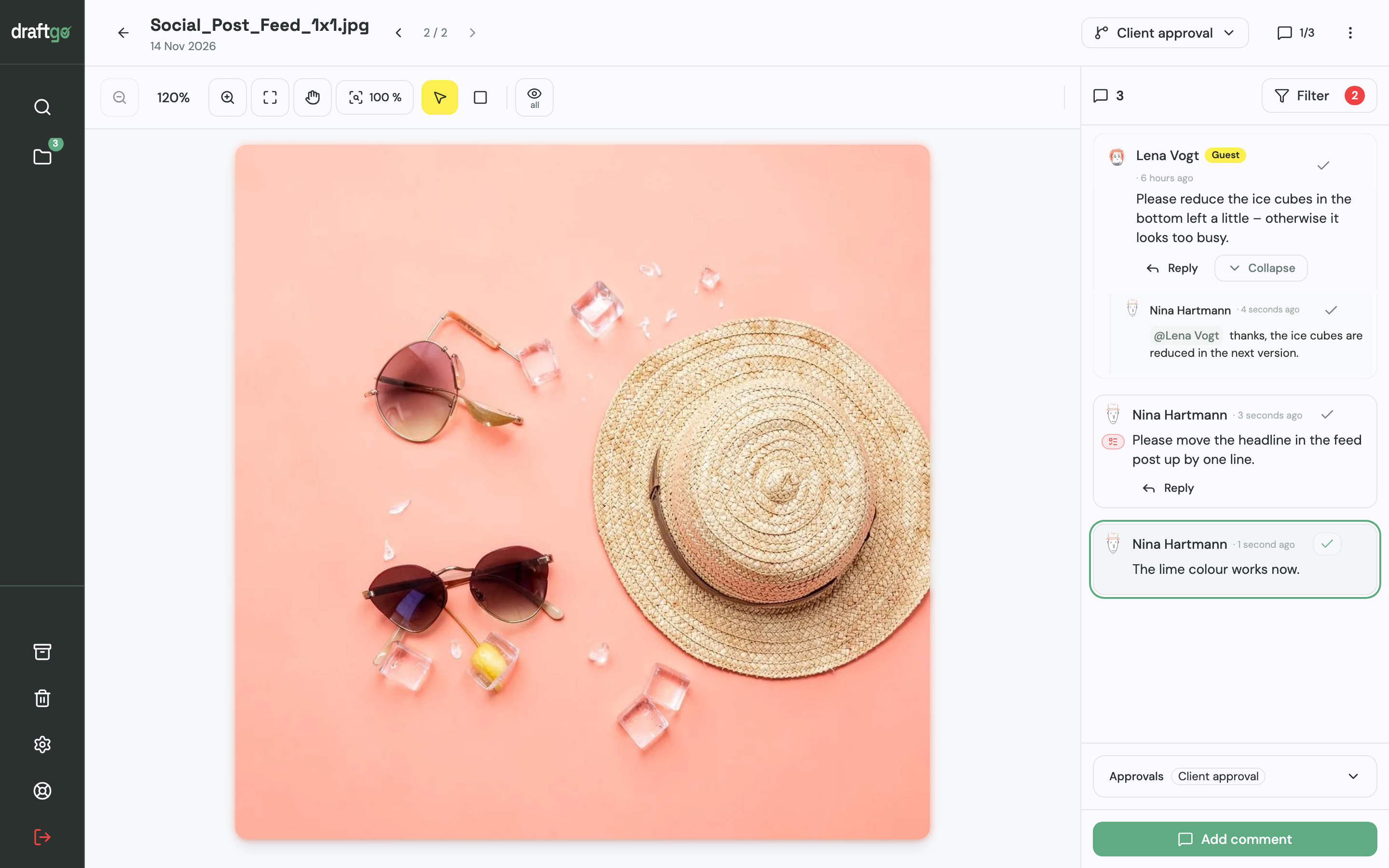
- Everyone comments at the exact spot: on the image, the PDF page or a timecode in the video. You reply in the thread, bring someone in with an @-mention and mark a comment as resolved.
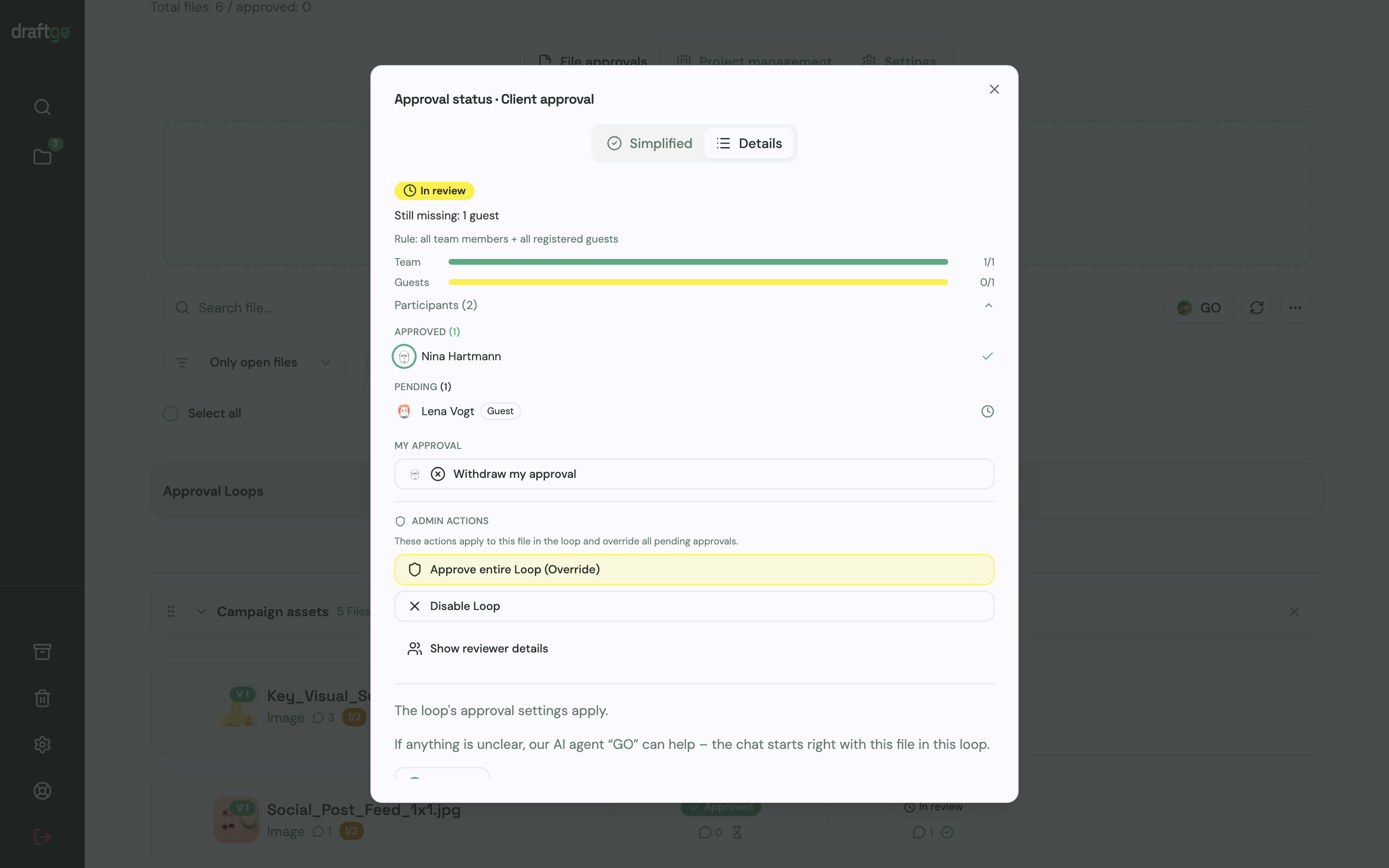
- The approval status shows who has approved and who is still pending. Pending approvals also appear in the optional daily or weekly summary email, and the activity log records every approval, comment and version with person and time, ready to export as CSV, JSON or PDF.
- Before you send the managing director a status update, ask our AI agent “GO” what is still open on a loop or file.
Loops carry no due date, so put the feedback date from your plan next to the link when you share it.
Peter Schönherr, founder and managing director of Loloson Media in Portugal, produces and edits image and video content, mainly e-commerce assets for an international hair care manufacturer. He describes what changed for his client: “With 70, 80 or more open assets, our client can now review flexibly in between other tasks instead of having to clear time for a whole mountain of them.” The page draftgo for agencies shows how agencies organise client feedback with draftgo.
FAQ
What is the difference between stakeholder communication and stakeholder management?
Stakeholder management covers identifying stakeholders, judging their influence and deciding how to involve them. Stakeholder communication is the part that runs through the project: who receives what, through which channel and by when.
How do you handle conflicting feedback from two stakeholders?
Collect all feedback in one place so that contradictions show up before the next version. Then let the person accountable for that stage decide, or settle it in a short call with both reviewers.
Should you limit the number of feedback rounds?
Yes. A fixed number of rounds in your proposal gives both sides a schedule they agreed to and moves the important feedback to the start. Extra rounds can then be offered as additional work.
How do you get clients to give feedback on time?
Make it easy for them: one link, no account and comments directly on the draft. Send the feedback date with the draft itself, and say at the kick-off what happens to feedback that arrives later.
Conclusion
Stakeholder communication works when every person knows their role, their feedback date and the one place where comments go. For your next project, fill in a one-page communication plan at the kick-off that names the person who approves each stage, and send it to the client with the brief.
Try it free – draftgo is free for 14 days, no credit card needed.
Written by
Emilia
Content Producer
Ready to streamline your approval processes?
Get started with draftgo today and see how easy professional collaboration can be.