
The kick-off for a regional charity’s new website goes well. Everyone agrees the site should “feel warmer”, and the studio starts on the designs the next morning. Three weeks later the fundraising lead asks where the donation form has gone, the chief executive wants the home page to recruit volunteers first, and the trustee who signs off the budget has never seen the plan. All three sat in the same meeting and left with a different project in mind. Stakeholder alignment closes that gap before the first layout exists.
What is stakeholder alignment?
Stakeholder alignment means that everyone with a say in a project agrees on three things before production starts: the goal, the scope and who decides what. People can still disagree about a headline or a colour. Their opinion then goes to the person who owns that decision, and the agreement sits in writing where the whole team can find it.
Alignment is the agreement you reach at the start, and stakeholder communication keeps everyone informed through the review rounds that follow. Reviewer types and a communication plan are covered in our guide to stakeholder communication in creative reviews; this post stays with the step before it.
Why stakeholder alignment breaks down in creative projects
Alignment breaks down when a kick-off ends with nods instead of written decisions. People then fill the gaps with their own picture of the project, and the differences can stay hidden until there is a draft to react to.
- The goal is a feeling. “Warmer” or “more premium” lets each stakeholder judge the draft against their own taste.
- Scope lives in the proposal’s small print. Nobody has said out loud how many pages, formats or rounds the budget covers.
- Decision rights are assumed. The senior person in the room is treated as the decider on everything, including details they never wanted to own.
- The person who can stop the project is missing. A trustee, a finance director or a legal adviser sees the work for the first time when it is nearly finished.
- Consensus replaces a decision. When everyone has to agree, the loudest or latest comment can end up deciding.
How to align stakeholders in 5 steps
You align stakeholders by mapping who has a say, agreeing one goal, fixing the scope, assigning decision rights and getting that agreement approved in writing. The five steps can fit into one kick-off meeting and a one-page document, for a freelancer with one client contact as well as for an agency facing six people on the client side.
1. Map who can change or stop the project
List everyone who sets requirements, signs off money or is affected by the result, on the client side and in your own team. Then judge each person on three of the criteria the Association for Project Management lists for this analysis: their power to change how things are done, the interest they are likely to show and how likely they are to support the project (APM, Stakeholder engagement). Bring in the people with high power and little interest at this stage, so that the first thing they see is the plan and not a finished draft.
2. Agree one goal and how you will judge it
Write the goal as one sentence that a draft can be checked against: who the work is for, what they should do and how you will know it worked. “Get 200 new volunteer sign-ups through the website in the first three months” gives every reviewer the same yardstick, while “feel warmer” gives each of them a different one. If two stakeholders want different goals, settle it here, before any layout is built around one of them.
3. Fix the scope: what is in, what is out
Scope answers three questions in plain words: which deliverables, how many rounds of changes and what happens to new requests. Name what is out as clearly as what is in, such as “no new photo shoot” or “English version not included”. A new request then becomes a change with its own quote, and the approved list shows whether it was promised. The sections for deliverables, timeline and approval in our creative brief template can carry this part.
Try it yourself: In the demo you work in a real draftgo workspace with sample data.
4. Assign decision rights for each decision
Different decisions can have different owners. The finance director may own the figures, the head of marketing the design and copy, and the chief executive only the final file. Among its five roles, Bain & Company’s RAPID model separates the person who recommends a decision, the people who give input and the person who decides (Bain & Company, 2023). For a creative project, a simplified table is enough:
| Decision | Prepares a proposal | Gives input | Decides |
|---|---|---|---|
| Goal and how success is judged | project lead | client team | head of marketing |
| Scope, budget and number of rounds | project lead | finance | budget holder |
| Creative direction | design lead | brand, sales | head of marketing |
| Facts and figures | copywriter | product, finance | finance director |
| Legal lines and disclaimers | copywriter | head of marketing | legal adviser |
| Final file before print or launch | project lead | everyone above | one named approver |
Put one name in each “Decides” cell. If two people claim the same cell, agree before production which of them decides.
5. Get the agreement approved before production
Put the goal, the scope and the decision table on one page, the alignment brief, and send it to the deciders for approval. Their written “yes” is what you point back to when an agreed point comes up again in a later round. The guide to client onboarding for agencies shows where this page fits into the first weeks with a new client.
Alignment mistakes and what to do instead
Each of the mistakes below can cost an extra round later in the project. Next to it is the habit that prevents it.
| Mistake | What to do instead |
|---|---|
| Treating a friendly kick-off as agreement | End the kick-off with a one-page alignment brief and have it approved |
| A goal nobody can check a draft against | One sentence with an audience, an action and a measure |
| Scope left to the proposal’s small print | A list of what is in, what is out and how many rounds |
| Everyone decides everything | One decider per decision, everyone else gives input |
| Reopening agreed points in a late round | Point back to the approved brief and treat new wishes as change requests |
If conflicting comments still arrive in a review round, our guide to feedback management for creative projects shows how to settle them.
Practical example: an annual report with three deciders
Take a three-person design studio that produces the annual report of a housing association. On the client side, the head of communications, the finance director and the chief executive want a say, and the board receives the finished report.
Before any layout, the studio writes a one-page alignment brief. The report is meant for tenants and local councillors and goes out as a PDF on the association’s website, with a short print run for the annual meeting. It has 24 pages, uses photos from the existing library and includes two rounds of changes and a final check, but no new shoot. The head of communications decides on design and copy, the finance director on the figures and the financial pages, and the chief executive approves the final file.
The finance director’s first comment on the brief changes the plan, because the full financial statements have to go into the report. The studio and the head of communications agree on 28 pages, and the deciders approve the revised brief before anyone opens a layout file. In round two, the chief executive suggests a new photo shoot. The studio points to the approved scope, and the shoot becomes a separate quote for next year’s report instead of a delay to this one.
How it works in draftgo
In draftgo, the alignment brief gets its own approval before production starts, and the design reviews follow in the same project.
- Upload the brief. Add the alignment brief to the project as a PDF. A Word file is converted to PDF on upload.
- Create an alignment loop first. Set up a loop called “Alignment” ahead of “Internal review” and “Client approval”. Set its rule to all approvers, so the brief counts as approved only once every decider has signed off. A loop can also require a set number or any one approver, separately for your team and for guests. A project holds 1 loop on Free, 3 on Freelancer and as many as you need on Agency and Team, so this setup fits from Freelancer up (plans and limits).
- Give each role the right link. The deciders get personal approver links with name and email address and can approve. People who give input get the shared viewer link and comment without approving. Nobody needs an account.
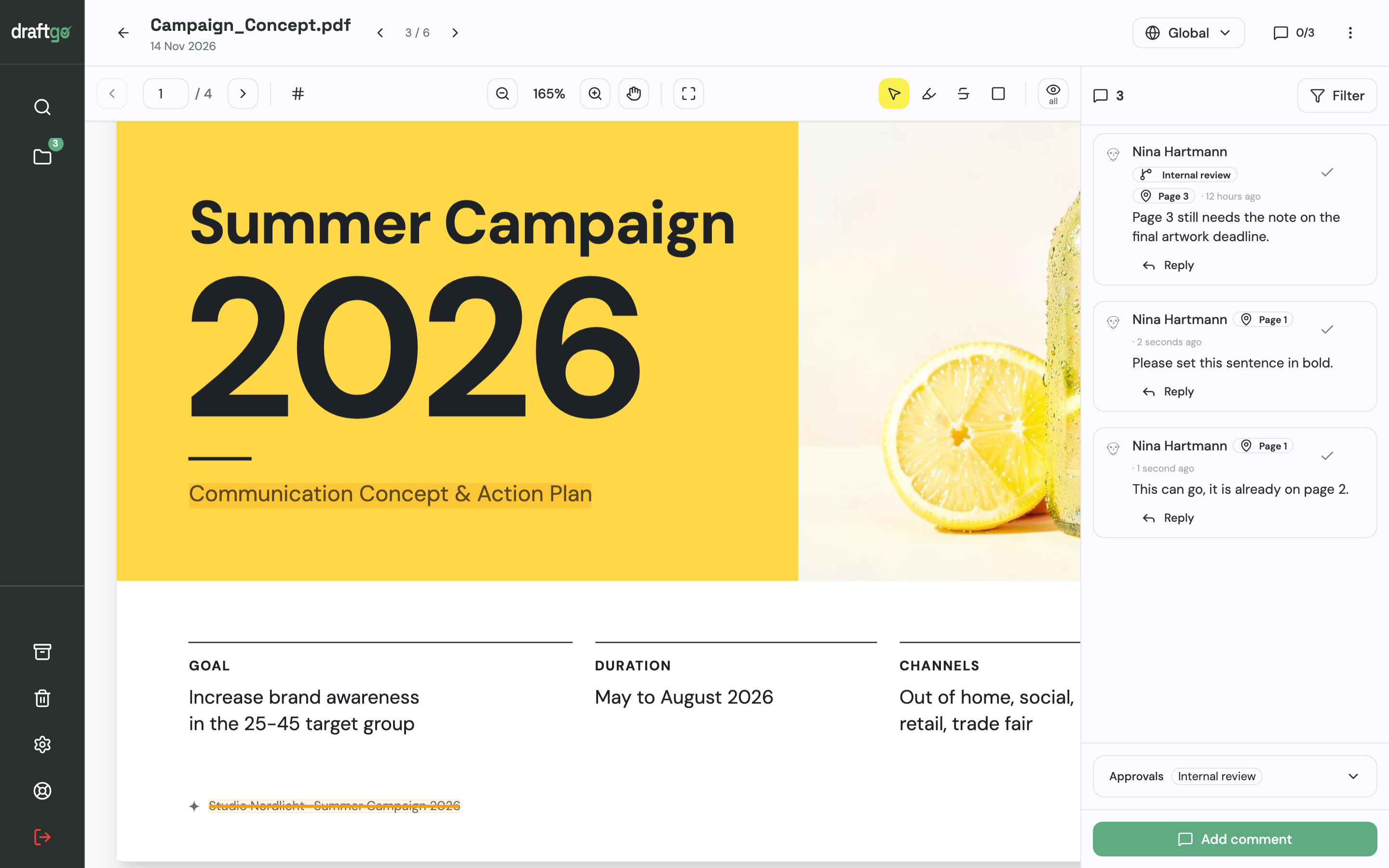
- Comment on the exact line. Reviewers highlight or strike through text in the PDF, or place a point or a rectangle, and each comment carries its page number.
- Keep the brief current. If the scope changes, upload the revised brief as a new version of the same file. The earlier version stays available, and the new version starts the approvals again, so the deciders sign off on the changed scope.
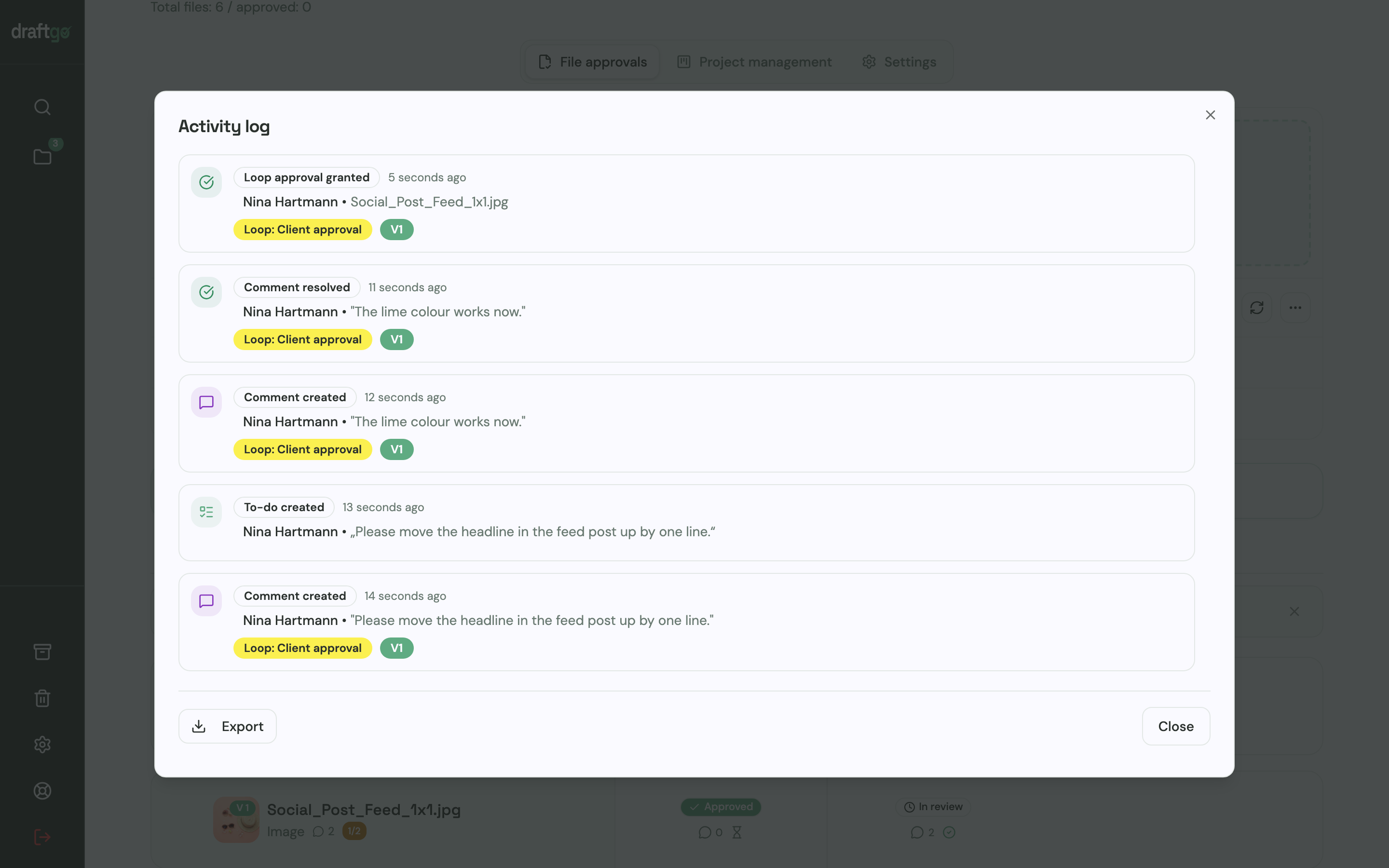
- Keep the record. The activity log records every approval, comment and version with person and time, and you can export it as CSV, JSON or PDF.
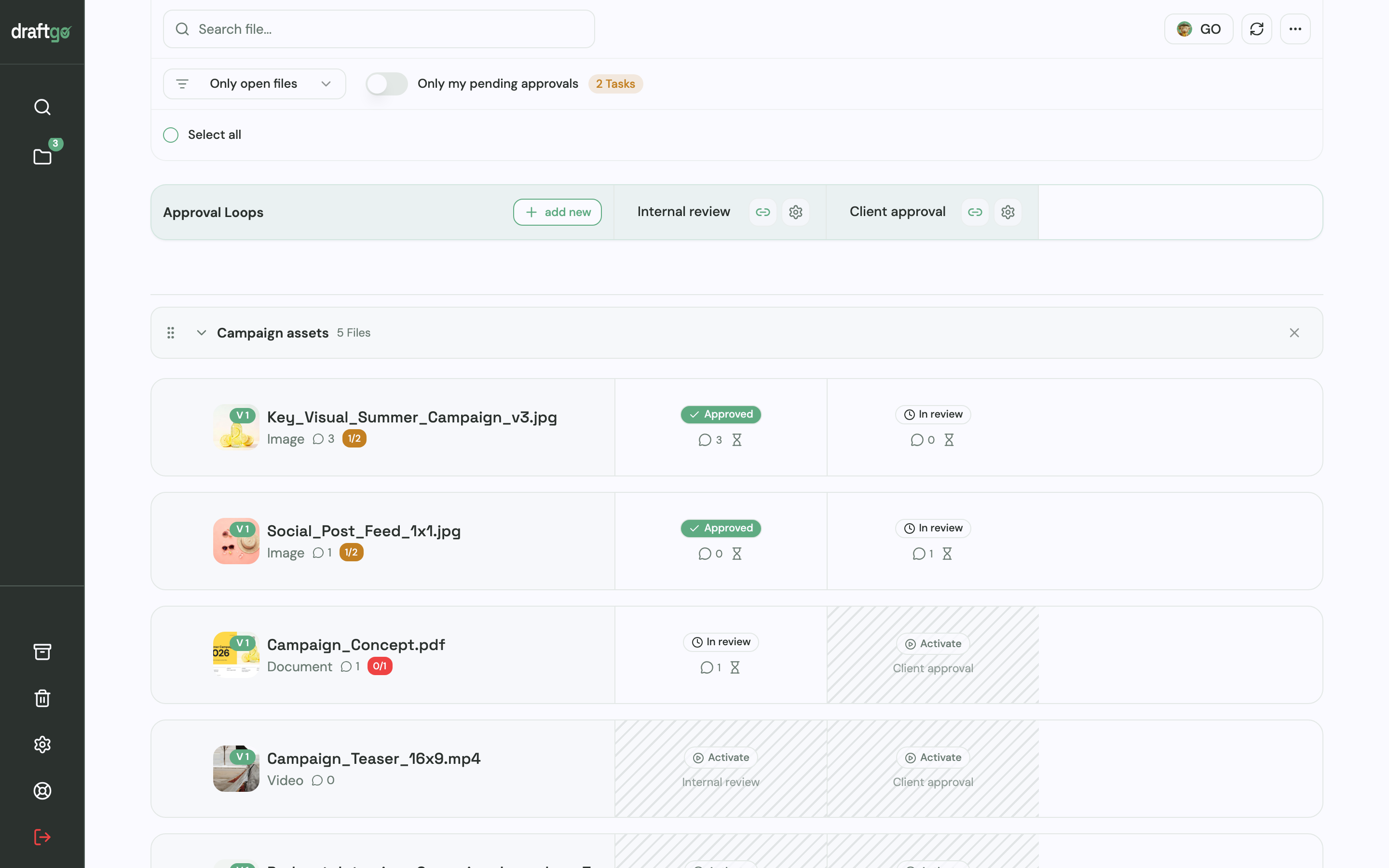
- Move into production. Upload the first designs and activate them in “Internal review”, later in “Client approval”. The project page shows each file’s status per loop.
If a decider has not yet approved the revised brief, ask our AI agent “GO” what is still open on the “Alignment” loop. The page draftgo for agencies shows how agencies collect client comments and approvals in one place, without an account for the client.
FAQ
What is the difference between stakeholder alignment and stakeholder communication?
Stakeholder alignment is the agreement on goal, scope and decision rights, reached before production and revisited when something major changes. Stakeholder communication runs through every review round: who receives which draft, through which channel and by when. The approved alignment brief gives that communication a fixed reference.
Does stakeholder alignment mean everyone has to agree?
No. Alignment means that the people involved accept the goal, the scope and who decides each question, even if they would have chosen a different design. Many people can give input, but each decision has one owner.
When should you align stakeholders in a creative project?
Align them once the creative brief exists and before the first draft. Check the alignment again whenever a new stakeholder joins, the budget changes or the goal shifts. A short check at the start of each new phase helps on longer projects.
What do you do when a stakeholder joins after alignment?
Send them the approved alignment brief and agree their role in the decision table before they comment on a draft. If their wishes overturn earlier decisions, treat them as a change request and discuss time and budget openly with the person who owns that decision.
Conclusion
Stakeholder alignment comes down to one goal you can check a draft against, a scope that says what is out, and one decider for each decision. Before your next project starts, write these three points on one page, have the deciders approve it and point back to it in every review round.
Try it free – draftgo is free for 14 days, no credit card needed.
Written by
Emilia
Content Producer
Ready to streamline your approval processes?
Get started with draftgo today and see how easy professional collaboration can be.