
You sent the final files for a restaurant group’s menu redesign at the start of the month, together with an invoice due in 30 days. Day 30 came and went. Your short check-in on day 33 got an automatic reply from someone on leave, and the owner who briefed you now answers messages about the next job but not about the invoice.
What moves an invoice like this is a sequence of steps that gets a little firmer each time and leaves a written trail.
This article is general information, not legal advice.
What to do when a client is not paying an invoice
When a client is not paying an invoice, first make sure it reached the person who pays it, then remind them in writing, call to clear up whatever is holding the payment back and send a formal demand with a new deadline. If that deadline passes, a final notice announces the next step: a court claim or a collection agency. Keep every step in writing, so you can show later what you asked for and when.
Why unpaid invoices drag on
Unpaid invoices drag on when the client has a reason to wait or no clear reason to pay now. You can fix these causes on your side:
- No payment terms in writing. Without an agreed due date, the client picks its own.
- The invoice went to the wrong person. The marketing lead who approved the work is not always the one who releases payments, and finance may need a purchase order number. When you agree who decides what on the client side before work starts, add the person who releases payments.
- A silent dispute about the work. A client who thinks something is missing may hold the invoice back without saying so.
- Reminders that ask for nothing. “Just checking in” names no amount, no date and no next step.
6 steps from reminder to court claim
Six steps take you from the first reminder to a court claim. Steps 5 and 6 are only for a client who still has not paid after the formal demand.
1. Check the invoice and who receives it
Before you chase anyone, check the invoice number, date, amount, due date, bank details and any purchase order number the client gave you. Then ask your contact who handles payments and send the invoice there too. Next time, collect the accounts contact and payment terms during client onboarding, before the first file goes out.
2. Send a friendly reminder
A few days after the due date, send a short, friendly email with the invoice number, the original due date and the invoice attached again.
"“Hi Sam, a quick note that invoice 2026-118 for the menu redesign was due on 1 December. I’ve attached it again in case it got lost. Could you let me know when it’s scheduled for payment?”
3. Call and clear up any dispute
If the reminder gets no answer, call. On the phone you find out whether the client forgot, is short of cash or has a complaint about the work. If it is a complaint, ask what exactly is missing and compare it with the creative brief, the quote and the version they approved. Afterwards, confirm by email what you agreed, for example a payment date.
4. Send a formal demand with a new deadline
Mark the formal demand clearly as overdue and give a new, specific date, for example 14 days ahead. State the amount, the original due date and anything you are entitled to add, such as interest on a late business invoice in the UK. Keep the tone factual: you state what is owed and by when.
5. Send a final notice
The final notice says what happens if the money has not arrived by the date it names: a court claim or a collection agency. Only announce a step you are ready to take. In California, for example, the courts want you to ask the other side for the money before you start a small claims case, and their guidance says you can ask in person, by letter or by email.
Try it yourself: In the demo you work in a real draftgo workspace with sample data.
6. File a court claim or hand the debt over
If the deadline passes, you can claim the money in court yourself or pass the debt to a collection agency. GOV.UK explains how to make a court claim for money at a county court, online or by post, and says the court may organise free mediation depending on the amount you claim. If you get no response or the client refuses to pay, you can ask the court to order them to pay. Scotland and Northern Ireland have a different process.
Late payment rules in the UK and the US
What you can add to a late invoice and how you claim it depends on where you and your client are.
United Kingdom
According to GOV.UK, you can claim interest and debt recovery costs when another business pays you late. If you did not agree a payment date, the payment is late 30 days after the client receives the invoice or after you deliver the work, whichever is later.
GOV.UK gives statutory interest as 8% plus the Bank of England base rate for business-to-business transactions. You cannot claim it if your contract sets a different rate, and if you add interest, GOV.UK tells you to send a new invoice.
On top of interest, GOV.UK lists a fixed sum for debt recovery: £40 for a debt up to £999.99, £70 from £1,000 to £9,999.99 and £100 for £10,000 or more, charged once for each payment.
The rules come from the Late Payment of Commercial Debts (Interest) Act 1998. Section 2 applies the Act to a contract for the supply of goods or services where the purchaser and the supplier are each acting in the course of a business, other than an excepted contract such as a consumer credit agreement. legislation.gov.uk shows the section in force in England, Wales, Scotland and Northern Ireland.
United States
In the US, small claims limits and procedures depend on the state, and New York City adds rules for freelancers. Two examples:
- California: The California courts’ self-help guide says you can generally sue for up to $12,500 in small claims court, or up to $6,250 if you are a business. You can ask a lawyer for advice before you go, but you cannot have one with you in court.
- New York City: The city’s Department of Consumer and Worker Protection describes the Freelance Isn’t Free Act, which protects individuals hired as independent contractors. Contracts worth $800 or more, including agreements that total $800 in any 120-day period, must be in writing. You must be paid on or before the date in the contract or, without one, within 30 days after you complete the work. If a complaint to the department stays unresolved, you can sue the hiring party in court.
For other states, check your state court’s website.
Mistakes and better practice
| Mistake | What happens | Better practice |
|---|---|---|
| Payment terms agreed only on a call | The client pays when it suits them | Due date and late payment terms in the quote and on the invoice |
| Invoice sent only to the creative contact | It waits in an inbox that doesn’t pay bills | The accounts contact and any purchase order number asked for at kick-off |
| Reminder without amount or date | The client has nothing to act on | Invoice number, amount, due date and a new deadline |
| The whole fee invoiced at the end of a long job | One late payment holds back weeks of work | A deposit when the quote is accepted and a part payment at a milestone, written into the quote |
| Announcing a claim and never filing it | Later deadlines lose their weight | Only announcing steps you will take |
Practical example: six product videos and one late change
Take an eight-person video production company that makes six short product videos for a fitness equipment retailer. The retailer’s head of marketing decides on the videos and reviews them through her personal approver link, while two product managers comment through the shared viewer link. The invoice goes to the retailer’s accounts team.
Ten days after the due date, the accounts team answers the reminder: the payment waits until marketing confirms that all six videos are final. On the call from step 3, the head of marketing says the rowing machine video still shows last season’s price in its end card. The producer opens the project’s activity log with her: she approved version 2 of that video, and the price came up in a product manager’s comment a week later. The company offers the new end card as a small extra job, she confirms the six videos to accounts, and the invoice gets a payment date.
How it works in draftgo
draftgo records which version a client approved and when, so a conversation about an open invoice can start from what was approved. Invoicing and chasing payment stay in your accounting tool.
- Upload the work and set up a client loop. For the loop you decide whether all approvers, a set number or any one of them must approve, separately for your team and for guests.
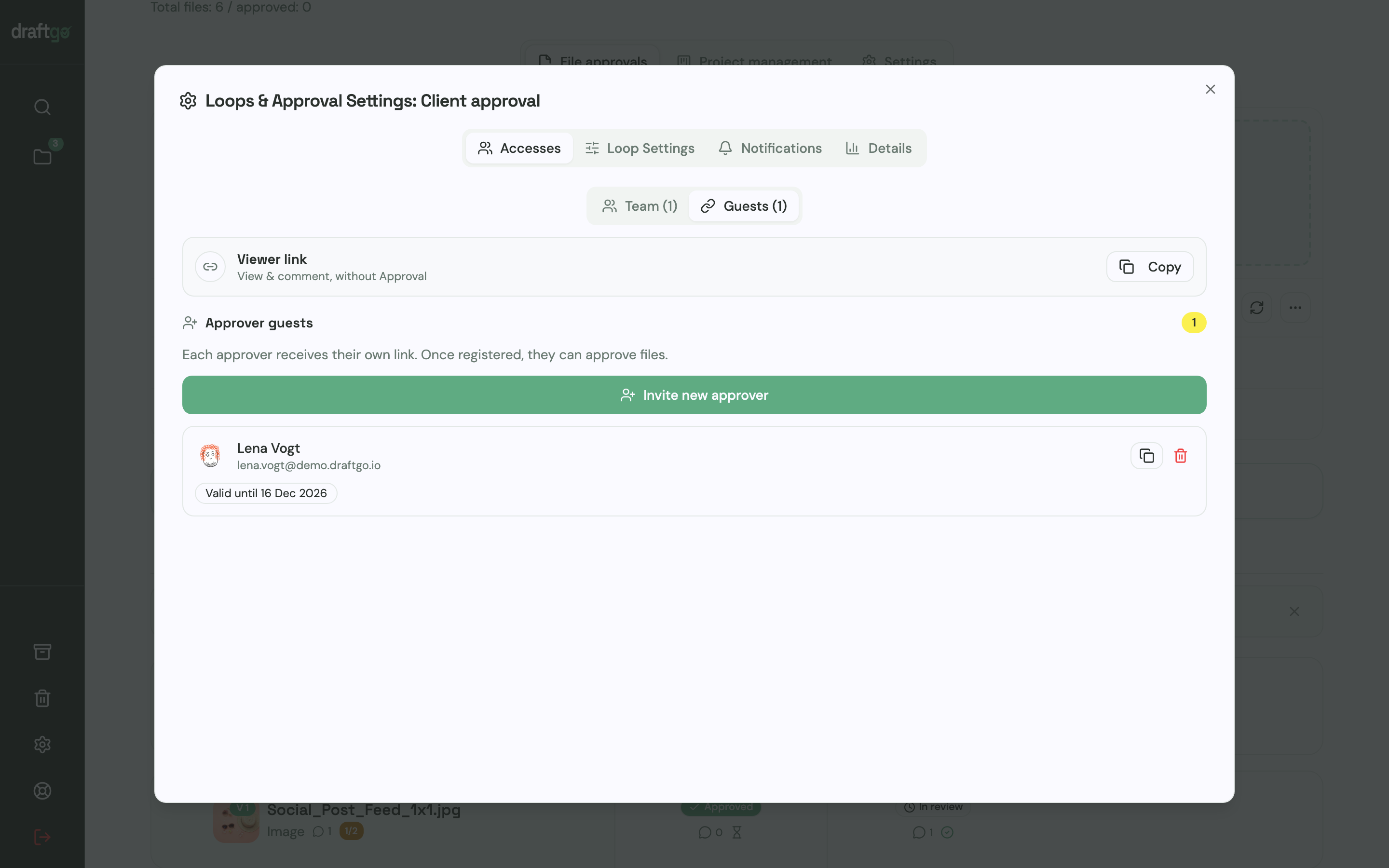
- Invite the client without an account. The person who decides gets a personal approver link with their name and email address. Everyone else who should comment gets the shared viewer link, which lets them comment but not approve.
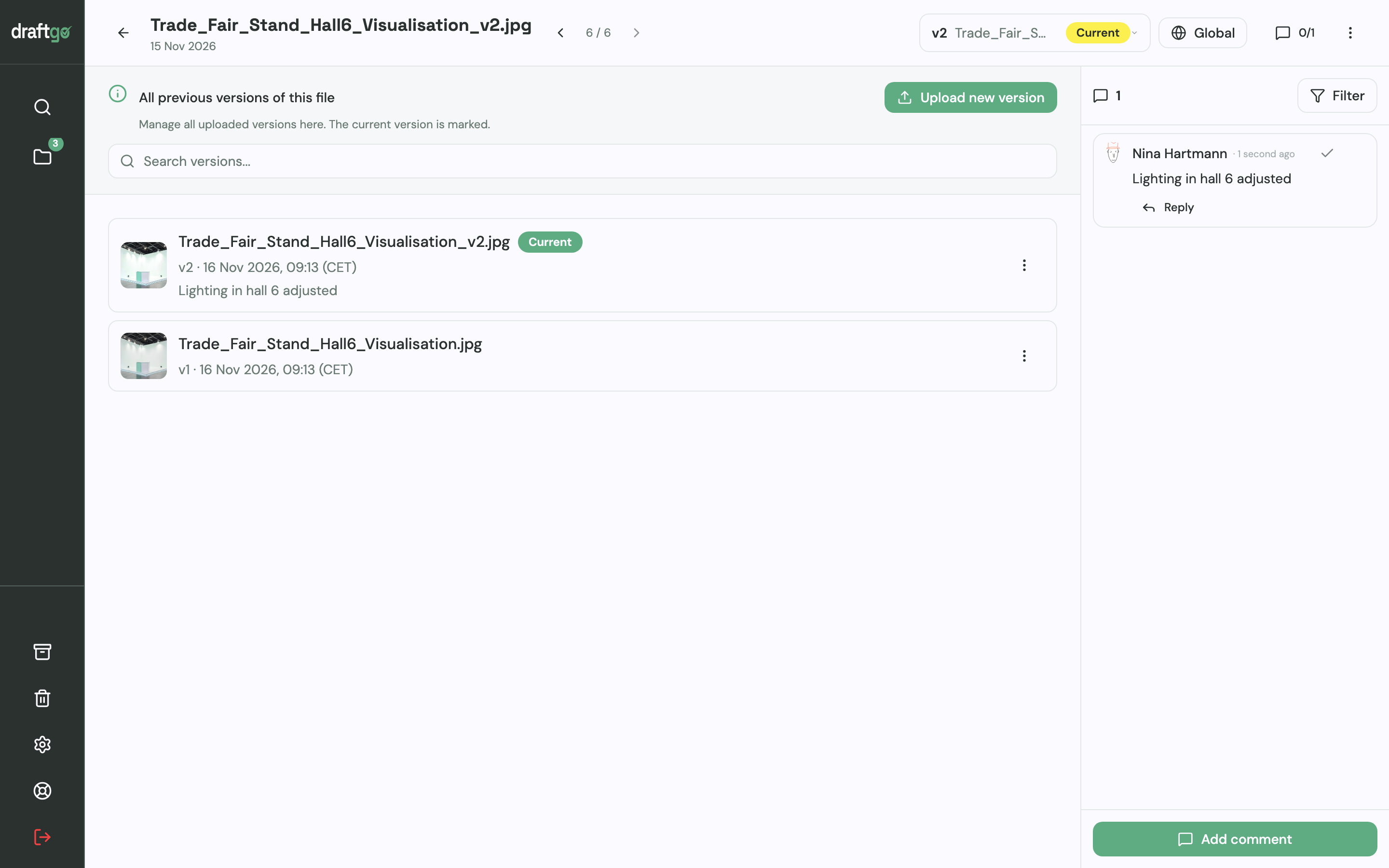
- Upload each correction as a new version. Earlier versions stay available, comments stay with their version and a new version starts the approvals again, so every approval belongs to exactly one version. A note on the version, such as “colour grade adjusted”, says what changed.
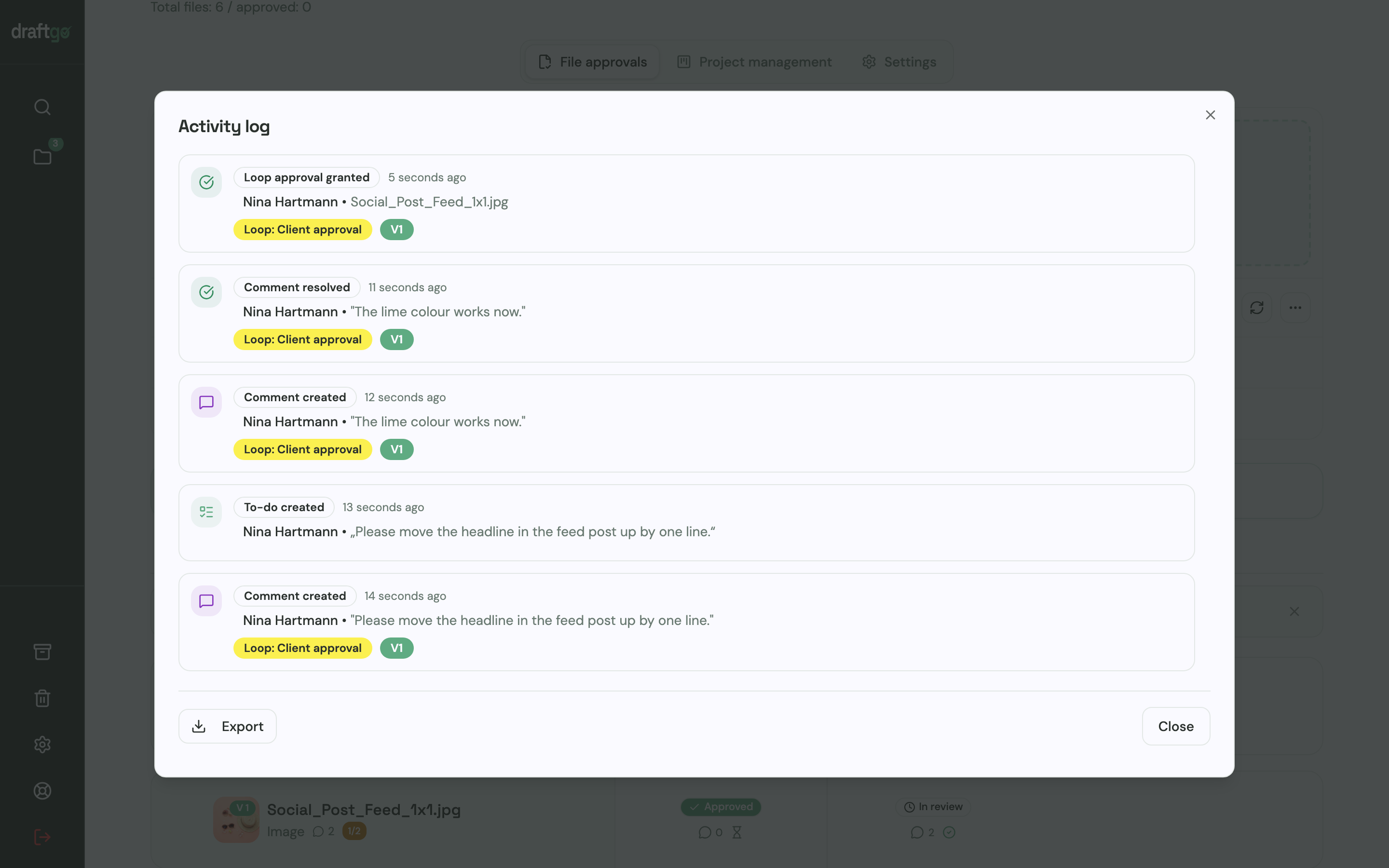
- Export the activity log. The log records approvals, comments, versions and downloads with person and time, and you export it as CSV, JSON or PDF. Our guide to the approval audit trail covers what such a record should contain and how long to keep it.
The page draftgo for freelancers shows the setup for client approvals.
FAQ
Can I charge interest on a late invoice?
In the UK, yes, on invoices to other businesses: statutory interest is 8% plus the Bank of England base rate unless your contract sets a different rate. For US clients, write any late fee or interest into the contract before work starts and check what your state allows.
Do I need a lawyer to claim an unpaid invoice?
Not necessarily. GOV.UK explains how to make a county court claim yourself online or by post and says you may need legal advice if your claim is complex. In California’s small claims court you cannot bring a lawyer, although you can get advice beforehand.
What if the client disputes only part of the invoice?
Ask the client to pay the part nobody disputes now and agree in writing which items are still open. Then settle those items separately, with the brief, the quote and the approved version in front of you. That way the undisputed amount does not wait for the disputed one.
What if the client says the work isn’t finished?
Ask what exactly is missing and compare it with the brief, the quote and the approved version. If something agreed is missing, deliver it and set a new payment date; if the request goes beyond the quote, offer it as a separate job.
Conclusion
If a client is not paying an invoice, work through the steps in order and put each one in writing: reminder, call, formal demand, final notice, claim. Write your reminder and demand templates today, and add payment terms, the accounts contact and the client’s approver to every quote.
Try it free – draftgo is free for 14 days, no credit card needed.
Written by
Emilia
Content Producer
Ready to streamline your approval processes?
Get started with draftgo today and see how easy professional collaboration can be.