
Medical affairs signed off the efficacy claim on page seven of the detail aid two weeks ago. Since then, legal has asked for the safety information to move to the front, the designer has rebuilt two spreads, and the PDF waiting for final approval is version five. The medical sign-off still sits in an email about version three, and the congress where the sales team will hand out the piece opens in nine days.
In pharma marketing, an approval only counts for the version the reviewer actually saw, and the rules of each market decide what may be said to whom.
This article is general information, not legal advice.
What is pharma marketing?
Pharma marketing is the promotion of medicines to the people who prescribe, supply or take them. It speaks to healthcare professionals and to patients, and the rules for each group differ from one market to the next.
The channels look familiar: detail aids, congress stands, websites for healthcare professionals, emails and social media. What changes is the work behind each piece: a claim needs a reference, and safety information has to sit where the reader sees it.
| Audience | Typical materials | What reviewers look at first |
|---|---|---|
| Healthcare professionals | Detail aids, congress stands, journal ads, HCP websites | Claims against the approved product information, references, prescribing information |
| Patients and the public | Disease awareness campaigns, patient leaflets, websites | Plain language, balance of benefit and risk, what the market allows |
Pharma marketing rules in the US and the UK
The FDA sets the frame in the US, the MHRA in the UK, where the industry adds its own code. Which rule applies to a product, an audience and a channel is for your regulatory team to decide.
United States: the FDA’s Office of Prescription Drug Promotion
The FDA’s Office of Prescription Drug Promotion (OPDP) works to help ensure that prescription drug promotion is truthful, balanced and accurately communicated. Its reviewers check prescription drug advertising and promotional labelling for false or misleading information, give pharmaceutical sponsors written comments on proposed promotional communications, review complaints and initiate compliance letters (FDA, Office of Prescription Drug Promotion, content current as of 9 September 2025).
The regulation for prescription drug ads is 21 CFR 202.1. Apart from exempt cases such as reminder ads, every ad must present a true statement in brief summary of side effects, contraindications and effectiveness. Broadcast ads must give the major side effects and contraindications in the audio or the audio and visual parts, and a TV ad presented directly to consumers must give them in audio and text at the same time. An ad is also false or misleading if it suggests, beyond what the labelling approves or permits, that the drug is better, safer or useful in a broader range of conditions or patients than substantial evidence or substantial clinical experience has shown (21 CFR 202.1, CFR edition of 1 April 2025).
United Kingdom: MHRA guidance and the ABPI Code
The MHRA’s guidance for advertisers says that prescription-only medicines may not be advertised to the general public in the UK, while companies may promote them to healthcare professionals and others who can prescribe or supply them. An advert to prescribers and suppliers has to give, among other details, the product name, its active ingredients, a summary of what the SPC (summary of product characteristics) says on adverse reactions, dosage and method of use, precautions and contraindications, the licence number and the cost. For a newly licensed or reclassified product, the MHRA may ask to see the advertising before it is published (MHRA, Advertise your medicines, updated 11 April 2025). Its detailed guidance for the UK is the Blue Guide (MHRA, updated 28 March 2025).
The industry’s own rules sit in the ABPI Code of Practice, which the Prescription Medicines Code of Practice Authority (PMCPA) administers independently of the ABPI. The PMCPA runs the complaints procedure, gives advice and training on the Code and scrutinises samples of advertising (PMCPA, About us).
Clause 8 of the 2024 Code sets the last step. Promotional material may only be issued once one person has certified its final form on behalf of the company, with no changes after that. This person is a registered medical practitioner or a pharmacist registered in the UK (a UK-registered dentist for dental-only products) and must not be the one who developed the material. The certificate states that the signatory has examined the final form and believes it follows the advertising regulations and the Code, is not inconsistent with the marketing authorisation and the SPC, and presents the facts about the medicine fairly and truthfully. Material still in use must be recertified at intervals of no more than two years (PMCPA, ABPI Code of Practice 2024, clause 8).
Try it yourself: In the demo you work in a real draftgo workspace with sample data.
Who reviews pharma marketing material
MLR review, short for medical, legal and regulatory review, is the term for a review in which these three functions check promotional material before it is used. The table shows roles that can take part and what each one checks.
| Role | What they check | The question they ask |
|---|---|---|
| Marketing or brand team | Message, brand, format | Does this say what the campaign set out to say? |
| Medical affairs | Accuracy, claims, references | Does the cited study support this claim for this patient group? |
| Legal | Wording, comparisons, required statements | Could a reader take this as a promise we can’t back? |
| Regulatory affairs | Fit with the approved product information | Is this consistent with the label or the SPC in this market? |
| Final approver or signatory | The final form as a whole | Is this exactly the version that will go out? |
A review can run in this order:
- Marketing drafts the piece and links every claim to its reference.
- An internal review settles message and layout before the experts spend time on it.
- Medical, legal and regulatory review the same version and comment on the material itself, as in any content review.
- Marketing uploads a corrected version, which the reviewers check again.
- The final approver approves the final form, and nothing changes after that.
Common review mistakes and what to do instead
Each of these mistakes happens in the process around the review, and a fixed habit in the team can prevent it.
| Mistake | What to do instead |
|---|---|
| Medical approves version 3, legal approves version 4 | Keep one file with its versions; a new version restarts every approval |
| A claim goes into review without its reference | Attach the study page to the claim before the first reviewer opens the file |
| A date changes after the final approval | Treat any change after approval as a new version for review |
| Feedback arrives by email, phone and on printouts | Collect every comment on the material, at the spot it refers to |
| The banner resize cuts the safety information | Review each format as a file of its own |
Clear document version control deals with the first and third rows. What an approval record should hold so that it answers questions months later is covered in the guide to the approval audit trail.
Practical example: a dermatology launch with two loops
Take an eighteen-person marketing team at a maker of prescription dermatology products. It is preparing material on a new prescription cream for UK dermatologists: a twelve-page detail aid as a PDF, a congress banner and a 45-second video for the company’s HCP website.
The brand manager sets up an internal loop, “Marketing review”, and a second loop, “Medical, legal, regulatory”, where all approvers must approve. Free holds one loop per project, Freelancer three, Agency and Team unlimited, so this setup needs a paid plan. The reviewers from medical affairs, legal and regulatory each get a personal approver link and review without an account. A colleague from market access, who should only comment, gets the shared viewer link.
The medical reviewer highlights the efficacy claim on page six and asks for the source, and the designer answers in the thread with the study page attached. Legal strikes through a sentence that reads like a comparison, and regulatory comments at 0:31 of the video, where the safety information leaves the screen too early. The designer uploads version 2 with the note “Claim p. 6 reworded, reference 3 added, safety text held longer”, and the approvals start again.
After a second round, version 3 gets all three approvals. The medical signatory then certifies the final form in the company’s own certification process, and the brand manager exports the activity log for the job file.
How it works in draftgo
In draftgo, each review stage becomes a loop and every comment sits on the file it refers to. The page on draftgo for legal and compliance teams describes this use.
Put the files into review
You upload PDFs, images, videos and audio files to a project; Word files become PDFs on upload. Then you select the files and activate them in the loop where the review starts. For each loop a rule decides whether all approvers, a set number or any one of them must approve, separately for your team and for guests.
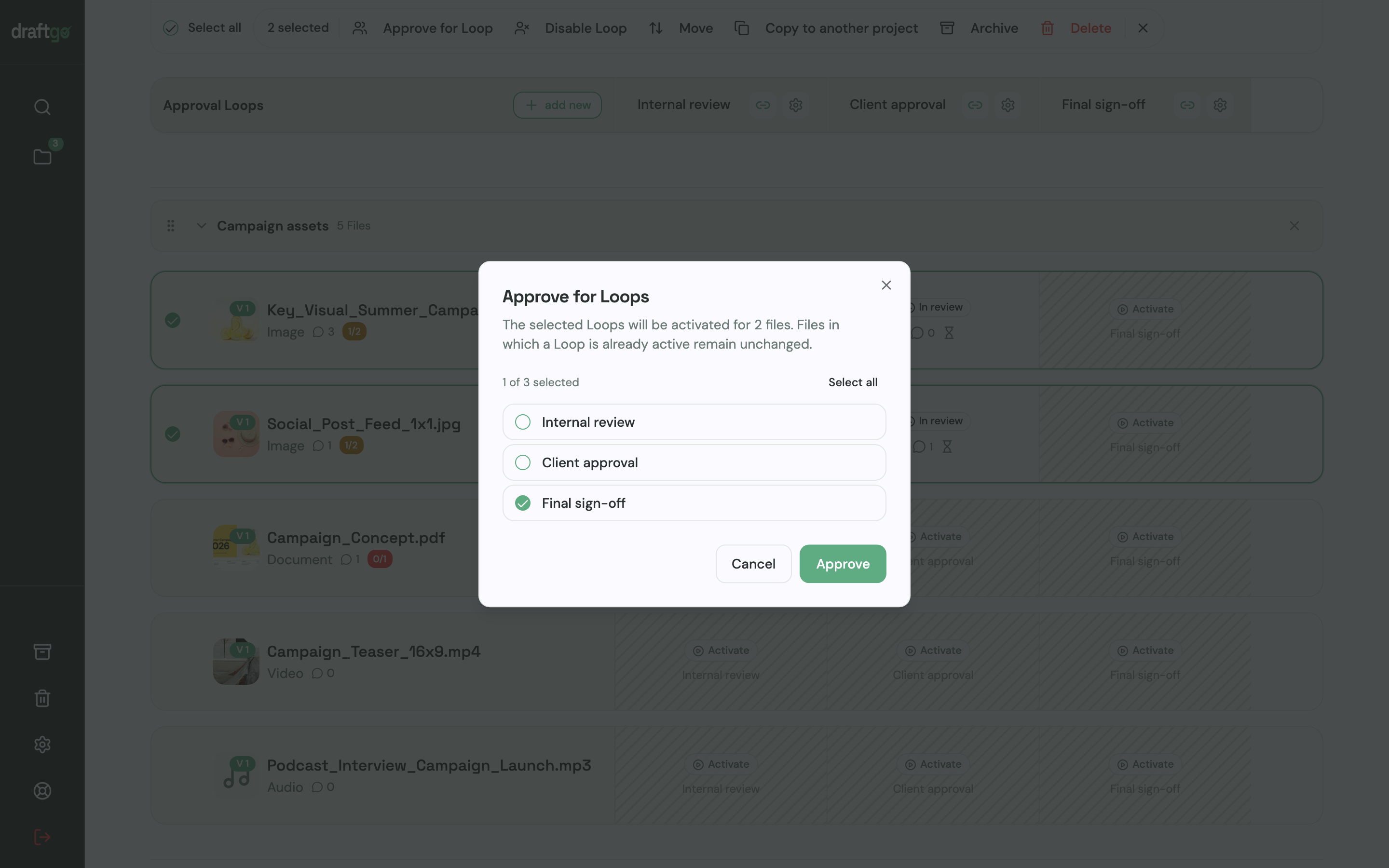
Once the internal loop has approved a file, a person activates it in the next loop.
Review claims on the page
Reviewers highlight or strike through text in a PDF, place a pin on an image or comment at a point in a video. They reply in the thread, mention colleagues with @ and attach files to a comment.
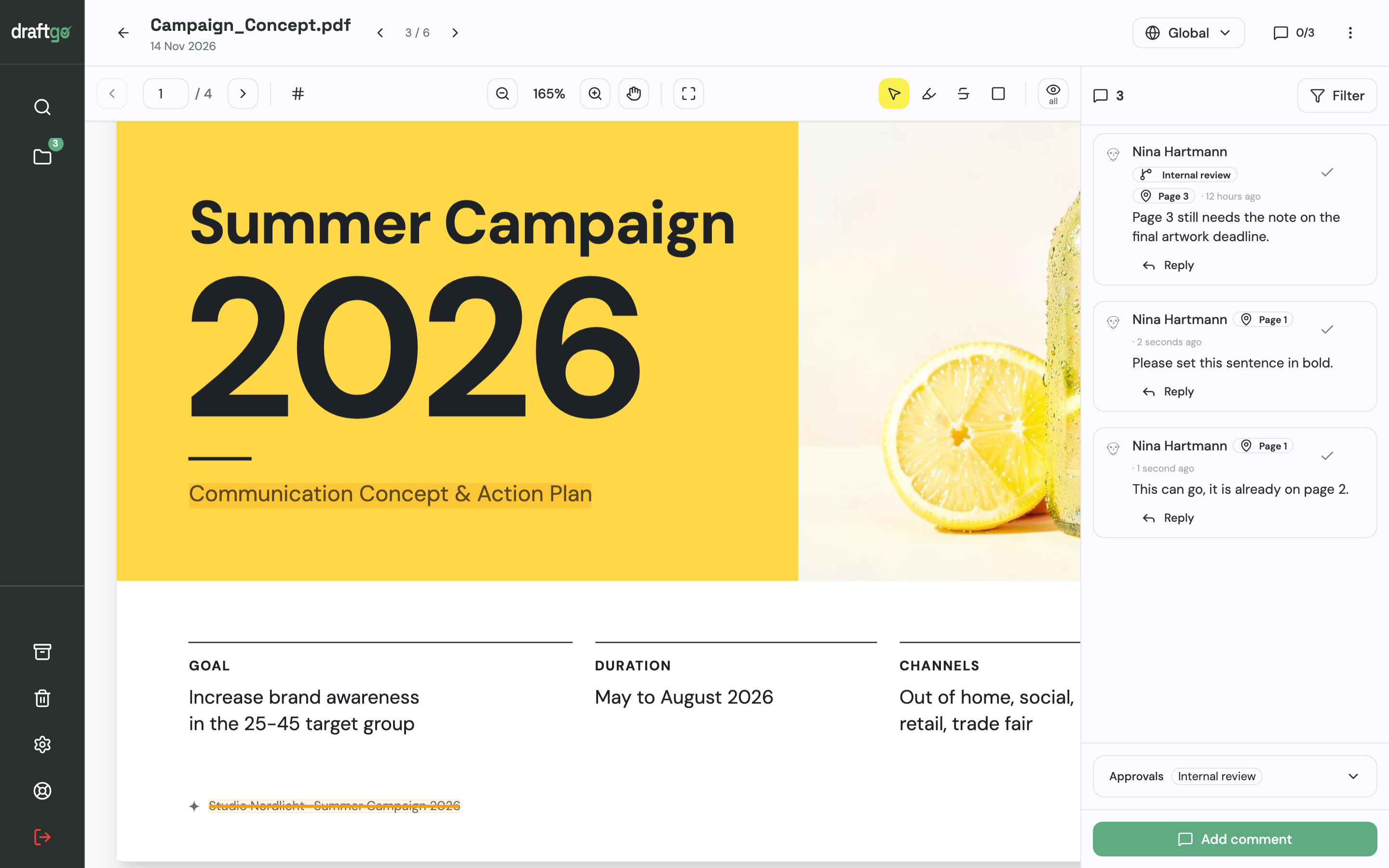
Before the PDF goes to medical, you can start the AI review on it (its pages come with the plans from Freelancer on). Its findings, such as a typo, cut-off text or very small type, appear as comments from our AI agent “GO”. Whether a claim is allowed stays with your medical and legal reviewers.
Keep every correction as a version
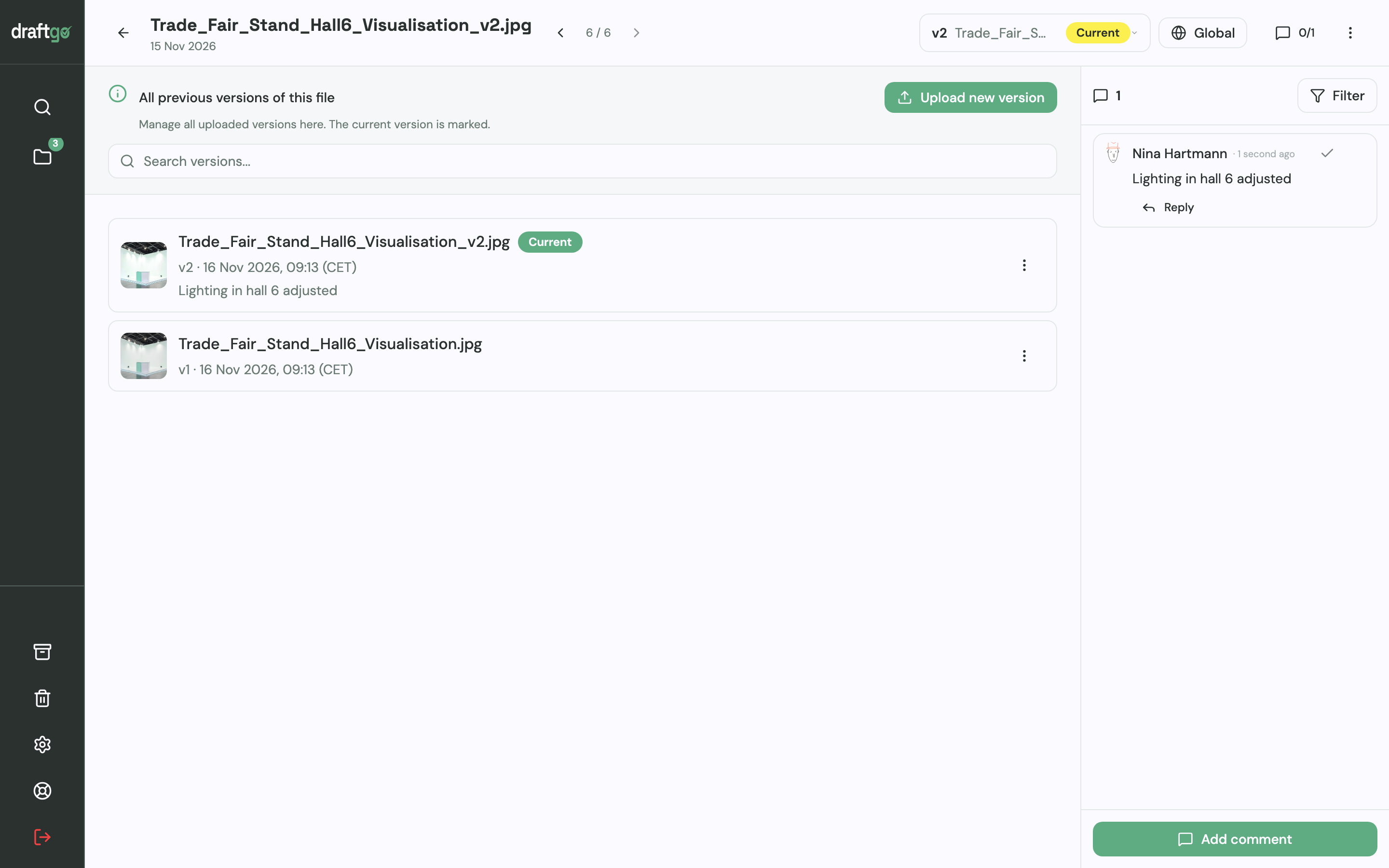
When the designer fixes a claim, the new PDF goes onto the same file as version 2, with a note saying what changed. Version 1 keeps its comments and stays available, and version 2 starts the approvals over.
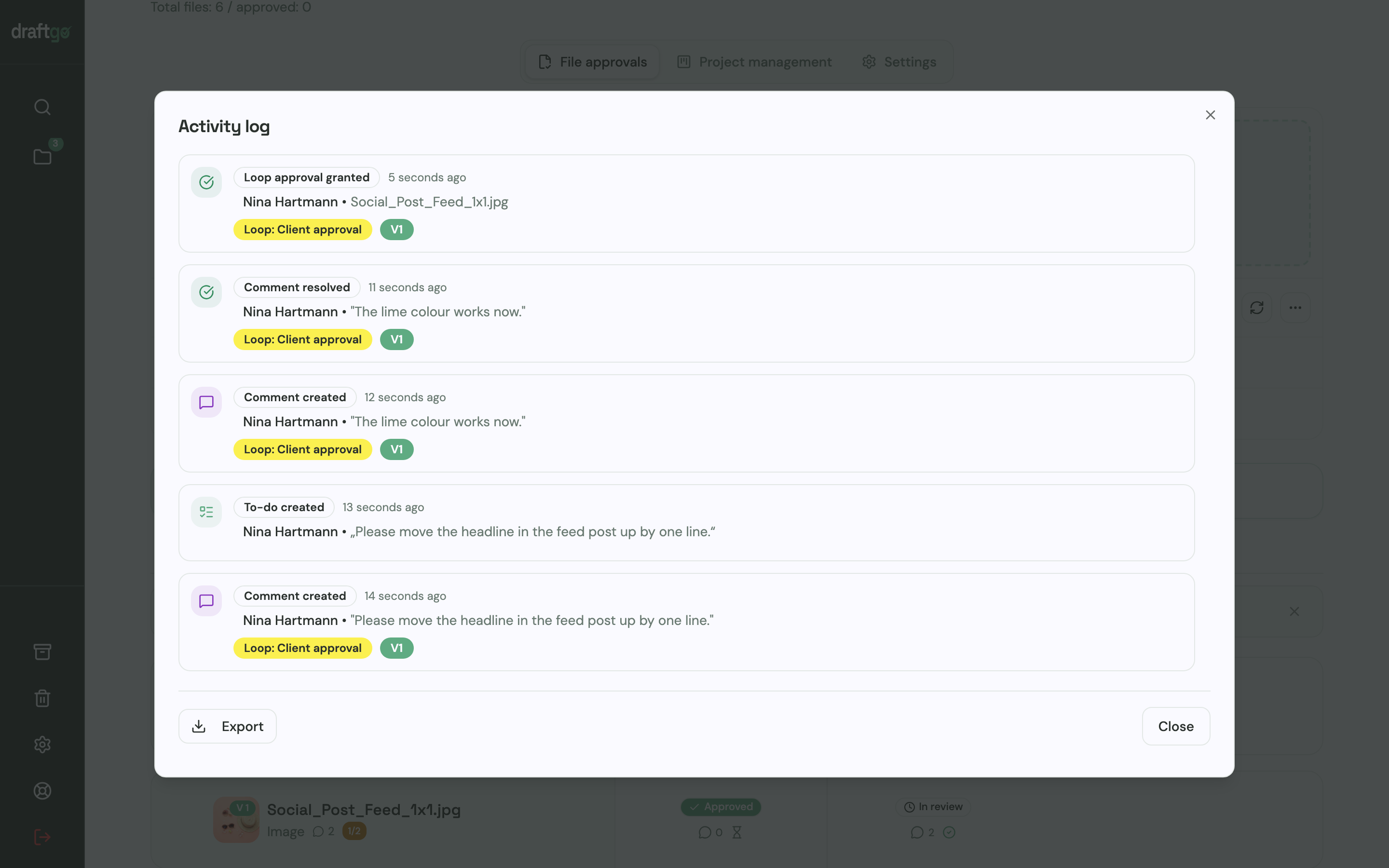
Show who approved which version
For the job file you export the activity log as CSV, JSON or PDF, with approvals, comments, versions and downloads listed by person and time. A single file’s review documentation comes as PDF or CSV. Stored data is kept on EU servers in the Frankfurt data centre.
New to reviewing files this way? The guide to online proofing explains the method.
FAQ
Can pharma companies advertise prescription drugs to patients?
It depends on the market. In the UK, MHRA guidance says prescription-only medicines may not be advertised to the general public (MHRA, Advertise your medicines). In the US, 21 CFR 202.1 sets what prescription drug ads must contain, including rules for TV and radio ads presented directly to consumers (21 CFR 202.1).
Does an approval tool replace the reviewers or the certification?
No. A review tool organises who sees which version and records the approvals. The judgement on a claim stays with medical, legal and regulatory, and in the UK the signatory the ABPI Code describes certifies the final form (PMCPA, clause 8).
How do agencies fit into pharma marketing approvals?
An agency can run its own internal review first, so the client’s reviewers only see material that is ready. After that, the client’s medical, legal and regulatory reviewers decide, and the agency ties each correction to a comment and a version.
Conclusion
The rules of pharma marketing differ between the US and the UK, and in both the review only holds if every approval belongs to one version. Before your next piece goes into review, agree which roles approve and in which order, and treat every change after approval as a new version.
Try it free – draftgo is free for 14 days, no credit card needed.
Written by
Emilia
Content Producer
Ready to streamline your approval processes?
Get started with draftgo today and see how easy professional collaboration can be.