
A prospective client sends its supplier questionnaire before signing. One question asks which of your tools send personal data to the United States and on what legal basis. You know that your project board, your video calls and your cloud storage come from US providers, but the second half of the answer sits in terms of service nobody on the team has read. The legal basis it asks for is what Schrems II changed.
This article is general information, not legal advice.
What did the Schrems II judgment decide?
Schrems II is the judgment of the Court of Justice of the European Union of 16 July 2020 in case C-311/18. The court declared the Commission’s Privacy Shield adequacy decision 2016/1250 invalid, while its review of decision 2010/87 on standard contractual clauses disclosed nothing that affected its validity (CURIA press release 91/20, 2020).
The case began with a complaint by Maximillian Schrems, an Austrian Facebook user, about the transfer of his data from Facebook Ireland to the United States. In Schrems I, a judgment of 6 October 2015, the court had already struck down the earlier Safe Harbour decision. This time it found that the US surveillance programmes assessed in the Privacy Shield decision were not limited to what is strictly necessary (CURIA, 2020).
For anyone who relies on standard contractual clauses, the press release sets out what the court required (CURIA, 2020):
- People whose data is transferred must get a level of protection essentially equivalent to the one guaranteed in the EU.
- The assessment looks at the contract between exporter and recipient and, where public authorities in the destination country can access the data, at the relevant parts of that country’s legal system.
- Unless there is a valid adequacy decision, supervisory authorities must suspend or prohibit a transfer if they find that the clauses cannot be complied with there, that the protection cannot be ensured by other means and that the exporter has not stopped the transfer itself.
The European Data Protection Board followed with a roadmap for exporters, its Recommendations 01/2020, adopted in their final version on 18 June 2021. Where an adequacy decision covers a transfer, the only further step it names is to monitor that the decision stays valid (EDPB, 2021).
Which rules apply to EU-US transfers today?
For US companies that participate in it, the route today is the EU-US Data Privacy Framework. The European Commission adopted its adequacy decision on 10 July 2023 (CURIA press release 106/25, 2025), and on that basis personal data can flow freely from the EU to those companies. According to the Commission, the US national security safeguards behind it apply to all transfers to companies in the US, whatever transfer mechanism is used (European Commission). The Commission adopted a modernised set of standard contractual clauses on 4 June 2021 (European Commission, standard contractual clauses).
On 3 September 2025, the General Court dismissed Philippe Latombe’s action for annulment of that decision (case T-553/23). It confirmed that the United States ensured an adequate level of protection on the date of adoption, and noted that the Commission must continuously monitor the US legal framework the decision rests on and may, if that framework changes, suspend, amend or repeal the decision or limit its scope (CURIA press release 106/25, 2025). Latombe appealed to the Court of Justice on 31 October 2025 (WilmerHale, 2025).
That leaves three situations for a tool with a US connection:
| Situation | When it applies | What you check |
|---|---|---|
| Data Privacy Framework | The US provider participates in the framework | Is the provider an active participant on the DPF List? |
| Standard contractual clauses | The provider does not participate, or the contract uses the clauses anyway | Are the clauses part of the contract, and is there an assessment of the destination country’s law? |
| No transfer | The data stays inside the EU and EEA | Does that also hold for the provider’s sub-processors? |
What does Schrems II mean for agencies in the UK and the US?
UK organisations transfer data under the UK GDPR and have their own US route. According to the UK government’s 2023 factsheet, businesses in the UK can transfer personal data from 12 October 2023 to US organisations certified to the “UK Extension to the EU-US Data Privacy Framework” without further safeguards, after confirming that the recipient is an active participant on the DPF List and signed up to the UK Extension. Otherwise the factsheet points to the International Data Transfer Agreement (IDTA), the UK Addendum to the EU standard contractual clauses or a derogation under Article 49 of the UK GDPR, and says you may also need a transfer risk assessment (GOV.UK, 2023).
Try it yourself: In the demo you work in a real draftgo workspace with sample data.
A US agency with clients in Europe sits on the other side of the transfer. EU data can reach it freely if it participates in the Data Privacy Framework (European Commission). If it signs standard contractual clauses instead, it takes on duties as the recipient. The clauses the court examined in 2020 required the recipient to tell the exporter when it could not comply, and the exporter then had to suspend the transfer or end the contract (CURIA, 2020).
How to check your tools in 4 steps
The check follows the first steps of the EDPB roadmap: know your transfers, then verify the transfer tool each one relies on (EDPB, 2021). A sheet with one row per tool is enough.
1. List every tool that touches client data
Go through each part of your agency software stack: project management, file storage, email, video calls, design review, analytics, AI tools and browser extensions. For each one, note which personal data it holds, such as client contacts, people who appear in photos and videos, or your team’s own data.
2. Find out where the data goes
Note the company you have the contract with, where it stores data and which sub-processors it lists. A provider with servers in Europe can still use sub-processors elsewhere, so read the list rather than the marketing page.
3. Check the transfer basis of each tool
For every transfer outside the EU and EEA, write down what it rests on: participation in the Data Privacy Framework, the UK Extension for UK data, or standard contractual clauses (for UK data, the IDTA or the UK Addendum) with an assessment of the destination country. If you find none of these, clear it up with the provider before more client data goes in, or move that work to another tool.
4. Sign a data processing agreement with each provider
When a provider processes personal data on your behalf, Article 28(3) GDPR requires a binding contract. It sets out the subject matter, duration, nature and purpose of the processing, the type of data and the categories of people, and it obliges the provider to act only on your documented instructions, including on transfers to a third country (GDPR, Article 28, as adopted). The UK GDPR contains the same requirement in its own Article 28(3) (UK GDPR, Article 28).
Keep each agreement next to its row in the sheet. When the next questionnaire arrives during client onboarding, you answer from the sheet instead of searching inboxes.
Common mistakes in a transfer check
| Mistake | Better practice |
|---|---|
| Reading “EU data centre” as “no transfer” | Check the sub-processor list as well as the storage location |
| Treating signed clauses as the end of the task | Keep the assessment of the destination country that the court and the EDPB describe |
| Using EU paperwork for UK data | For UK data, check the UK Extension, the IDTA or the UK Addendum |
| Checking once and filing it away | Re-evaluate at intervals, as the sixth step of the EDPB roadmap asks |
Practical example: a Dublin agency checks its US tools
Take a twenty-five-person digital agency in Dublin that builds campaigns and websites for clients in Germany, the Netherlands and Spain. Its operations manager opens a shared sheet with one row per tool and ends up with 19 apps that hold client data, 11 of them from US providers.
Eight providers appear on the DPF List. Two rely on standard contractual clauses, so she files the agency’s assessment next to them. A small browser plugin names neither a company nor a transfer basis, and the team uninstalls it. Three data processing agreements are missing; she signs them in the providers’ admin panels and saves the PDFs in the folder linked from each row. A calendar entry for next November reminds her to repeat the check.
How it works in draftgo
Your client review tool is one of the rows in that sheet, because drafts can show names, faces and unreleased products. For draftgo, the entries are short. Stored data is kept on EU servers in the Frankfurt data centre. Every customer receives a data processing agreement under Art. 28 GDPR, which lists the sub-processors, so you can check each of them in step 3.
Your team members work with their own accounts, while clients need none: only the person who decides gets a personal approver link with name and email address, and anyone else who comments opens the shared viewer link, which cannot approve.
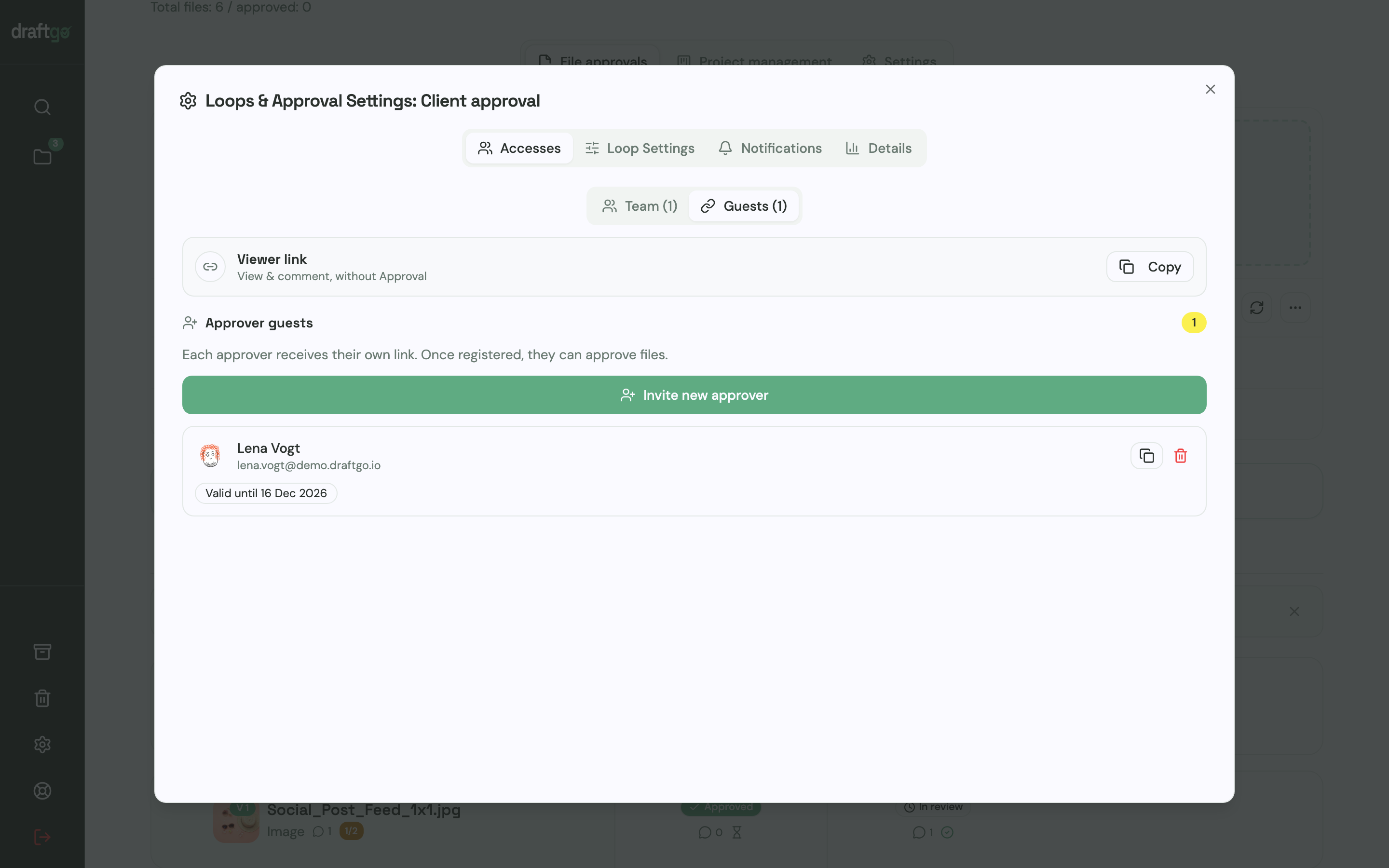
Comments sit on the file, each correction becomes a new version of it, and approvals run in loops, for example an internal check before the client loop. A project holds one loop on Free, three on Freelancer and as many as you need on Agency and Team. That is online proofing in practice, and it leaves a record behind. The activity log holds approvals, comments, versions and downloads with person and time, and you can export it as CSV, JSON or PDF. For what a client may expect in that record, read the guide to an audit trail for creative approvals.

More on client work with draftgo is on the page draftgo for agencies.
FAQ
What is the difference between Schrems I and Schrems II?
Schrems I is the judgment of 6 October 2015, in which the Court of Justice declared the Safe Harbour decision invalid. Schrems II followed on 16 July 2020 and struck down its successor, the Privacy Shield.
Are standard contractual clauses enough for transfers to the US?
The court kept them valid, but the exporter has to check that the data gets protection essentially equivalent to EU law, including against access by public authorities. Where that check shows a gap, the EDPB describes supplementary measures. A provider in the Data Privacy Framework lets the transfer rest on the adequacy decision instead.
Is the EU-US Data Privacy Framework still valid?
Yes. The General Court upheld the adequacy decision on 3 September 2025, and an appeal to the Court of Justice followed on 31 October 2025. Note which tools rely on the framework, so you know what to review if the appeal changes it.
Which rules apply to UK agencies sending data to the US?
UK agencies transfer under the UK GDPR. Since 12 October 2023 they can send personal data to US organisations certified to the UK Extension to the Data Privacy Framework. Where that route does not fit, the UK government’s factsheet points to the IDTA or the UK Addendum, possibly with a transfer risk assessment.
Does Schrems II matter for freelancers?
Yes, whenever a tool moves client data outside the EU or the UK. A freelancer who sends that data is the exporter, and Article 28 requires a contract whenever a provider processes personal data on your behalf.
Conclusion
Schrems II ended the Privacy Shield, and transfers to the US now rest on the Data Privacy Framework, the UK Extension or contractual clauses with an assessment. List your tools this month, write the transfer basis next to each one and sign the missing data processing agreements, then set a date to repeat the check. Try it free – draftgo is free for 14 days, no credit card needed.
Written by
Emilia
Content Producer
Ready to streamline your approval processes?
Get started with draftgo today and see how easy professional collaboration can be.