
The layout is approved internally and the copy reads well. Then the draft goes to the client, and the comments pull in four directions: “more professional, please”, “can it sound more human?”, “less salesy”, “a bit cold”. Each reviewer means something similar and wants a different sentence. Without an agreed tone of voice, every review round turns into a debate about taste.
What is tone of voice?
Tone of voice is the way a brand sounds in a particular text: the words it chooses, how long its sentences run, how formal it gets and how much warmth or humour comes through. It adapts to the channel and the situation, while the brand behind it stays recognisable.
Tone of voice vs brand voice
| Brand voice | Tone of voice | |
|---|---|---|
| What it describes | the brand’s fixed character | how that character sounds in one text |
| When it changes | rarely, with a rebrand | with channel, reader and situation |
| Example | clear and warm | calm in a support reply, playful on Instagram |
As Mailchimp’s style guide puts it: “You have the same voice all the time, but your tone changes.” (Mailchimp Content Style Guide)
The four dimensions of tone of voice
The Nielsen Norman Group describes tone along four dimensions, each a spectrum between two ends: formal or casual, serious or funny, respectful or irreverent, matter-of-fact or enthusiastic (Kate Moran, Nielsen Norman Group, 2016). Placing your brand on each one gives the team a position to discuss. Here is the same message to a client at both ends of each dimension:
| Dimension | One end | Other end |
|---|---|---|
| Formal or casual | “The revised draft is now available for your review.” | “Your new draft’s ready. Take a look.” |
| Serious or funny | “The draft is ready for review.” | “Fresh out of the oven: your new draft.” |
| Respectful or irreverent | “Thank you for your patience while we revised the layout.” | “Third time’s the charm. New layout’s up.” |
| Matter-of-fact or enthusiastic | “Version 3 is uploaded.” | “We’re really excited about version 3!” |
Positions can shift by channel. Monzo’s writing principles, for example, set “warm wit” to “None” for customer service and to “Maxed out” for organic social media (Monzo writing principles).
Benefits and limits of a defined tone of voice
A written tone of voice gives reviewers a shared yardstick, so feedback refers to rules instead of taste.
A guide does not replace judgement. An apology needs a different tone from a launch, and rigid rules make texts sound alike.
Try it yourself: In the demo you work in a real draftgo workspace with sample data.
How to write a tone of voice guide in 5 steps
A tone of voice guide fits on one page if it names the brand’s traits, a position per channel and example sentences:
- Start with the brand voice: Write down the traits that hold in every text, such as “clear” or “warm”, and test each against a hard case like an apology.
- List the situations: Note the texts your team writes most and what the reader needs in each.
- Set a position per dimension: “Casual, but never flippant” on Instagram, “friendly, but precise” in proposals.
- Write do and don’t pairs: Example sentences teach faster than adjectives.
- Name an owner who keeps the guide current and decides on wording. Link the guide in each brief; our creative brief template has a section for tone and style.
| Do | Don’t |
|---|---|
| “Your new draft is in the project.” | “Please find attached the updated version for your perusal.” |
| “Two changes make the opening clearer.” | “This doesn’t work yet.” |
| address the reader as “you” throughout | switch between “you” and “the customer” |
How to keep the tone consistent in reviews and approvals
Tone holds when every reviewer checks against the same page and one person decides.
- Comment on the exact sentence, with the guide open next to the draft.
- Name the rule: “Too formal for Instagram, drop ‘kindly’” instead of “sounds a bit off”.
- Let one person settle wording questions, as our guide to feedback management recommends.
- Check content first, then tone. A structured content review gives brand voice a check of its own, and a brand compliance check adds logo, colours and legal lines.
Practical example: one guide for three client reviewers
Take a five-person agency that writes social posts and a newsletter for a chain of bike shops. The owner, the marketing lead and a shop manager comment on each text: the owner wants “more professional”, the shop manager “more like we talk in the shop”.
With the client, the agency drafts a one-page guide: four traits, positions for social and newsletter, and five do and don’t pairs from earlier comments. Reviewers now comment on the exact sentence and point to a line in the guide, and the marketing lead has the final word. Both wishes become lines in the guide instead of a debate each round. For the posts, see our guide to choosing a social media approval tool.
How it works in draftgo
In draftgo, the guide and the drafts share one project.
- Guide next to the drafts: Upload the guide as a PDF; a Word file becomes a PDF on upload.
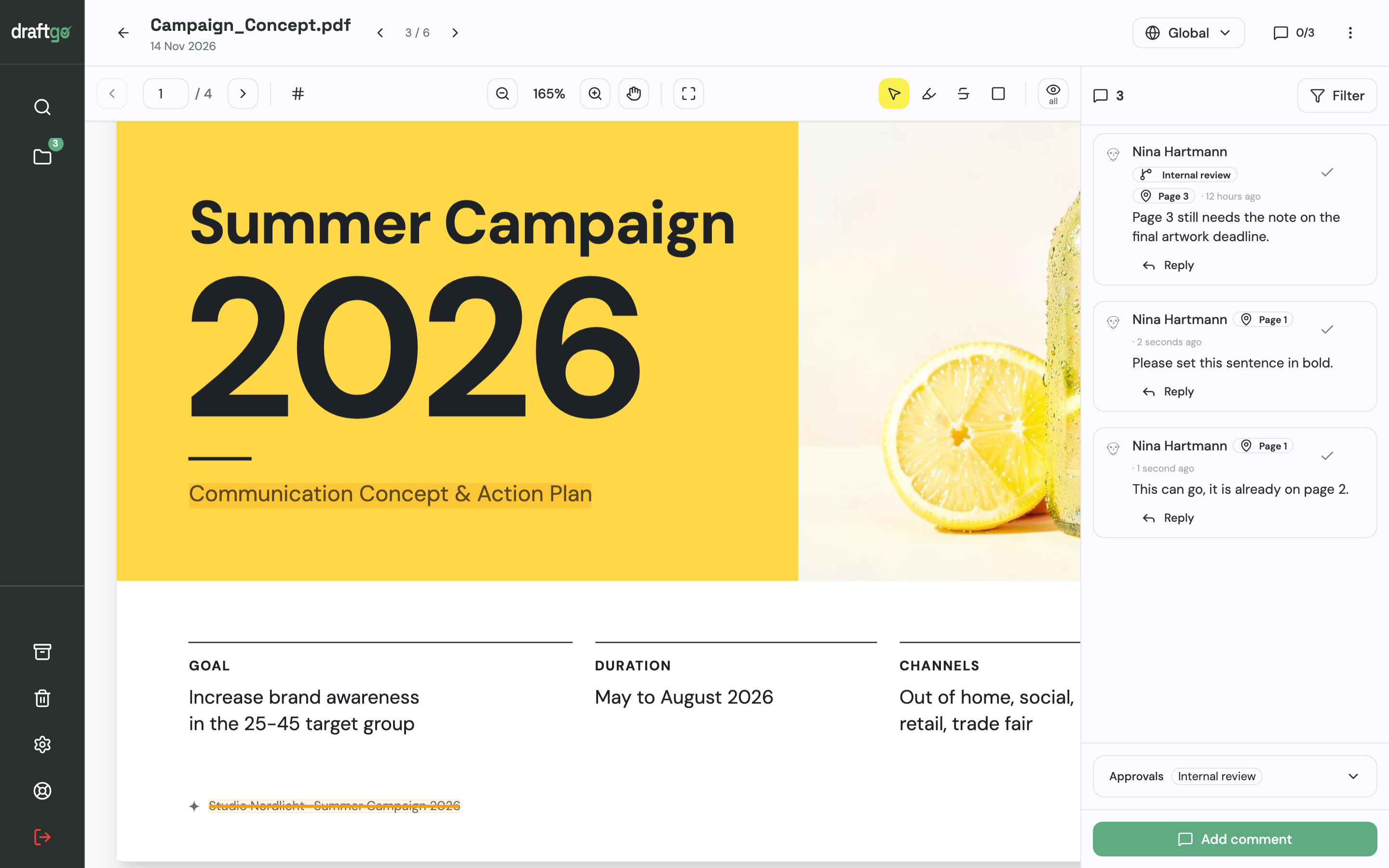
- Comments on the line: Reviewers highlight or strike through text in a PDF, or pin a comment on an image.
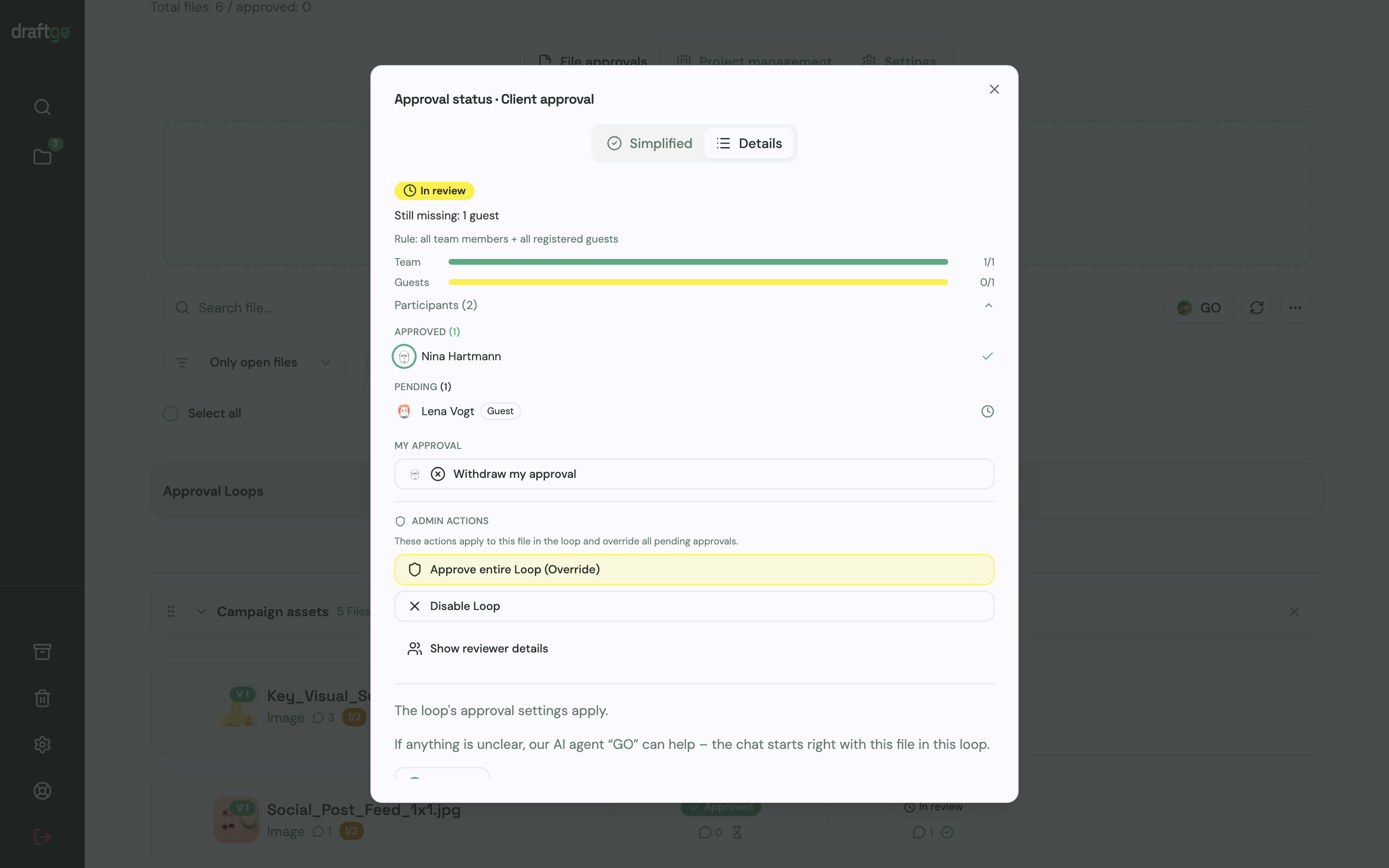
- One person approves: In the approval loop the marketing lead gets a personal approver link; the other client reviewers comment through the shared viewer link, which cannot approve. Nobody needs an account.
- Errors caught early: Before the client sees a draft, you can start the AI review. It checks PDFs, images and social media posts for typos, cut-off text or very small type, and its findings appear as comments from our AI agent “GO”. The Freelancer, Agency and Team plans include AI review pages (pricing).
The AI review does not check against your own brand guidelines, so the tone itself stays a human call. The page draftgo for agencies shows the full client approval workflow.
FAQ
What is the difference between tone of voice and brand voice?
Brand voice is the brand’s fixed character, the traits that hold in any text. Tone of voice is how that character sounds in one text, adjusted to where and to whom it speaks.
How many principles should a tone of voice guide have?
Three to five principles fit on one page that reviewers keep open next to a draft. Example sentences matter more than the number, because they show how each principle sounds.
How do you keep the tone consistent when several people review?
Give every reviewer the same one-page guide, ask for comments on the exact sentence and let one person decide on wording. Comments like “sounds off” then become requests that point to a rule.
Conclusion
Tone of voice turns your brand’s character into concrete choices about words, sentence length and formality for each channel. Write it on one page with a position per dimension and do and don’t pairs, then let one person decide on wording in reviews. Try it free – draftgo is free for 14 days, no credit card needed.
Written by
Emilia
Content Producer
Ready to streamline your approval processes?
Get started with draftgo today and see how easy professional collaboration can be.