
It is Thursday afternoon, and your client’s launch release goes to journalists on Monday under embargo. The managing director’s quote sits in an email thread in three versions, and the survey figure in the second paragraph has no source next to it. Meanwhile the team is collecting PR campaign examples to show the client that a bolder idea could work.
Below are six public relations examples, each with a source, followed by the review a campaign goes through before launch.
What makes a good public relations example?
A good public relations example earns attention the brand did not pay for. People share it and journalists report on it because the story is worth passing on. The examples below meet these four criteria in different ways, and you can test your own idea against them:
- A tension people recognise: a common phrase or a habit the audience knows.
- A reason to report it now: a date such as International Women’s Day or a problem the public can already see.
- A form that travels on its own: a film or a statue that works without the press release.
- A message the brand can back up: what the campaign says matches what the company does.
6 PR campaign examples and what made them work
The six cover purpose campaigns, a stunt, a crisis apology and a product feature.
1. Always #LikeAGirl: research turned into one question
In June 2014, Always released a film by documentary maker Lauren Greenfield. Older girls, a man and a boy are asked to run or throw “like a girl” and act out a weak, clumsy version, while younger girls run and throw with confidence (Women’s eNews, 2014). Always linked the film to a study it had sponsored on girls’ confidence at puberty.
The film turned a phrase used as an insult into a question anyone could try on themselves. In 2015 it won the PR Grand Prix at Cannes Lions (Leo Burnett release on PR Newswire, 2015).
2. Dove Real Beauty Sketches: an experiment instead of a claim
Dove and Ogilvy Brazil asked a sketch artist trained in drawing criminal suspects to draw women twice: once from their own description and once from another person’s description of them. The two portraits differed starkly, and in Adweek’s reading the women were more beautiful than they thought. The campaign won the Titanium Grand Prix at Cannes Lions in 2013 (Adweek, 2013).
Instead of arguing its point about self-image, the brand let viewers see it in the gap between two drawings of the same face.
3. Patagonia “Don’t Buy This Jacket”: a message against the calendar
On Black Friday 2011, Patagonia ran a full-page ad in The New York Times showing its R2 jacket under the headline “Don’t buy this jacket” (Adweek, 2011; Patagonia). The copy explained how the jacket, like everything the company makes, harms the environment, and asked readers to buy less, Patagonia products included.
The ad was paid space, but a retailer asking people to buy less on a day built around discounts was news, and the message fitted what Patagonia stood for.
4. Fearless Girl: a stunt with a date and a message that has to hold up
Overnight, a day before International Women’s Day 2017, State Street Global Advisors and McCann New York placed the statue of a girl in Bowling Green Park in Manhattan, facing the Charging Bull (Adweek, 2017). The campaign’s message was that companies with women in top positions perform better financially. That year it won four Grand Prix at Cannes Lions, one in PR (Adweek, 2017).
A message also has to match the sender’s own record. Later, State Street Corp., whose subsidiary had created the statue, agreed to a $5 million settlement over allegations that it had underpaid hundreds of female and minority employees, and critics on social media accused it of hypocrisy (Adweek, 2017).
5. KFC “FCK”: a crisis apology that names the problem
In February 2018, KFC in the UK moved its chicken deliveries to DHL, and hundreds of restaurants had to close for lack of chicken (Fortune, 2018). KFC answered with a full-page newspaper ad that rearranged the letters of its name to read “FCK”, above a short apology.
The ad named the problem and apologised, and the joke in the lettering made the apology the story. Such an ad has to be signed off within days, which only works if everyone knows who approves what.
Try it yourself: In the demo you work in a real draftgo workspace with sample data.
6. Spotify Wrapped: user data as a yearly news moment
Once a year, Spotify gives its users a review of their listening year, with share cards they can send to friends or post on social channels (Spotify newsroom, 2025). Spotify says it introduced the Wrapped concept as it is known today in 2015 and has changed it every year since.
Every user gets their own version of the story to pass on. A small team can borrow the idea with data it already holds, such as survey results, and turn it into a release that returns every year, as long as each figure is checked as carefully as a headline.
What these PR campaigns have in common
All six had a reason to be reported at that moment and a form that worked without the press release.
| Campaign | Year | Starting point | What people passed on |
|---|---|---|---|
| Always #LikeAGirl | 2014 | research on confidence | a film and a question |
| Dove Real Beauty Sketches | 2013 | an experiment | two portraits of one woman |
| Patagonia | 2011 | Black Friday | an ad against buying |
| Fearless Girl | 2017 | International Women’s Day | a statue to photograph |
| KFC “FCK” | 2018 | closed restaurants | an apology with a joke |
| Spotify Wrapped | yearly since 2015 | listening data | a personal card |
What gets reviewed before a PR campaign or press release goes out
Before a PR campaign or press release goes out, the team reviews five things: facts and figures, quotes, legal points, brand fit and the embargo. Each check has an owner and a set point in the process.
| What | Who checks | When |
|---|---|---|
| Facts and figures | writer and data owner | before the internal review |
| Quotes | each person quoted | on the final text |
| Legal points | legal team or counsel | before the client sign-off |
| Brand fit | brand or communications lead | in the internal review |
| Embargo and send list | PR lead | on the approved version |
1. Facts and figures
Every number needs its source: which survey, how many respondents, which year and whose share a percentage describes. Headline, text and graphic show the same figure, and a number nobody can trace comes out. The same rule holds in any content review process.
2. Quotes and the people quoted
A quote carries a person’s name, so that person approves the exact wording and their job title in writing. If the release quotes a client or a partner, their approval is part of the sign-off, and a changed quote is approved again.
3. Legal points
Your legal team or counsel checks claims you must be able to prove, comparisons with competitors, the rights to photos, music and names, and permits for anything in a public place.
This article is general information, not legal advice.
4. Brand fit
The brand check covers tone of voice, logo use and the boilerplate, plus one harder question: does the company’s own record support the message? A short checklist per asset type, as in our guide to brand compliance, keeps it quick.
5. Embargo and the final version
An embargo is an agreement that journalists who receive the release early do not publish before a set date and time. Put it at the top of the release with the time zone, and send only the approved final version.
A practical example: one launch, two review rounds
Take a five-person agency that launches a client’s new app with a press release, a short video, a survey graphic and three social images. The copywriter puts the survey report next to every figure in the draft.
In the first round, the agency team checks the figures and the brand fit. In the second, the client’s head of communications and the managing director quoted in the release review the files, while the client’s counsel reads the claims. The managing director rewrites one sentence of the quote, so the release goes up as a new version and both approve again. The social images go through the same rounds, as in our guide to social media approval tools.
On Friday the release is approved, and the agency sends exactly that version, embargoed until Monday at 09:00 GMT. draftgo for agencies is built for this kind of client approval.
How it works in draftgo
In draftgo, the release, the video and the images sit in one project, and each review round is an approval loop. Clients and the people quoted take part through a link, without an account.
- Upload the materials. A Word file becomes a PDF on upload, so the release can be marked up line by line; video comments sit at a point on the timeline.
- Set up two loops. “Internal review” is for your team, “Client approval” for the client. For each loop you decide whether all approvers, a set number or any one of them must approve, separately for team and guests.
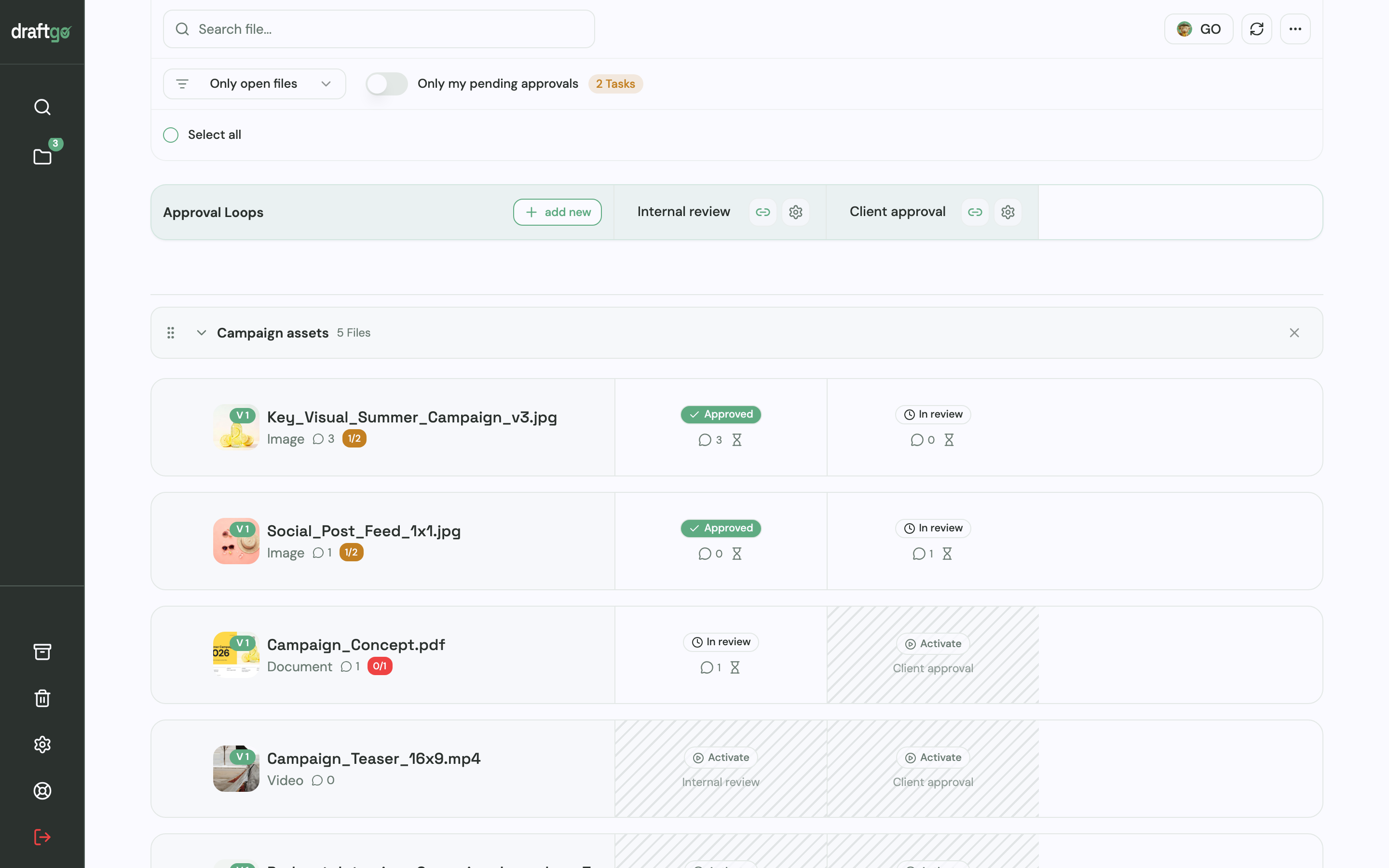
A project holds one loop on Free, three on Freelancer and any number on Agency and Team, so two loops start on Freelancer (see pricing).
- Invite the approvers. The head of communications and the managing director each get a personal approver link; a shared viewer link lets others comment without approving.
- Comment at the exact spot. Reviewers highlight the quote or strike through a figure in the PDF, and each comment carries its page number.
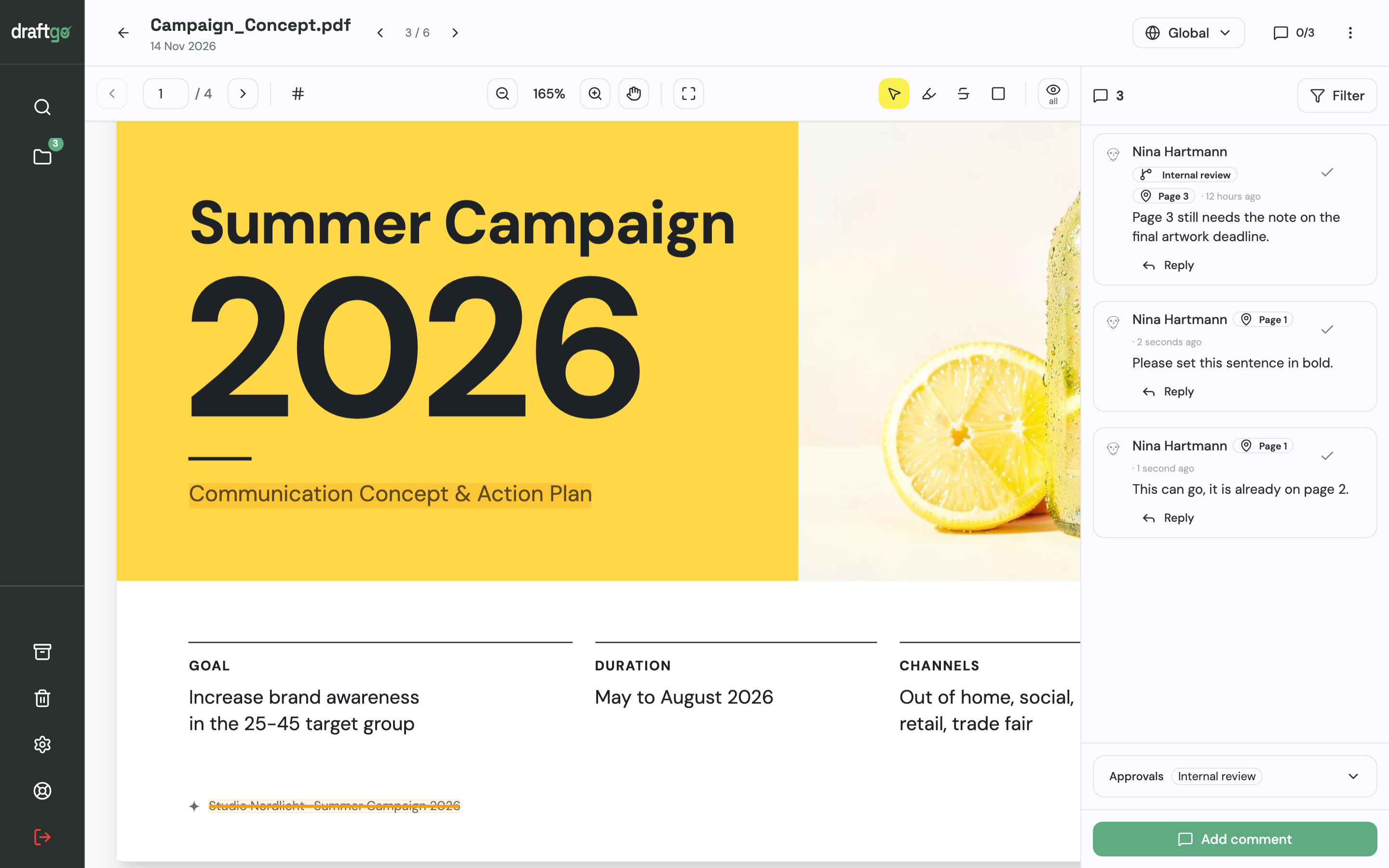
- Upload the corrected version. A new version starts the approvals again, so the quote is approved in its published form.
- Run a last check. With AI review pages in your plan, you can start the AI review: our AI agent “GO” checks PDFs and images for spelling mistakes, cut-off text or very small type and leaves its findings as comments.
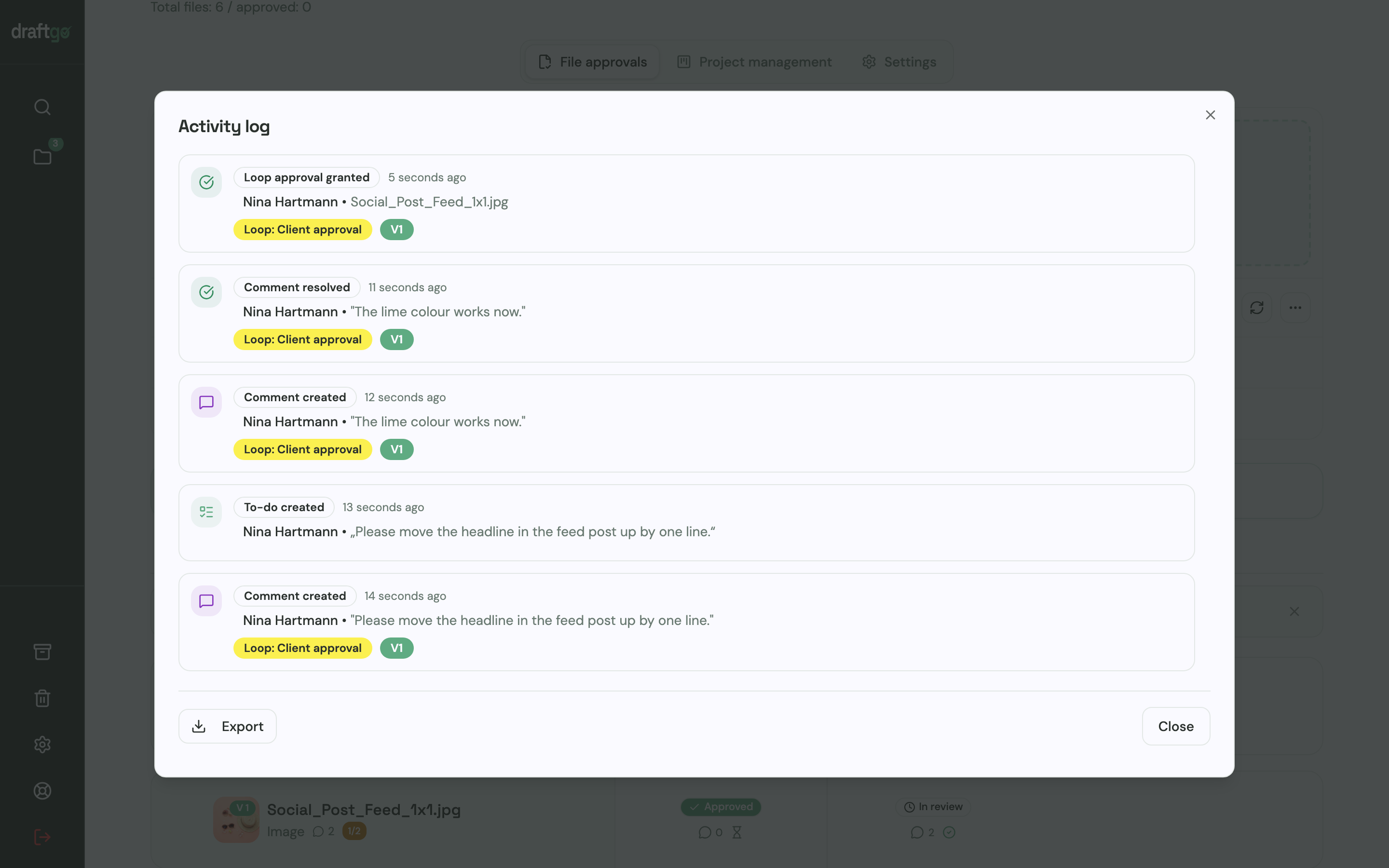
- Keep the record. The activity log shows who approved which version and when, as an export in CSV, JSON or PDF. Our article on the approval audit trail explains what such a record needs.
Embargoed releases are sensitive files. Stored data is kept on EU servers in the Frankfurt data centre.
FAQ
What is an example of public relations?
A press release about a product launch, a founder interview in a trade magazine and a stunt like Fearless Girl are all public relations. In each case the attention is earned, not bought, and journalists or the public decide whether to pass the story on.
What is the difference between PR and advertising?
Advertising is paid space, so you buy the slot and control the message. PR aims for coverage you do not pay for, and a journalist decides what gets said. Patagonia used both when its paid ad became a news story.
Who approves a quote in a press release?
The person quoted approves the exact wording, in writing and on the final version of the release. If the quote comes from a client or a partner, their communications team may want to sign it off too.
What does an embargo on a press release mean?
An embargo asks journalists not to publish before a set date and time, so they can prepare their story in advance. It only works with journalists who have agreed to it.
Conclusion
Pick the public relations example whose mechanism fits your story, such as an experiment or your own data, and plan the review before you write the release. Give each of the five checks an owner, and send only the approved final version. Try it free – draftgo is free for 14 days, no credit card needed.
Written by
Emilia
Content Producer
Ready to streamline your approval processes?
Get started with draftgo today and see how easy professional collaboration can be.