
Your agency added Marker.io to the client's staging site, and the developers like it: every report arrives with a screenshot, the browser and the screen size. The client wants something else from the next round: she wants to sign off the layout and copy of eight pages at desktop and mobile width, and next week the printed flyer and a launch video follow. That is when agencies start comparing Marker.io alternatives.
Marker.io is a strong tool for turning website feedback into issues, and for many web teams it stays the right one. Below are six alternatives with pros, cons and entry prices, checked on the vendors' own pages on 23 November 2026.
Why teams look for a Marker.io alternative
Marker.io collects feedback on websites and web apps: reviewers annotate a screenshot of the page, each report carries the browser, the operating system and the screen resolution, and clients send feedback without an account (Marker.io). The reasons to switch usually lie somewhere else.
- The developer features start on Team. Starter costs $39 a month billed annually or $59 billed monthly, with 3 team members and basic integrations. Session replay, console logs, network requests and Jira are listed from Team, at $149 a month billed annually with 15 team members. Eligible agencies can apply for a separate plan at $99 a month billed annually (Marker.io pricing).
- Something has to be installed first. Marker.io runs through a code snippet, a WordPress plugin or a browser extension. If you cannot add code to a client's site, a tool that opens the site from a link starts faster.
- Clients approve more than websites. When the same client also signs off print PDFs, videos or social posts, a tool that reviews those files keeps the project in one place.
- The question is a sign-off, not a bug. Before launch, many clients check layout and copy page by page, and the agency wants a record of who approved which state.
How we evaluated the alternatives
We looked at each tool as an agency or freelancer that collects website feedback from clients, using five criteria:
- How the page is reviewed: a widget or snippet, an extension, a link to the live site or a screenshot.
- Client access: comments without an account.
- Technical context: browser data, console logs and session replay with each report.
- Other files and approvals: PDFs, images or videos in the same tool, and how a decision is recorded.
- Pricing model and free entry: per user, per plan or per company, and whether a free plan exists.
All information comes from the vendors' own pages as of 23 November 2026. draftgo is our product, and it gets pros and cons like every other tool here. The order is not a ranking: the two tools closest to Marker.io's bug reporting come first, then three tools that open the live site from a link, then draftgo, which reviews a screenshot.
Marker.io alternatives compared
| Tool | Suited for | How the page is reviewed | Free entry | Entry price, as of 23 Nov 2026 |
|---|---|---|---|---|
| Marker.io, for reference | web teams turning feedback into issues | snippet, WordPress plugin or extension | 15-day trial | Starter $39 a month, billed annually |
| BugHerd | agencies that want feedback as tasks on a board | extension, or a script for staging | free trial | Standard $42 a month, billed yearly |
| Userback | product teams collecting user feedback | widget on your site or app, extension | free forever, 2 seats | Team $39 a month, billed annually |
| ruttl | websites and mobile apps without code on the site | paste a URL | free Basic, 1 project | Pro $18 per user a month |
| Pastel | clients who comment on the live site by link | enter a URL | free, 1 canvas | Pro $29 a month, billed yearly |
| MarkUp.io | link-based reviews of websites, PDFs and videos | drop a link, Chrome extension | 14-day trial | Pro from $79 a month |
| draftgo | layout and content sign-off next to other files | screenshot of a public page | permanent Free plan | see the draftgo entry below |
The 6 Marker.io alternatives in detail
1. BugHerd: suited for agencies that want client feedback as tasks on a board
BugHerd works through a browser extension on live sites, or a JavaScript snippet on staging and internal sites. Clients pin feedback to a spot on the page without an account or login, every comment arrives with a screenshot and technical details, and each one becomes a task on a Kanban board (BugHerd). The pricing page lists feedback on Figma designs, PDFs and images on every plan, Trello, Slack and GitHub from Standard, and Jira, Asana and Linear from Premium.
- Pros: feedback as tasks with technical data, unlimited guests, Figma, PDF and image feedback on every plan
- Cons: an extension or a script comes before the first comment, and Jira, Asana and Linear start with Premium
- Price: Standard $42 a month billed yearly or $50 billed monthly for 5 members, Premium $125 a month billed yearly for 25 members (BugHerd pricing)
2. Userback: suited for product teams that collect feedback from the users of a live app
Userback collects feedback through a widget on your website or app and a browser extension, with annotated screenshots, video recordings and session replay, and in-app surveys and a feature portal sit next to the bug reports (Userback). On the pricing page, the Free Forever plan covers 2 sites and 2 seats, Team costs $39 a month billed annually for 5 seats, and console logs, session replay and the two-way Jira sync start with Business at $89 a month billed annually.
- Pros: a free plan, surveys and a feature portal next to the bug reports
- Cons: developer tools and the Jira sync start with Business, and the widget has to run on your site or app
- Price: Team $39 a month billed annually or $49 billed monthly (Userback pricing)
Try it yourself: In the demo you work in a real draftgo workspace with sample data.
3. ruttl: suited for teams that review websites and mobile apps without code on the site
In ruttl you paste the website's URL when you create a project and pin comments on the live page, and clients comment through a shareable link without signing up (ruttl). Images and PDFs get comments too, mobile apps are reviewed once developers install an NPM package, and integrations include Trello, Slack, Asana, Jira and ClickUp (ruttl).
- Pros: nothing to install for a website review, a free Basic plan, mobile apps and PDFs in the same tool
- Cons: Pro is billed per user, and the free plan holds one project
- Price: Pro $18 per user a month with unlimited projects and guests (ruttl pricing)
4. Pastel: suited for clients who comment on the live site by link
Pastel shows the live site through its own proxy and lays the comments on top, and for password-protected pages you log in through the canvas in browse mode (Pastel help). Reviewers need no login, and Pastel also takes PDFs and images (Pastel). The plans page lists unlimited reviewers, approvals and feedback deadlines from the Free plan, and project management integrations on Team.
- Pros: nothing to install, approvals and feedback deadlines on every plan, unlimited reviewers
- Cons: Free holds 1 canvas and Pro 3, and integrations come with Team
- Price: Pro $29 a month billed yearly ($350 a year) or $35 billed monthly, Team $99 a month billed yearly (Pastel plans)
Our Usepastel alternative comparison looks at Pastel from the other side.
5. MarkUp.io: suited for link-based reviews of websites, PDFs and videos
MarkUp opens a live site from a link: you drop the URL and comment on the page, and its Chrome extension creates reviews from the browser with a screenshot attached to every comment (MarkUp). Videos get comments at exact timestamps, PDFs and images are marked up in the same tool, and guests join without registering. Every plan includes unlimited users and is sized by MarkUps, the items you create for review each month (MarkUp pricing).
- Pros: websites, PDFs, images and videos by link, unlimited users
- Cons: no free plan, and the monthly MarkUp allowance sets the price
- Price: Pro from $79 a month or $990 a year for 50 to 100 MarkUps a month, with a 14-day trial (MarkUp pricing)
6. draftgo: suited for layout and content sign-off next to the project's other files
draftgo is an online proofing platform for agencies, freelancers and in-house teams. It captures a publicly reachable page as a screenshot, as desktop, tablet or mobile, either the full page up to 10,000 pixels high or the visible area, and your team and guests comment on the image with a pin or a rectangle.
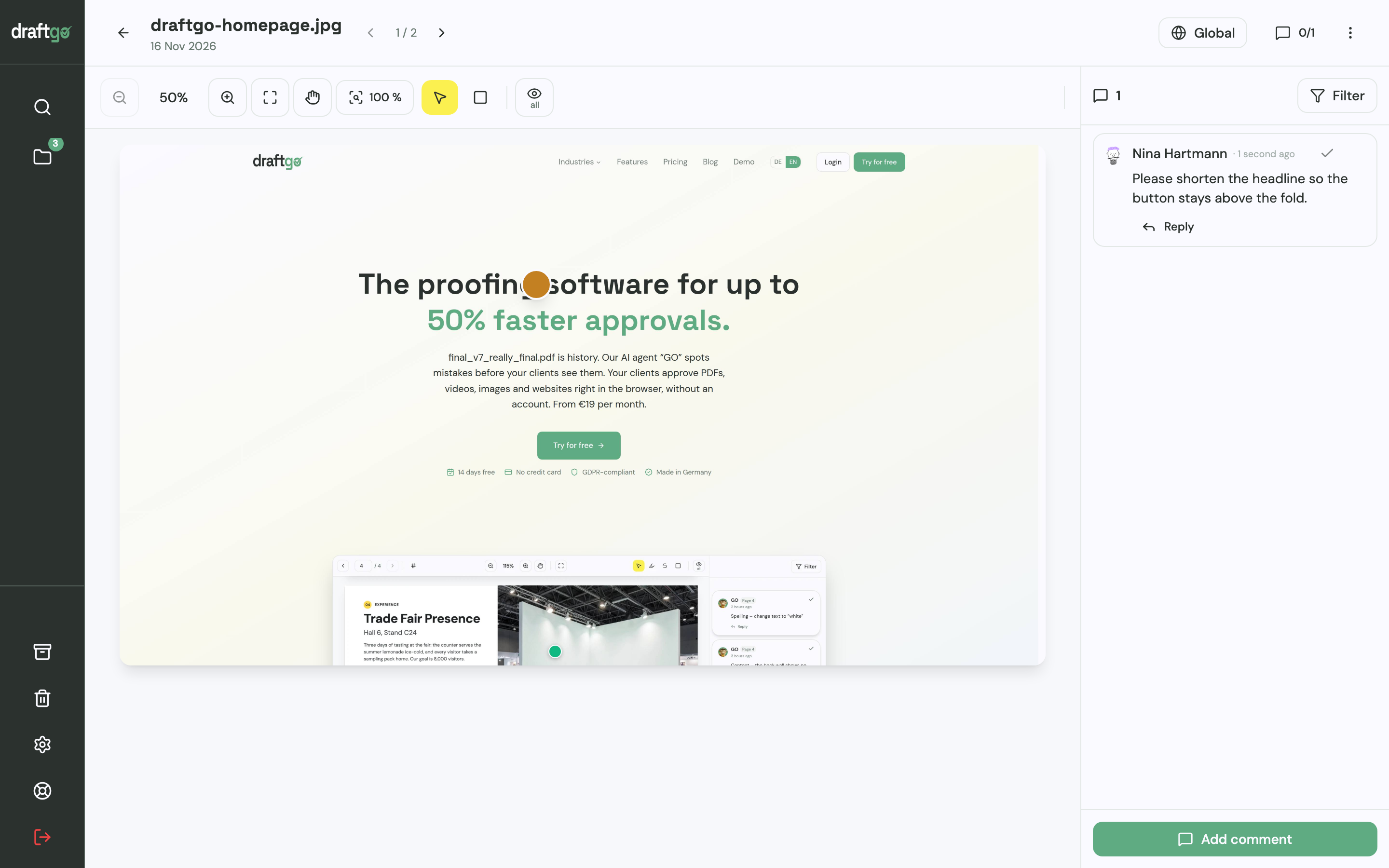
Clients comment through a link without an account: the person who decides gets a personal approver link, and everyone else shares a viewer link. Approvals run in loops, for example internal first and client second, and for each loop you decide whether all approvers, a set number or any one of them must approve. The same project holds the mockups, PDFs, images and videos of the launch, and the activity log keeps approvals and comments with person and time.
From the Freelancer plan, the AI review checks mockups uploaded as PDFs or images for errors such as spelling mistakes or cut-off text. Its comments carry the name of our AI agent “GO”.
Pricing is per company, and guests are unlimited from the Freelancer plan. Stored data is kept on EU servers in the Frankfurt data centre. Agencies find the setup for website projects on draftgo for web design.
- Pros: desktop, tablet and mobile views of the full page, an approval rule for each loop, websites next to PDFs, images and videos, one price per company
- Cons: reviewers comment on a screenshot rather than the live site, without a widget or technical data, and pages behind a login cannot be captured
- Price: a permanent Free plan and paid plans you can test free for 14 days, all listed on draftgo pricing
Marker.io and draftgo compared
| Criterion | Marker.io, as of 23 Nov 2026 | draftgo |
|---|---|---|
| What reviewers see | the live website or web app (Marker.io) | a screenshot of a public page at desktop, tablet or mobile width |
| Setup | code snippet, WordPress plugin or browser extension | the address of a publicly reachable page |
| Technical context | browser, operating system and screen resolution; console logs, network requests and session replay from Team (pricing) | none, comments sit on the image |
| Files reviewed | websites and web apps | website screenshots, images, PDFs, videos, audio, social media posts |
| Clients | reporters send feedback free, without an account (pricing) | guests comment by link without an account, unlimited from the Freelancer plan |
| Integrations | Trello, Asana, ClickUp, GitHub and others from Starter, Jira from Team (pricing) | no ready-made integrations |
| Pricing model | per plan with included team members, extra members per seat | one price per company, internal users capped by plan |
| Free entry | 15-day trial, no credit card | permanent Free plan, 14-day trial of the paid plans |
Marker.io is ahead when developers fix what clients report: each report carries technical data and lands as an issue in the team's tracker. draftgo fits better when the client signs off the layout and copy of each page at every device width, together with the print files and videos of the same launch, and that sign-off should stay on record.
An agency can also run one of each. Our guide to the website feedback tool explains when each kind fits, and the comparison overview puts draftgo next to other proofing tools.
Which alternative fits you?
| Your situation | Tool to test first |
|---|---|
| Developers want every client comment as a task on a board | BugHerd |
| You collect bug reports, surveys and feature ideas from the users of a live product | Userback |
| You review websites and mobile apps and cannot add code to the client's site | ruttl |
| Clients click through the live site and comment by link | Pastel or MarkUp.io |
| Clients sign off layout and copy page by page, next to PDFs and videos, at one price per company | draftgo |
| Bug reports with session replay go straight into Jira | stay with Marker.io on Team |
What to check before the site goes live is listed in our website launch checklist.
Practical example: the relaunch of a bakery chain's website
A three-person web agency rebuilds the website of a bakery chain with six shops on a public preview address. The owner approves every page, the marketing lead collects comments from the shop managers, and the launch comes with a printed flyer and a short video for social media.
The developer tests the order form on staging with a live-site tool. For the sign-off, the agency captures the home page, the menu and the shop pages in draftgo at desktop and mobile width and adds the flyer and the video to the same project. The owner gets a personal approver link, and the others share the viewer link. One shop manager marks the wrong opening hours on the mobile view of her shop page. After the fixes, the agency captures the page again, and the owner approves the pages, the flyer and the video, which the activity log records with her name and the date. How to get comments a designer can act on is covered in our guide to design feedback.
FAQ
How much does Marker.io cost?
Starter costs $39 a month billed annually or $59 billed monthly with 3 team members, and Team $149 a month billed annually or $199 billed monthly with 15, as of 23 November 2026 (Marker.io pricing). Clients report for free on every plan, and the 15-day trial needs no credit card.
Is there a free Marker.io alternative?
Yes, with limits. As of 23 November 2026, Userback's Free Forever plan covers 2 sites and 2 seats, ruttl's Basic plan 1 project and Pastel's Free plan 1 canvas (Userback, ruttl, Pastel). draftgo has a permanent Free plan with one user, one loop per project and 5 guest accesses.
Do clients need an account to give website feedback?
No. Marker.io, BugHerd, ruttl, Pastel, MarkUp.io and draftgo let clients comment without creating an account. Send a test link to a colleague who plays the client before the first real round.
What is the difference between bug reporting and screenshot review?
A bug reporting tool such as Marker.io or BugHerd captures what happens on the live site, with browser data, and sends each report to the developers' tracker. A screenshot review shows a fixed image of the page, so clients judge layout and copy and approve the state they saw.
Conclusion
If your developers work from Jira and rely on console logs and session replay, compare Marker.io's Team plan with BugHerd and Userback, or stay. If you cannot touch the client's code, test ruttl, Pastel or MarkUp.io. If the client mainly signs off layout and copy, together with the PDFs and videos of the launch, run your next relaunch through draftgo.
Try it free – draftgo is free for 14 days, no credit card needed.
Written by
Emilia
Content Producer
Ready to streamline your approval processes?
Get started with draftgo today and see how easy professional collaboration can be.