
A client wants to launch a new product line with the slogan “100% eco-friendly and climate neutral”, and the marketing deck is already scheduled for sign-off. Copywriters love snappy environmental buzzwords because they capture attention, but for creative agencies and brand managers, vague claims have become a serious legal hazard. Regulators no longer tolerate unverified green slogans, and misleading marketing can lead to formal reprimands, competitor lawsuits and forced campaign withdrawals.
This article is general information, not legal advice. For any specific claim, the brand's legal team or qualified legal counsel must make the final determination.
What counts as a green claim?
A green claim is any statement, logo, symbol, label or product name in commercial communication that suggests a product, service or company has a positive or neutral impact on the environment, or causes less harm than competing alternatives. This includes explicit environmental promises such as “biodegradable”, “carbon neutral”, “100% recyclable” or “organic”, but it also covers subtle cues such as nature-inspired imagery, green colour schemes and custom-designed sustainability badges.
Whether a green claim appears on retail packaging, in paid social ads, on a website landing page or in a press release, consumer protection bodies treat it as an objective factual assertion. If an advertising asset implies an environmental benefit, your team must be able to substantiate that claim with independent, verifiable evidence.
The rules in the EU, the UK and the US
Regulatory authorities have updated their consumer protection regimes to stamp out greenwashing. If you produce advertising for international campaigns or national rollouts, you must navigate distinct requirements in each market.
European Union
In the European Union, Directive (EU) 2024/825 on empowering consumers for the green transition amends both the Unfair Commercial Practices Directive and the Consumer Rights Directive. Member states were required to transpose the directive into national legislation by 27 March 2026, and its rules have applied since 27 September 2026.
According to the European Parliament, the directive introduces severe bans on misleading marketing practices:
- It bans generic environmental claims such as “environmentally friendly”, “natural”, “biodegradable”, “climate neutral” or “eco” if the business cannot demonstrate recognised excellent environmental performance relevant to the claim.
- It permits sustainability labels only if they are based on official certification schemes or established by public authorities, effectively prohibiting self-certified corporate badges.
- It bans claims that a product has a neutral, reduced or positive greenhouse gas impact when that assertion is based on emissions offsetting schemes outside the product's value chain.
A separate legislative proposal, the Green Claims Directive (procedure 2023/0085(COD)), introduces detailed substantiation and pre-approval rules for voluntary environmental claims. According to the European Parliament’s Legislative Observatory, this file remains pending, awaiting the Council’s first-reading position.
Austria and Switzerland
For campaigns running in Austria, Directive (EU) 2024/825 applies directly through Austrian national consumer protection law. Austrian courts and consumer associations have traditionally enforced unfair competition rules strictly, so generic environmental slogans require immediate substantiation.
Switzerland is not an EU member state and is not bound by EU directives. However, Swiss federal fair trading laws penalise deceptive or unsubstantiated marketing statements. Furthermore, any Swiss brand that markets goods to consumers inside the EU must comply fully with the EU directive for those cross-border consumer assets.
United Kingdom
In the UK, the Competition and Markets Authority (CMA) published its Green Claims Code on 20 September 2021. Rooted in the Consumer Protection from Unfair Trading Regulations 2008 and the Business Protection from Misleading Marketing Regulations 2008, the code sets out six core principles:
- Claims must be truthful and accurate.
- Claims must be clear and unambiguous.
- Claims must not omit or hide important relevant information.
- Comparisons must be fair and meaningful.
- Claims must consider the full life cycle of the product or service.
- Claims must be substantiated with credible evidence.
The CMA actively investigates consumer-facing sectors, meaning creative teams cannot rely on fine-print disclaimers to qualify an otherwise misleading headline.
United States
In the US, the Federal Trade Commission (FTC) regulates environmental marketing under its Green Guides. Under 16 CFR 260.4, it is deceptive to misrepresent, directly or by implication, that a product or service offers a general environmental benefit. The FTC explicitly notes that broad, unqualified claims are exceptionally difficult to substantiate because they convey a wide range of specific meanings to consumers.
Regarding carbon claims, 16 CFR 260.5 requires sellers to employ competent and reliable scientific and accounting methods to track emission reductions, and sellers must not sell or count the same carbon reduction twice.
Try it yourself: In the demo you work in a real draftgo workspace with sample data.
A green-claims check in the approval process
Environmental claims should never be waved through during a casual layout review. If your team manages campaigns across social media, retail packaging and video, green claims require a dedicated review checkpoint alongside your standard marketing compliance procedures.
When structuring your review workflow, involve the client’s legal or sustainability team as an independent approval gate. The review must address four questions for every single claim:
- Scope: What exact attribute is being claimed, and does it apply to the whole product or merely one minor component?
- Evidence: Does the client hold current, scientific proof that supports the precise wording?
- Certifications: If a seal or sustainability badge is shown, does it stem from an approved, independent certification body?
- Precision: Can broad terminology like “green” or “conscious” be replaced with a concrete, factual explanation?
If the client cannot produce documentation for an assertion, the marketing team must reword the copy to reflect only verified facts or cut the claim entirely before publication.
Typical mistakes in environmental advertising
Even experienced brand managers slip up when assembling multi-channel campaigns. The table below outlines frequent missteps and how agencies can resolve them:
| Common mistake | Why it creates regulatory risk | Better practice |
|---|---|---|
| Relying on emissions offsets for “climate neutral” copy | Banned under EU rules and scrutinised by the CMA; offsetting does not eliminate product-level emissions. | State exact operational reduction figures instead (e.g. “manufacturing facility powered by on-site solar panels”). |
| Universal claims for single-part features | Claiming a beverage is “100% recyclable” when only the aluminium can is recyclable and the cap is not. | Clarify exact boundaries in the main copy (e.g. “can made from recyclable aluminium; dispose of cap separately”). |
| Reusing custom green leaf or planet badges | Lookalike seals mimic official certifications and mislead consumers under EU and UK standards. | Use only authorised, third-party certification logos that meet statutory standards, or omit the badge. |
| Forgetting legacy social posts and product names | Regulators review old campaign posts and brand names that remain publicly visible online. | Audit existing social channels using a structured social media approval tool workflow. |
| Vague comparative statements | Claiming a product is “greener than conventional options” without naming the benchmark or test conditions. | Name the exact benchmark, testing standard and measured percentage reduction. |
A claims inventory in five steps
To protect your agency and client from regulatory scrutiny, establish a repeatable claims inventory before releasing final campaign artwork.
1. Collect all campaign materials
Gather every deliverable that touches the public domain. This includes primary print packaging, website copy, digital banners, influencer scripts, press releases and older social media posts that will remain live. When reviewing sensitive launch files, ensure teams share confidential files safely so unverified drafts are not leaked externally.
2. Mark every environmental assertion
Conduct a visual and textual sweep across all collected assets. Highlight any word, slogan, leaf graphic, carbon claim or sustainability badge. Treat both headline copy and packaging footer notes as formal claims.
3. Request substantiation from the client
Ask the brand's legal, regulatory or technical team for the underlying documentation supporting each highlighted point. This proof must consist of independent laboratory tests, life-cycle assessments or official certification licences, rather than marketing summaries.
4. Narrow, prove or delete
Evaluate each claim against the evidence provided. If the client holds documentation showing recycled ocean plastic, change “made from ocean plastic” to “bottle body made from verified recycled ocean plastic”. If no proof exists, remove the claim entirely.
5. Document the final sign-off
Log who verified the claim, which document served as proof and which asset version was approved. Maintaining a clear audit trail protects the agency if questions arise months after launch.
Practical scenario: Reviewing a cosmetic brand relaunch
Consider an independent branding agency preparing a global packaging and digital campaign for a boutique skincare line. The initial creative brief features the headline “Clean, 100% natural and kind to the planet”, alongside an agency-designed green droplet emblem stating “Zero Carbon Footprint”.
During the compliance gate, the team flags the phrase “kind to the planet” as an impermissible, unquantified general claim under both EU rules and FTC guidance. When requesting proof for “Zero Carbon Footprint”, the client reveals that the product itself has not reduced manufacturing emissions; instead, the brand purchased forestry credits.
To resolve the compliance risk, the agency updates the copy:
- They remove the droplet emblem and the phrase “kind to the planet”.
- They cut “Zero Carbon Footprint” because emissions offsetting cannot support product-level neutrality claims in the EU.
- They review the formulation records and confirm which ingredients by weight meet certified plant-derived standards.
- The final approved headline reads: “Skincare formulated with certified plant-derived ingredients”.
The revised assets convey a compelling, transparent message without exposing the brand to greenwashing fines.
How it works in draftgo
Managing legal sign-offs across dozens of creative files often devolves into messy email threads and lost attachments. With draftgo, marketing teams and brand compliance officers can review environmental copy directly on the creative asset without requiring external reviewers to create an account.
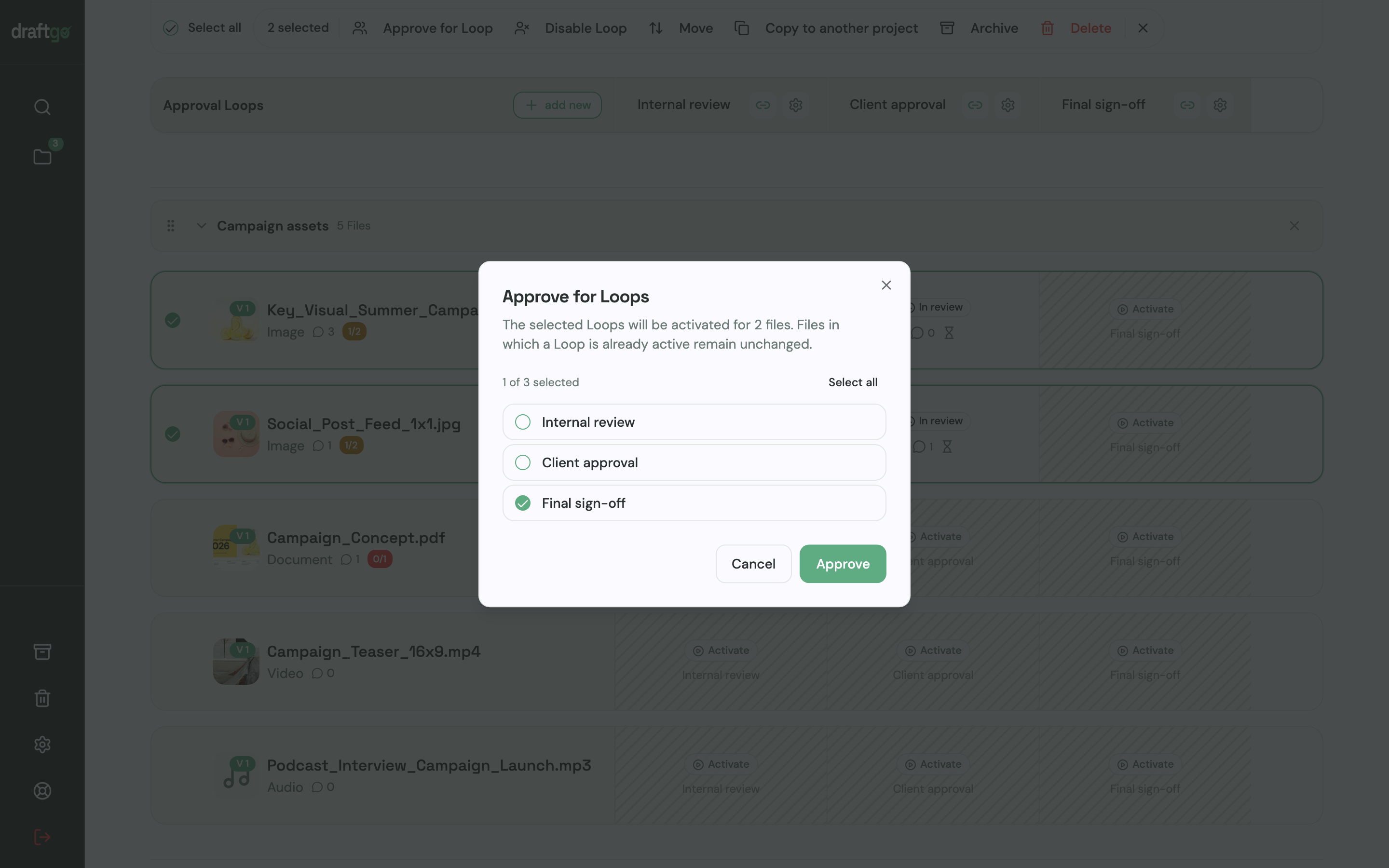
You set up sequential review loops for your campaign assets. For example, your internal creative team signs off on loop one, your client’s legal or compliance team reviews claims in loop two, and the brand marketing director grants final release in loop three.
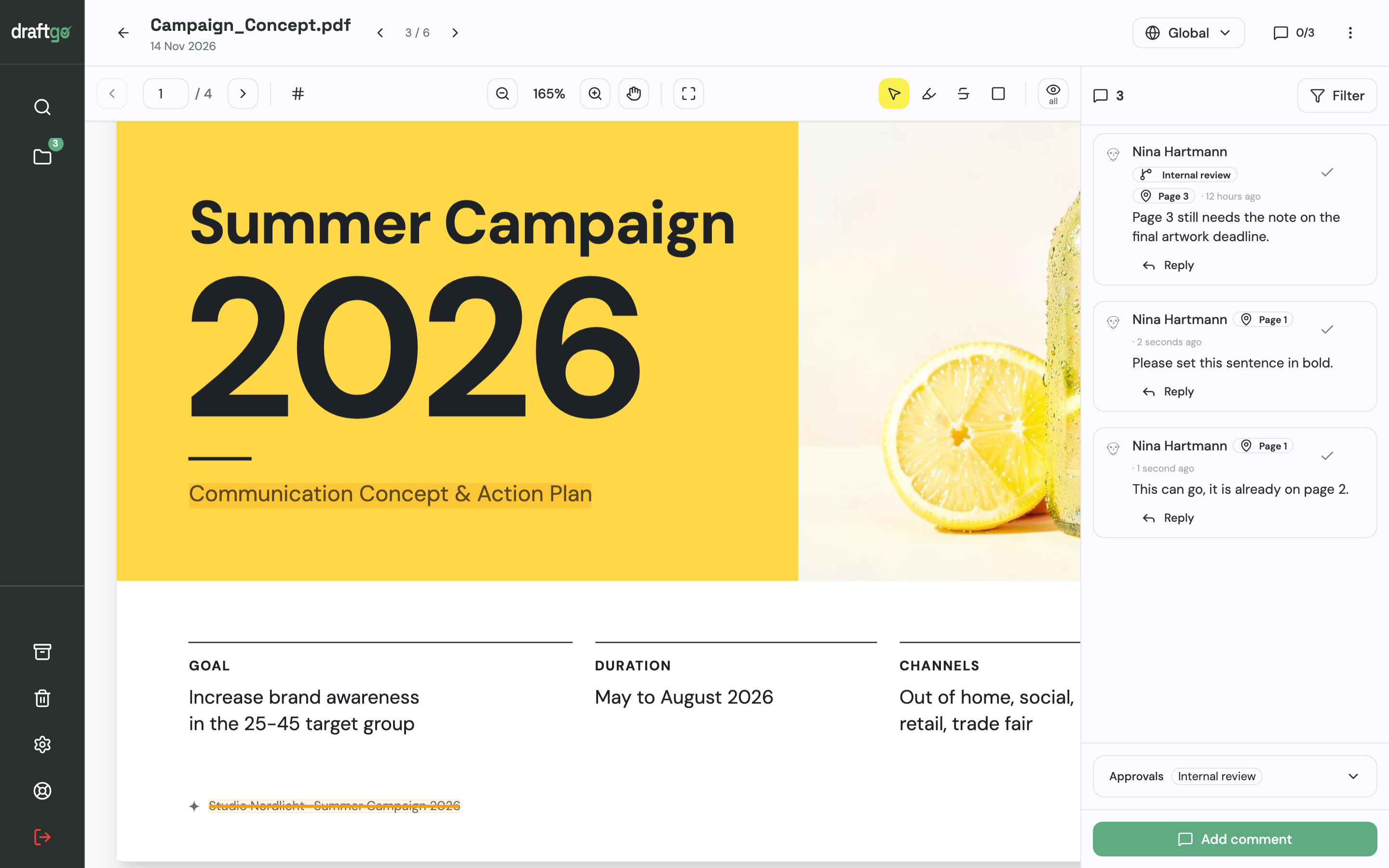
In PDFs and packaging proofs, reviewers can highlight text passages or strike through impermissible words, leaving specific revision instructions right where the copy appears. On packaging mockups or digital display ads, reviewers place pins or draw rectangles around unverified seals and ask for proof.
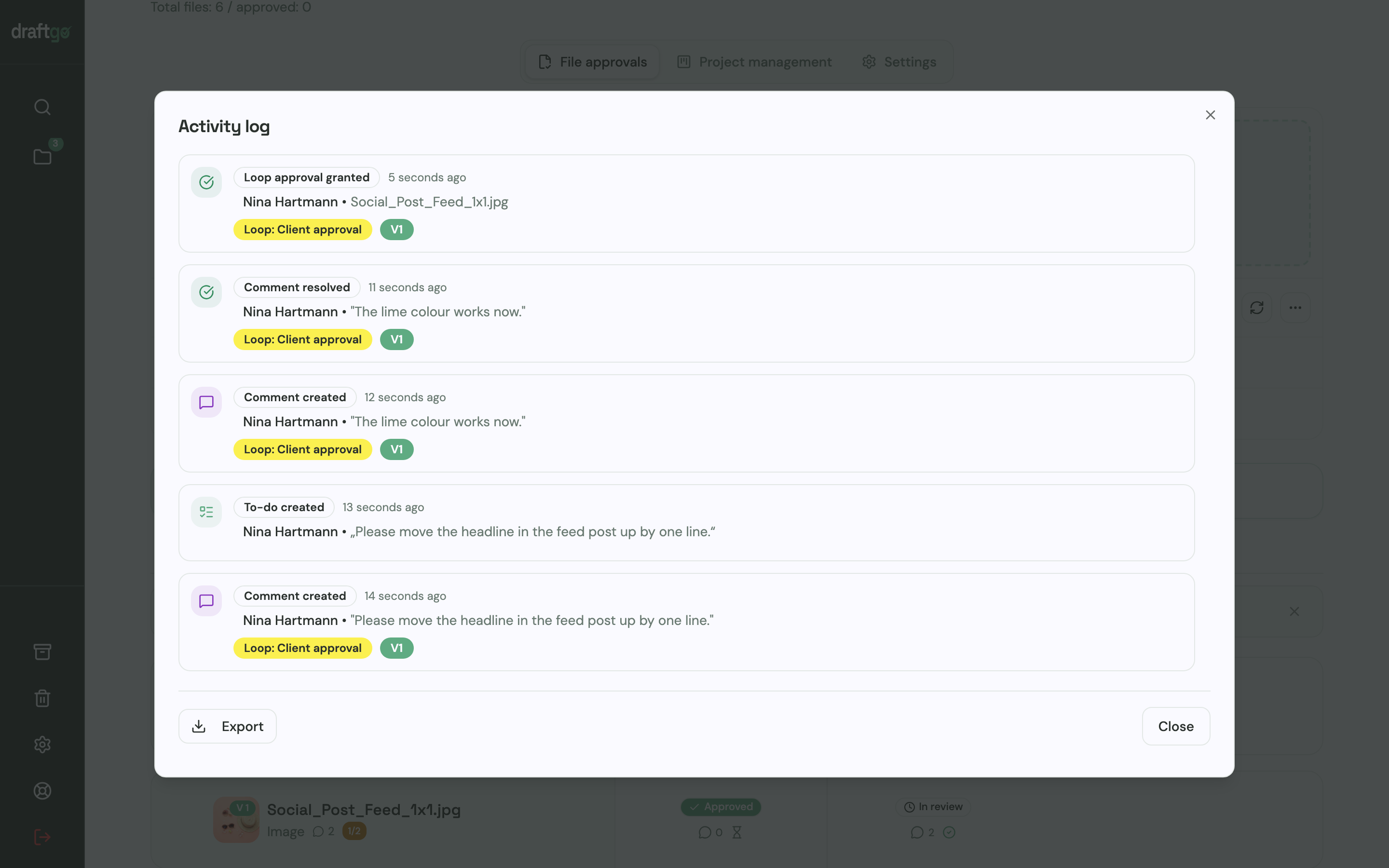
draftgo automatically logs every comment, new version and approval with a clear timestamp and reviewer identity. This activity log can be exported as a PDF or CSV file, providing your agency with an indisputable record of who approved each environmental claim.
Our AI agent “GO” answers questions about a chosen file or loop, and the AI review feature scans PDFs and images for design issues such as low image resolution or cut-off text. Stored data is kept on EU servers in the Frankfurt data centre, giving agencies and regulated clients full confidence in their data privacy standards. For teams managing tight sign-off boundaries, our dedicated legal and compliance solution provides the necessary structure.
FAQ
Can we still use the term “climate neutral” in European advertising?
Under Directive (EU) 2024/825, claims that a product has a neutral, reduced or positive environmental impact based on greenhouse gas emissions offsetting are banned. If your neutrality claim relies on purchased carbon credits rather than eliminating emissions within the product's own life cycle, it cannot be used on consumer-facing assets in the EU.
Are agencies legally liable for misleading green claims made by clients?
Regulatory enforcement targets the advertiser or brand making the claim, but agencies often face contractual indemnity claims from clients if an agency introduced unverified copy without approval. Documenting every review step protects the agency by proving that the client reviewed and authorised the final claim.
What is the difference between a self-declared badge and an official sustainability label?
A self-declared badge is created internally by a brand's design team and reflects internal standards without third-party governance. An official sustainability label is awarded by an independent certification scheme or public authority following objective, third-party verification against public standards.
How does the UK Green Claims Code treat product life cycles?
The CMA requires businesses to consider the full life cycle of a product when making an environmental statement. If an advert highlights that a product uses sustainable materials during production, but the product creates severe, unmitigated pollution during use or disposal, the claim can be deemed misleading by omitting crucial facts.
Conclusion
Environmental claims in advertising are now treated as objective legal statements that require rigorous, pre-publication proof. Agencies that replace broad slogans like “eco-friendly” with clear, measurable facts protect their clients from regulatory fines and build genuine trust with consumers. Establish a formal claims inventory and route every creative asset through a dedicated compliance review before any file goes live.
Try it free – draftgo is free for 14 days, no credit card needed.
Written by
Emilia
Content Producer
Ready to streamline your approval processes?
Get started with draftgo today and see how easy professional collaboration can be.