
Writing a press release is rarely the hardest part of public relations. The real difficulty begins once the draft leaves your desk. A product manager corrects technical specifications, legal amends a disclaimer, and an executive rewrites their own quote – each in a separate document sent as an email attachment. Within twenty-four hours, you are comparing three conflicting versions, unsure which comments leadership has already seen.
When reviews stall, publication windows slip. Journalists lose interest in stale announcements, and partners miss coordinated launch dates. Knowing how to write a press release means mastering both the editorial format and the sign-off workflow that carries a draft from initial copy to final distribution.
The structure of a press release
Journalists scan dozens of news releases every morning. If the core facts are buried halfway down the page, your story will be ignored. Professional releases follow the inverted pyramid structure, placing the most critical information at the top and supporting details further down.
A complete press release consists of several standard components:
- Media contact details: Place the contact person’s name, email address, and direct phone number at the very top or bottom of the document so reporters know immediately whom to contact for interviews.
- Headline: A concise line that summarises the news in plain terms. Avoid marketing jargon; editors want to see what actually happened.
- Sub-headline (dek): An optional single sentence beneath the headline that adds context or highlights a secondary angle.
- Dateline: The distribution date and location (usually the city of the issuing organisation), separated from the opening text by an en-dash.
- Lead paragraph: The first two to three sentences must answer the essential reporting questions: who, what, when, where, and why. If a reporter reads only this paragraph, they should understand the announcement.
- Body copy: Two to four short paragraphs that provide context, background data, and commercial significance in descending order of importance.
- Executive quote: A statement from a named, responsible person that provides perspective, vision, or opinion rather than repeating dry figures.
- Boilerplate: A standardised "About" paragraph providing factual background on the company or organisation.
- End mark: In North American and international media practice, the conclusion of the text is marked by
-30-or, more commonly today,###. - Media assets: High-resolution press images, infographics, or broadcast video clips, complete with descriptive captions and photo credits.
If you are sending the release ahead of an agreed publication time, state the news embargo clearly above the headline: "EMBARGOED UNTIL [Date, Time, Time Zone]". When the dateline carries a date later than the transmission date, recipients understand that the information is confidential until that moment.
Why press releases get stuck in review
Even well-crafted announcements suffer bottlenecks during internal sign-off. When multiple departments hold a stake in the message, review cycles often unravel for predictable reasons:
- Parallel documents and tracked changes: Sending a Word file to five stakeholders simultaneously creates five conflicting versions. Merging their revisions by hand takes hours and introduces transcription errors.
- Unapproved executive quotes: PR writers frequently draft placeholder quotes for company directors. If the quoted individual only sees the text minutes before distribution, they often rewrite it completely, undoing previous factual checks.
- Leadership approving outdated copy: When an executive reviews an older draft while technical experts are still refining figures in another, contradictory corrections collide.
- Missing media assets in the review: Copy is approved in isolation, but accompanying charts, product photos, or captions are forgotten until distribution day, forcing an emergency sign-off round.
- Regulatory and compliance oversight: For publicly traded businesses, premature or uneven disclosure can carry serious legal consequences.
In the United States, Regulation FD (17 CFR 243) generally requires an issuer disclosing material non-public information to certain market professionals or shareholders to make it public simultaneously for intentional disclosures, or promptly for unintentional ones. When an announcement touches on financial results, executive changes, or mergers, investor relations and legal counsel must be part of the sign-off sequence. This article is general information, not legal advice.
Try it yourself: In the demo you work in a real draftgo workspace with sample data.
6 steps from draft to approved release
A structured content workflow eliminates guesswork. Treating review stages as sequential gates rather than an open-ended group discussion protects your timetable and ensures every stakeholder checks only what falls within their remit.
1. Create the first draft and compile media assets
Draft the release according to the inverted pyramid and assemble all supporting assets immediately. If your announcement includes product photography, charts, or video clips, attach them to the review package from day one. Captions, photo credits, and licensing rights must be agreed alongside the text.
2. Complete the subject-matter check
Route the draft to the technical experts or product managers responsible for the underlying facts. Their task is strictly factual: verifying specifications, performance figures, launch dates, and technical nomenclature. They should not alter tone of voice or rewrite headlines; keeping their focus on accuracy prevents stylistic debates.
3. Secure sign-off from the person quoted
Send the proposed quotation directly to the named spokesperson. Allow them to refine the wording so it reflects how they speak while maintaining the key strategic message. Once the executive approves their quote, mark that section as frozen so later reviewers do not alter attributed speech. Establishing a documented content review routine prevents these quotes from being reopened late in the process.
4. Review with legal, compliance, and investor relations
Submit the fact-checked text to legal counsel or compliance officers. They verify that performance claims are defensible, trademarks are attributed correctly, and disclaimers meet industry standards. For listed firms, investor relations confirms that the disclosure aligns with market regulations.
5. Obtain leadership and client sign-off
Present the fully checked release to executive leadership or, for agencies, the client’s primary decision-maker. Because technical, legal, and spokesperson reviews are already complete, leadership can focus purely on strategic alignment. Reviewing successful public relations examples shows that leaders approve copy far more swiftly when they can see that operational details have already been signed off by their team.
6. Coordinate with external partners for joint releases
If the announcement involves a partnership, customer story, or acquisition, the external party must review the final draft. Ensure their PR contact checks their corporate boilerplate, logo usage, and executive quote. Both parties must agree on the distribution timestamp, especially if the release carries an embargo.
Checklist before distribution
Before you distribute the text via a wire service or pitch it to media desks, run through this final verification list:
- Figures and dates: Are financial results, product specs, and launch dates consistent across the headline, lead, and body?
- Names, titles, and roles: Are all job titles, department names, and external partner designations current and spelt correctly?
- Approved quotes: Has every quoted individual given written consent for their words as they appear in the final text?
- Media contact: Is the listed press contact available via phone and email on the day of distribution?
- Image rights and credits: Do you have written distribution rights for all supplied images, and are photographer credits included in the captions?
- Embargo details: If embargoed, are the exact release time and time zone clearly displayed at the top?
- Links and tracking: Do all hyperlinks work, and do campaign landing pages lead to live destinations?
- End mark: Does
-30-or###appear after the final paragraph to signal the end of the announcement copy?
Common mistakes and better practice
Reviewing releases under tight deadlines often causes teams to repeat the same procedural errors. The table below contrasts common pitfalls with better editorial practice.
| Pitfall | Why it causes problems | Better practice |
|---|---|---|
| Sending Word attachments to multiple reviewers | Feedback scatters across separate inboxes, forcing manual consolidation | Keep one master file in a central review space where comments sit directly on the text |
| Burying the news below background context | Busy reporters discard releases that fail to explain the story in the opening sentences | Use the inverted pyramid: place who, what, when, where, and why in the lead paragraph |
| Writing generic executive quotes | Quotes that merely say "we are delighted" offer no journalistic value and editors cut them | Frame quotes around strategic perspective, industry impact, or the problem being solved |
| Leaving visual assets out of review | Missing credits or unapproved graphics delay distribution on launch morning | Review images, charts, and captions in the same project workspace alongside the copy |
| Changing facts after legal approval | Unchecked revisions reintroduce compliance risks right before publication | Lock approved paragraphs and route late changes back to the relevant reviewer |
Practical scenario: managing a launch release under pressure
A communications agency is preparing a global product release for a European software firm. The announcement involves technical benchmarks, an executive quote from the founder, and a secondary quote from an enterprise beta customer.
In previous campaigns, the agency circulated a text document by email. The founder altered figures that the engineering team had already verified, while the client’s legal counsel requested disclaimers that accidentally removed the main news angle from the headline. Merging the changes took two days, and the launch missed the planned tech press cycle.
For this launch, the agency establishes a two-stage review sequence. First, the technical team and the beta customer review the factual data and their respective quotes. Once confirmed, the file advances to the second stage: legal and the client's managing director.
Because comments are visible on the document itself, legal can see why a specific metric was phrased in a particular way, avoiding unnecessary edits. The founder approves the final layout directly from their smartphone without needing to register for an account. The release is cleared forty-eight hours ahead of the embargo deadline, giving the PR team ample time to pitch media outlets under embargo.
How it works in draftgo
draftgo provides agencies and in-house communications teams with a clean workspace to manage press release sign-offs without version confusion. When you upload Word documents, draftgo automatically converts them to PDF so the layout remains identical for every reviewer.
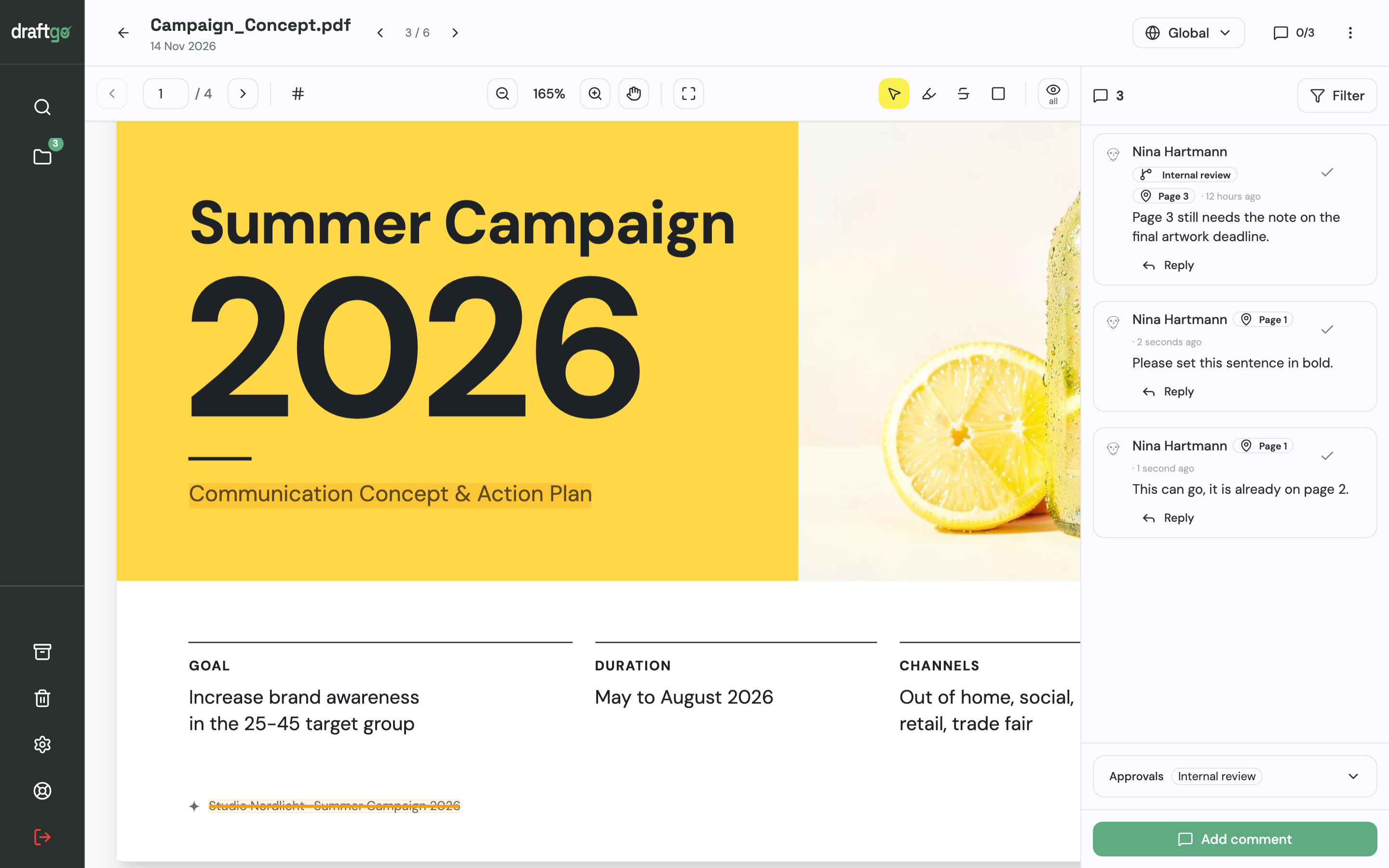
Feedback happens directly on the page. Stakeholders highlight sentences, apply strikethrough markup, or pin comments to specific paragraphs instead of describing line numbers in email threads. Press photos, infographics, and social teasers sit in the same project, allowing teams to review copy and visuals together.
To keep sign-offs structured, you organise approvals into sequential loops – for instance, an internal review loop with subject experts followed by a final approval loop for leadership or client stakeholders. Review rules allow you to specify whether all reviewers or any one of them must sign off before the release advances. External reviewers, such as clients or external partner PR contacts, open personal approver links directly in their browser without creating an account or logging in.
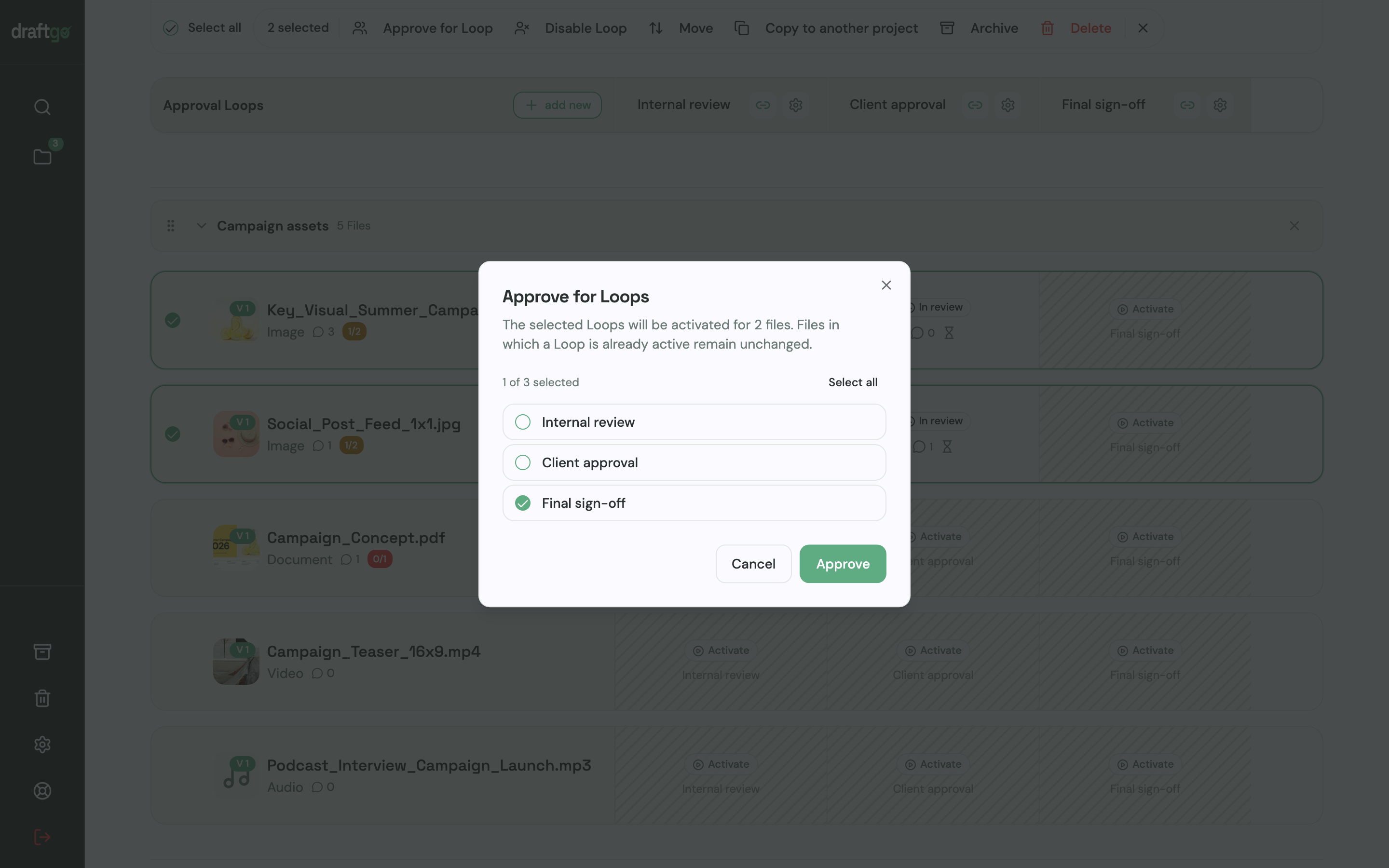
When revisions are required, upload the revised file as a new version. draftgo archives previous drafts in the version history, while the new version automatically restarts the necessary approval loop. To support quality control, our AI agent “GO” can inspect text files and images on request, flagging typos, awkward formatting, or cut-off text before the document reaches senior leadership.
Stored data is kept on EU servers in the Frankfurt data centre. PR teams managing client campaigns under strict non-disclosure terms receive a data processing agreement under Art. 28 GDPR that openly lists all sub-processors. For teams coordinating broader announcements, review workflows can cover media publishing collateral alongside press releases, while dedicated social media approval tools handle social campaign assets.
FAQ
What is the ideal length for a press release?
A standard release should run between 400 and 600 words, occupying a single printed page or two brief screen lengths. If an announcement requires more technical background or data, provide it as an attached fact sheet or link to an online press kit rather than lengthening the release itself.
How do I format quotes in a press release?
Attribute quotes to a full name, professional job title, and organisation. Introduce the quote with a colon or comma, place punctuation inside the speech marks, and keep the speaker's tone conversational. Avoid using quotes for basic facts; reserve them for opinion, context, and future outlook.
What does an embargo mean on a news release?
An embargo is an agreement between the issuing organisation and journalists that the shared information will not be published before a specified date and time. It gives reporters time to research background details, interview spokespeople, and write thorough articles ahead of an official launch.
Who should sign off on a press release before it goes out?
The sign-off chain should include the subject-matter expert who verifies the facts, the spokesperson whose quote is featured, legal or compliance specialists, and executive leadership or the agency client. If the release announces a partnership, the partner's communications team must also approve the copy.
Conclusion
A successful press release combines a disciplined, inverted-pyramid structure with a clear, staged approval sequence. By separating factual checks from executive sign-off and reviewing copy alongside media assets in one place, communications teams prevent conflicting edits and meet tight press deadlines with confidence.
Try it free – draftgo is free for 14 days, no credit card needed.
Written by
Emilia
Content Producer
Ready to streamline your approval processes?
Get started with draftgo today and see how easy professional collaboration can be.