
The detail aid for the congress is in its fourth round. Medical affairs commented in the PDF, legal sent back a marked-up printout, and the agency asks which file is current. Then the quality team asks a question nobody in marketing can answer: is the tool you use for all this validated?
This comparison sorts seven tools for medical, legal and regulatory review, or MLR review: life sciences platforms on one side, general proofing tools on the other. How the review process itself runs is covered in our guide to pharma marketing. Every vendor statement below was checked on the vendor's own page on 23 November 2026.
This article is general information, not legal advice.
What is MLR review software?
MLR review software is software in which medical, legal and regulatory reviewers check promotional material for a medicine or medical device, comment on its claims and approve one specific version, with a record of every decision. Specialist platforms add a library of approved claims with their references, workflows the company can validate and packages for submissions to the FDA. General proofing tools cover markup, versions and approval rounds.
What US and UK rules expect from the system
Which rules apply to your material and your system is for your regulatory and quality teams to decide. Three rules are worth knowing before you choose software.
United States: 21 CFR Part 11 and Form FDA 2253
21 CFR Part 11 sets the criteria under which the FDA considers electronic records and electronic signatures trustworthy, reliable and generally equivalent to paper records and handwritten signatures. For closed systems it asks for controls such as system validation, time-stamped audit trails and limited access (21 CFR Part 11, eCFR, up to date as of 19 November 2026). In its guidance of September 2003, the FDA says it reads the scope of Part 11 narrowly and applies enforcement discretion to some requirements, among them validation and audit trails (FDA guidance on Part 11 scope and application).
Separately, the applicant for a prescription drug submits promotional labelling and advertising when it is first disseminated or published, each with a completed Form FDA 2253 (21 CFR 314.81, eCFR).
United Kingdom: certification under the ABPI Code
Under clause 8 of the ABPI Code of Practice 2024, promotional material may only be issued once one person has certified its final form on behalf of the company: a registered medical practitioner or a UK-registered pharmacist who did not develop the material. The supplementary information allows validated electronic signatures for certifying. Certificates must be kept for at least three years after the final use of the material, and material still in use must be recertified at least every two years (PMCPA, ABPI Code 2024, clause 8).
How we evaluated the tools
We looked at each tool as a pharma or medical device marketing team working with an agency, using six criteria:
- Claims and references: whether approved claims and their references live in the tool.
- Compliance statements: what the vendor says about Part 11, validation and certifications. We did not audit any system.
- Markup: comments on PDFs, images and video at the spot they refer to.
- Workflow: stages, parallel reviews and rules for who must approve.
- External reviewers: whether agencies and outside experts can take part.
- Pricing: a public price, a free plan or a trial.
draftgo is our product, and it gets pros and cons like every other tool here. The order is not a ranking: the three life sciences platforms come first in alphabetical order, then four proofing tools, from the most life sciences features the vendor names to the fewest. More general tools are compared in our overview of proofing software.
MLR review software compared: 7 tools
| Tool | Type | Suited for | Life sciences features the vendor names | Entry price, as of 23 Nov 2026 |
|---|---|---|---|---|
| Aprimo | DAM and content operations | global content teams | MLR workflows, claims traceability, Part 11 support | quote on request |
| Veeva Vault PromoMats | life sciences content platform | one system of record for biopharma | claims management, eCTD packages for the FDA | not published |
| Vodori | life sciences content platform | pharma, device and diagnostics teams | Part 11, Annex 11, GxP validation, claims | Starter, Pro and Enterprise on request |
| Ziflow | online proofing tool | healthcare teams with staged workflows | audit logs, e-signatures on Enterprise | Standard $199 a month, billed annually |
| Filestage | online proofing tool | pre-checks before MLR | AI review agents, verified approval on Enterprise | Starter €199 or $199 a month, yearly billing |
| PageProof | online proofing tool | one flat price | ISO 27001:2022, choice of data location on Enterprise | Team $2,499 a year or $249 a month |
| draftgo | online proofing tool | drafts before formal MLR | none, a general proofing tool | see the draftgo entry below |
The 7 MLR review tools in detail
1. Aprimo: for global content teams that want MLR workflows next to their assets
Aprimo is a digital asset management and content operations platform. Its life sciences page describes structured MLR workflows, claims and reference traceability, version control, documented approvals and audit-ready content histories, and it names SOC 2 Type II, ISO 27001 certification and support for 21 CFR Part 11 requirements (Aprimo life sciences). Aprimo integrates with MLR platforms, Veeva repositories and creative tools, and packages are built from users and modules (Aprimo pricing).
- Pros: MLR workflows next to every approved asset, claims and references kept with the content, integrations with Veeva and other MLR systems
- Cons: a large platform if you only need the review step, and no public prices
- Price: quote on request (Aprimo pricing)
2. Veeva Vault PromoMats: for biopharma companies that want one system of record for promotional content
Veeva describes PromoMats as the system of record for compliant promotional content, covering creation, review and approval, claims management, digital asset management, a brand portal and content strategy (Veeva PromoMats). Its MLR review page lists tier-based review, multi-document workflows for a whole campaign, automatic redline annotation of references and eCTD compliance packages for submissions to the FDA (PromoMats MLR review). A CRM connection distributes approved content.
- Pros: claims, review, submission packages and distribution in one system
- Cons: no public prices or self-service trial, and a scope far beyond the review step
- Price: not published; a product sheet and a contact form are on the PromoMats page
3. Vodori: for pharma, device and diagnostics teams that want a validated MLR platform
Vodori brings MLR review, claims and evidence management, workflow and distribution together for pharmaceutical, biotech, medical device and diagnostics companies (Vodori platform). Vodori states that it is 21 CFR Part 11 and EU Annex 11 compliant, GxP validated and audited annually for SOC 2 Type 2, that each release comes pre-validated with a validation package, and that it holds ISO 27001. The platform prepares material for submissions such as FDA 2253.
The pricing page lists Starter, Pro and Enterprise tiers and a standalone claims module, all with prices on request; claims management and single sign-on start with Pro.
- Pros: Part 11, Annex 11 and GxP validation as stated by the vendor, a validation package with each release, a standalone claims module
- Cons: no public prices, and claims management starts with Pro
- Price: on request for every tier (Vodori pricing)
Try it yourself: In the demo you work in a real draftgo workspace with sample data.
4. Ziflow: for healthcare marketing teams with multi-stage workflows
Ziflow's healthcare page describes text inspection for disclaimers, checklists for legal and compliance reviewers, audit logs of every decision and a “Confirm and Sign” prompt that it presents as aligned with FDA 21 CFR Part 11 guidelines. On the pricing page, electronic signatures, ReviewAI and SAML single sign-on come with Enterprise, which is priced on request. Standard costs $199 a month billed annually with 15 users, two stages and a 90-day audit trail, and Pro $329 with 20 users and three stages.
- Pros: sequential and parallel stages, healthcare features on its own page, a free plan to start
- Cons: the signature step, ReviewAI and single sign-on sit on Enterprise without a public price
- Price: Standard $199 and Pro $329 a month, billed annually (Ziflow pricing)
draftgo vs Ziflow compares the two tools in general.
5. Filestage: for marketing teams that pre-check content before MLR
Filestage's pharmaceutical page says its review agents, on Business and Enterprise, check content against FDA, EMA and MHRA standards before MLR review, including claims and dosage accuracy. On the pricing page, Enterprise adds verified approval, which turns “Approve” into “Approve and sign” with a password check that Filestage describes as in line with FDA 21 CFR Part 11 and EU Annex 11, plus audit logs and SSO. Starter costs €199 or $199 and Business €329 or $329 a month on yearly billing.
- Pros: AI pre-checks for pharma claims on Business, reviewers who need no account, a free plan
- Cons: verified approval and audit logs only on Enterprise, which has no public price
- Price: Starter €199 and Business €329 a month on yearly billing (Filestage pricing)
draftgo vs Filestage sets out the general differences.
6. PageProof: for regulated teams that want one flat price
PageProof's security page states that its information security management system is certified to ISO 27001:2022 and names pharmaceuticals and healthcare among the sectors it serves. On the pricing page, Team costs $2,499 a year or $249 a month with unlimited reviewers, proofs and storage. Team Plus adds single sign-on, and Enterprise adds digital signing and a choice of where proofing data is stored.
- Pros: one flat price with unlimited reviewers, an ISO 27001:2022-certified security management system
- Cons: no claims library or submission support named on its pages, and no free plan
- Price: Team $2,499 a year or $249 a month (PageProof pricing)
7. draftgo: for marketing teams and agencies in the review rounds before formal MLR
draftgo is an online proofing platform for agencies, freelancers and in-house teams. It fits the rounds before formal MLR review, when marketing, the agency and medical writers settle a draft. Your team uploads PDFs, images, videos and audio files. Reviewers highlight a claim in a PDF, comment at a point in a video and attach a file such as the study page to a comment.
Approvals run in loops, for example a marketing loop first and a brand loop second. For each loop you decide whether all approvers, a set number or any one of them must approve, separately for your team and for guests, who review through a link without an account. A corrected draft becomes a new version of the same file and starts the approvals again.
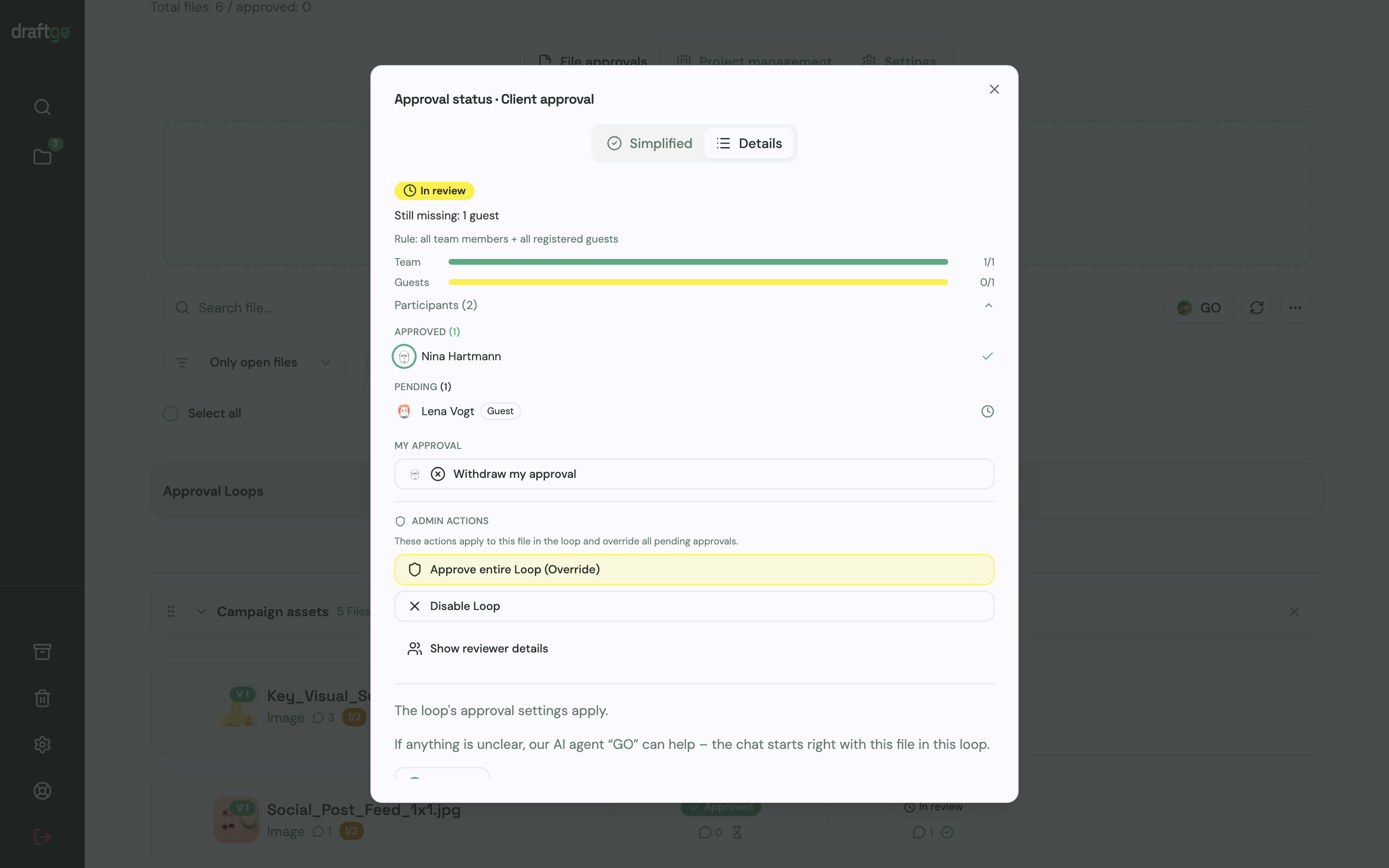
The activity log records approvals, comments, versions and downloads with person and time and exports as CSV, JSON or PDF, and a file's review documentation comes as PDF or CSV. From the Freelancer plan, the AI review flags typos, cut-off text or very small type as comments from our AI agent “GO”, while the judgement on a claim stays with your reviewers. Stored data is kept on EU servers in the Frankfurt data centre.
- Pros: comments at the spot on PDFs, images and video, approval loops with a rule each, guests without an account, one price per company
- Cons: teams that need a validated system for formal MLR review choose a specialist life sciences platform
- Price: a permanent Free plan and paid plans you can test free for 14 days, all listed on draftgo pricing
More on this use is on draftgo for legal and compliance.
Which MLR review software fits your team?
| Your situation | What matters most | Tools to test first |
|---|---|---|
| Pharma company standardising promotional content worldwide | one system of record, claims, submissions | Veeva Vault PromoMats, Aprimo |
| Mid-sized pharma, device or diagnostics company | Part 11 statements, validation package, claims | Vodori, Veeva Vault PromoMats |
| Content team that already runs a DAM | MLR workflows next to its assets | Aprimo |
| Marketing team that wants AI pre-checks | review agents, staged reviews | Filestage, Ziflow |
| Regulated team that wants a flat price in a proofing tool | unlimited reviewers, certified security | PageProof |
| Agency or brand team settling drafts before MLR | comments on the file, guests without an account | draftgo |
If you lack reviewers rather than software, IQVIA offers Pharma Review as a service, with material review, medical certification and process support (IQVIA, MLR review).
Practical example: an agency's drafts before the client's MLR review
A twelve-person healthcare agency produces an email for doctors and a six-page detail aid for a mid-sized pharma client. The client runs formal MLR review in its own validated system and wants material there only once its brand team agrees.
The agency works in draftgo on the Agency plan with two loops: an internal one for the copy chief and the art director, and a brand loop in which the client's brand manager approves through a personal approver link. A medical writer at the client comments through the shared viewer link. She highlights the efficacy claim on page three and attaches the study page to her comment, and the copywriter answers in the thread. The designer uploads version 2, the approvals start again, and the brand manager approves version 3.
The agency hands over the final PDF with the file's review documentation, and the client loads it into its MLR system for formal review and certification. Why each correction should be a version is explained in our guide to document version control.
FAQ
What is MLR review software?
MLR review software takes promotional material for medicines and medical devices through medical, legal and regulatory review and records who approved which version. Specialist platforms such as Veeva Vault PromoMats, Vodori and Aprimo add claims management and workflows the company can validate.
Does MLR review software have to comply with 21 CFR Part 11?
Part 11 applies to electronic records kept under the FDA's record requirements or submitted to the FDA, and to the electronic signatures on them (21 CFR Part 11). Whether your review records fall under it is for your quality and regulatory teams to decide. Several vendors in this list make statements about Part 11, so ask for their validation documentation.
Can a general proofing tool be used for MLR review?
Yes, for the rounds before formal review, when marketing, the agency and medical writers settle a draft. The formal review and the certification belong in the system that your company's procedures name.
How much does MLR review software cost?
Veeva, Vodori and Aprimo publish no prices on their pages, as of 23 November 2026. Among the proofing tools, Ziflow Standard costs $199 a month billed annually, Filestage Starter €199 a month on yearly billing and PageProof Team $2,499 a year (Ziflow, Filestage, PageProof).
Conclusion
If your formal MLR review needs a validated system with claims management and submission support, shortlist Veeva Vault PromoMats and Vodori, and Aprimo if your content already lives in a DAM. For the drafts before that step, a proofing tool that your agency can use without extra accounts is enough; agree with your quality team where the formal review starts.
Try it free – draftgo is free for 14 days, no credit card needed.
Written by
Emilia
Content Producer
Ready to streamline your approval processes?
Get started with draftgo today and see how easy professional collaboration can be.