
Running marketing campaigns for banks, fintechs or investment firms is fundamentally different from promoting ordinary consumer goods. When creative assets promise returns, quote interest rates or introduce credit products, an ambiguous phrase or an omitted risk warning can lead to regulatory interventions, heavy fines and reputational damage.
Yet fast-moving campaign schedules frequently clash with legal oversight. Feedback ends up scattered across chat channels and long email chains, leading to uncertainty about whether the latest social reel or search ad genuinely received legal sign-off. Establishing a reliable financial promotions approval process is essential for financial institutions and the creative agencies supporting them.
This article is general information, not legal advice.
Why financial marketing gets extra scrutiny
Unlike traditional retail marketing, financial promotions influence decisions that directly affect people's savings, investments and personal solvency. If a product feature is overstated or a core risk is buried in tiny text, consumers can suffer immediate financial loss.
Because of this inherent consumer risk, supervisory authorities hold financial firms to far stricter advertising standards than other industries. Regulators expect every promotional asset to present a balanced view of risks and rewards. Creative ideas cannot simply launch because the marketing lead likes them; they require systematic verification against product specifications and legal boundaries. When teams treat these reviews as an afterthought, campaigns stall, deadlines slip, and unapproved versions risk leaking into public view.
The rules in the UK and the US
Financial marketing rules vary depending on the jurisdiction and the specific financial product, meaning internal compliance teams hold the final say on what passes. However, both the UK and the US impose strict, legally binding frameworks on promotional sign-offs.
The UK regime (FSMA)
In the United Kingdom, financial marketing is governed by statutory law under the Financial Services and Markets Act 2000, section 21. Under s. 21, a person must not, in the course of business, communicate an invitation or inducement to engage in investment activity unless:
- The person is an authorised firm, or
- The content of the promotion is approved by an authorised person.
For authorised firms, the Financial Conduct Authority (FCA) sets out detailed conduct rules. Communications must be clear, fair and not misleading. This means prominent risk statements, visible qualification of promotional rates, and balanced presentations of potential downsides alongside prospective yields. The principle extends to third-party distribution, meaning financial institutions remain responsible for marketing circulated on their behalf.
The US regime (FINRA)
In the United States, broker-dealers and financial institutions face rigorous standards enforced by the Financial Industry Regulatory Authority. Under FINRA Rule 2210, an appropriately qualified registered principal of the member firm must approve each retail communication before its use or filing with FINRA.
Furthermore, FINRA Rule 2210 mandates that all communications must be fair and balanced, must provide a sound basis for evaluating the facts, and must never omit material facts. Materials must not contain false, exaggerated, unwarranted, promissory or misleading statements. Promising guaranteed returns or minimising volatility violates these foundational requirements.
Similar requirements for substantiated claims and fair advertising apply across broader commercial markets, as explored in our guide to marketing compliance.
A multi-stage approval process with roles
To meet regulatory expectations without grinding daily work to a halt, financial firms rely on multi-stage sign-off workflows. Handing an unrefined creative draft straight to compliance results in endless revisions. Instead, reviews should move progressively through clearly defined roles.
| Stage | Responsible Role | Core Responsibility |
|---|---|---|
| 1. Marketing Review | Creative Lead / Marketing Manager | Checks visual layout, campaign messaging, branding, and basic brief alignment. |
| 2. Product Review | Product Manager / Proposition Specialist | Verifies interest rates, terms, product limits, fee schedules, and technical accuracy. |
| 3. Compliance & Legal | Compliance Officer / Registered Principal | Reviews legal disclosures, risk warnings, regulatory balance, and statutory wording. |
| 4. Final Sign-off | Appointed Approver / Business Head | Confirms that all prior notes were resolved and grants formal publication release. |
1. Marketing review
The creative team or agency evaluates the initial draft. The focus here is verifying that the asset meets the brief, uses appropriate visual hierarchy, and respects brand guidelines. Catching spelling mistakes and basic design problems at this stage keeps subsequent reviewers focused on substantive matters.
Try it yourself: In the demo you work in a real draftgo workspace with sample data.
2. Product review
Once the creative concept is sound, the product team examines the technical details. A financial product specialist checks that cited percentages, bonus qualifications, payback periods and fee caps correspond exactly to the current live product specifications.
3. Compliance and legal review
Next, a compliance officer or registered principal examines the asset against statutory codes. They assess whether risk disclaimers appear with sufficient prominence, whether the tone is fair and balanced, and whether mandatory regulatory notices are present. This stage often requires precise textual markups.
4. Final approval
With all previous changes addressed, the designated approver signs off the final asset. This formal release confirms that no further modifications will take place before distribution. Every transition between these stages must record the reviewer’s identity, the exact version, and the date.
Typical mistakes in short formats
Short-form digital media, such as mobile banners, social ads, stories and video reels, present the highest compliance failure rate. Trying to fit complex financial terms into tiny screen spaces often produces serious compliance errors:
- Outdated rates in running ads: Marketing teams frequently adjust variable percentage rates or annual yields on products without updating long-running paid ad sets. When the live rate changes but an active ad displays old numbers, the promotion becomes misleading.
- Missing risk warnings: In video reels, carousels or banner ads, teams often forget required disclaimers entirely or hide them behind separate clicks where users rarely see them.
- Multiple versions in circulation: When marketing managers download drafts from chat threads, older or unapproved iterations easily get handed over to media buyers by mistake.
- Unreviewed influencer content: Partnering with creators or "finfluencers" creates high exposure. If an influencer publishes spontaneous endorsements without compliance sign-off on their exact script and visual disclosures, the sponsoring firm remains liable.
The risks of uncoordinated digital approvals mirror issues found in social media approval tools, where version control on fast turnaround assets is crucial. Similar rigorous multi-stakeholder workflows are common in pharma marketing, where regulatory omissions carry parallel risks.
Checklist for social ads, banners and reels
Before clearing any short-form creative for campaign release, review each asset against this foundational checklist:
- Clear ad identification: Is the post or banner immediately recognisable as a paid commercial promotion?
- Readable risk warnings: Are required disclaimers legible on mobile screens without zooming, and do video disclaimers remain visible long enough to read?
- Dated rates and figures: Does every quoted interest rate, APY or promotional bonus state the effective date or state that terms are subject to change?
- Strict version control: Has the media agency confirmed that only the final, approved export is scheduled in the ad manager?
- Influencer parity: Has every piece of partner or influencer creative gone through the exact same formal compliance process as internal ads?
What the approval tool must provide
Relying on PDF comments sent over email or verbal sign-offs in meetings fails to satisfy internal audit departments or external regulators. A financial marketing tool must provide:
- Strict versioning: Uploading an altered asset must clearly create a new version, automatically archiving earlier iterations while keeping their comment history intact.
- Granular roles and stages: Reviewers need distinct access levels so that compliance sign-offs cannot be accidentally bypassed by creative staff.
- Exact timestamps and audit logs: The system must record when an asset was uploaded, who annotated it, who approved it, and when the sign-off took place.
- Exportable activity records: Teams must be able to export an audit trail showing the full approval path whenever internal compliance or external authorities request evidence.
- Transparent data handling: Financial firms must know where their files and customer-facing drafts are hosted, ensuring cloud providers meet organisational data governance rules. Agencies handling sensitive documentation can find further background in our guide on cloud data privacy.
Practical scenario: launching a credit card campaign
Consider a mid-sized fintech launching a digital campaign for a new rewards credit card. The agency produces ten social image assets, three short video ads, and a series of mobile banners.
In the initial draft, the headline highlights a competitive balance transfer promotion in large type, while the representative APR is placed in tiny, low-contrast text at the bottom. During stage one, the agency's creative lead verifies layout balance. In stage two, the fintech's product manager spots that the introductory fee terms were updated the previous day and notes the revised figure directly on the design.
In stage three, the compliance team flags that the representative APR fails the prominence test under domestic advertising rules, requiring larger type and equal prominence to the promotional rate. Because all feedback is tied directly to specific coordinates on the file, the designer fixes the typography without ambiguity.
Once the revised version is uploaded, the compliance officer reviews the changes and grants formal approval. When the media buyer schedules the campaign, they pull solely from the approved repository, eliminating the risk of launching uncorrected drafts.
How it works in draftgo
For teams balancing rapid campaign production with regulatory precision, draftgo offers a structured environment for managing reviews.
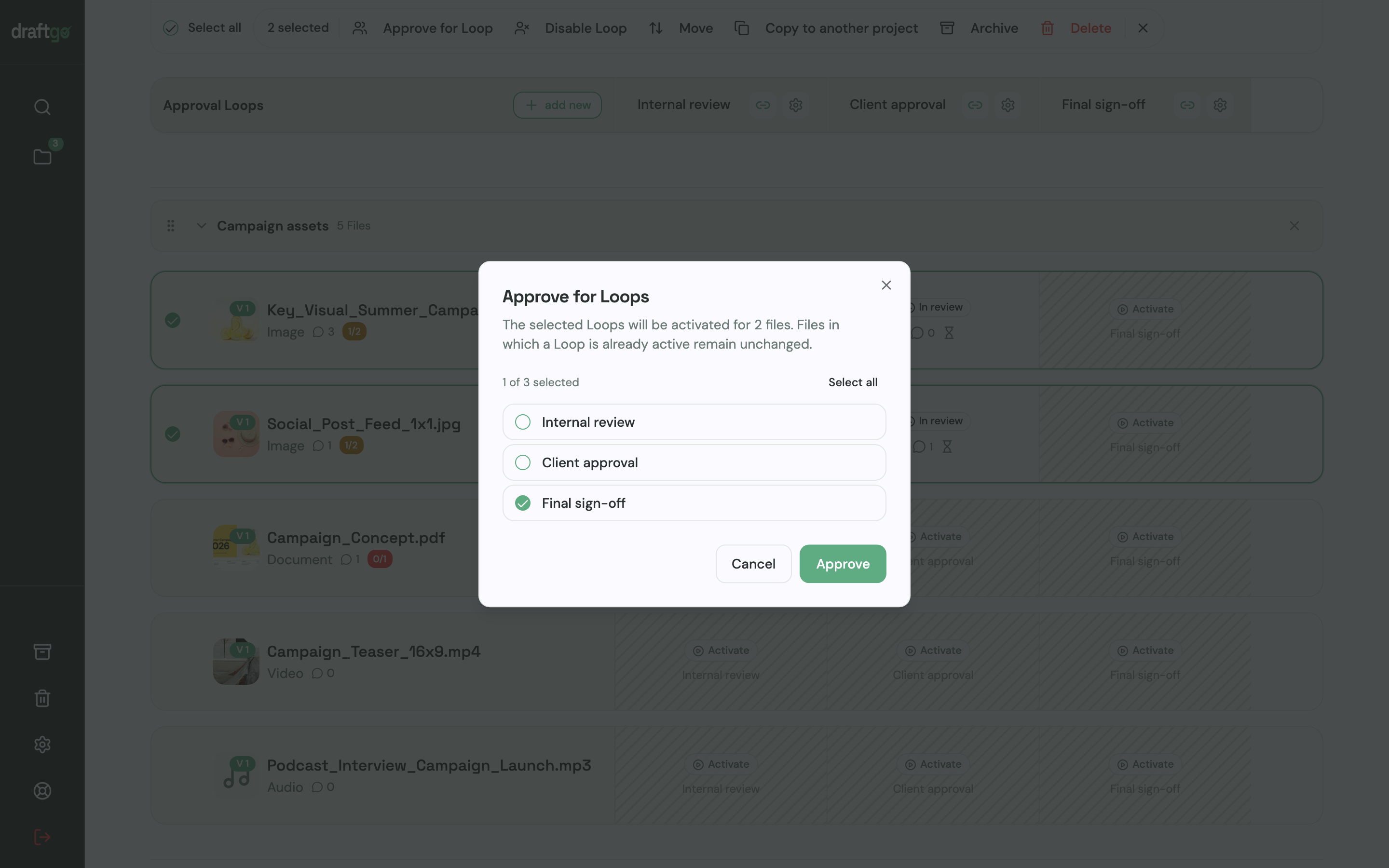
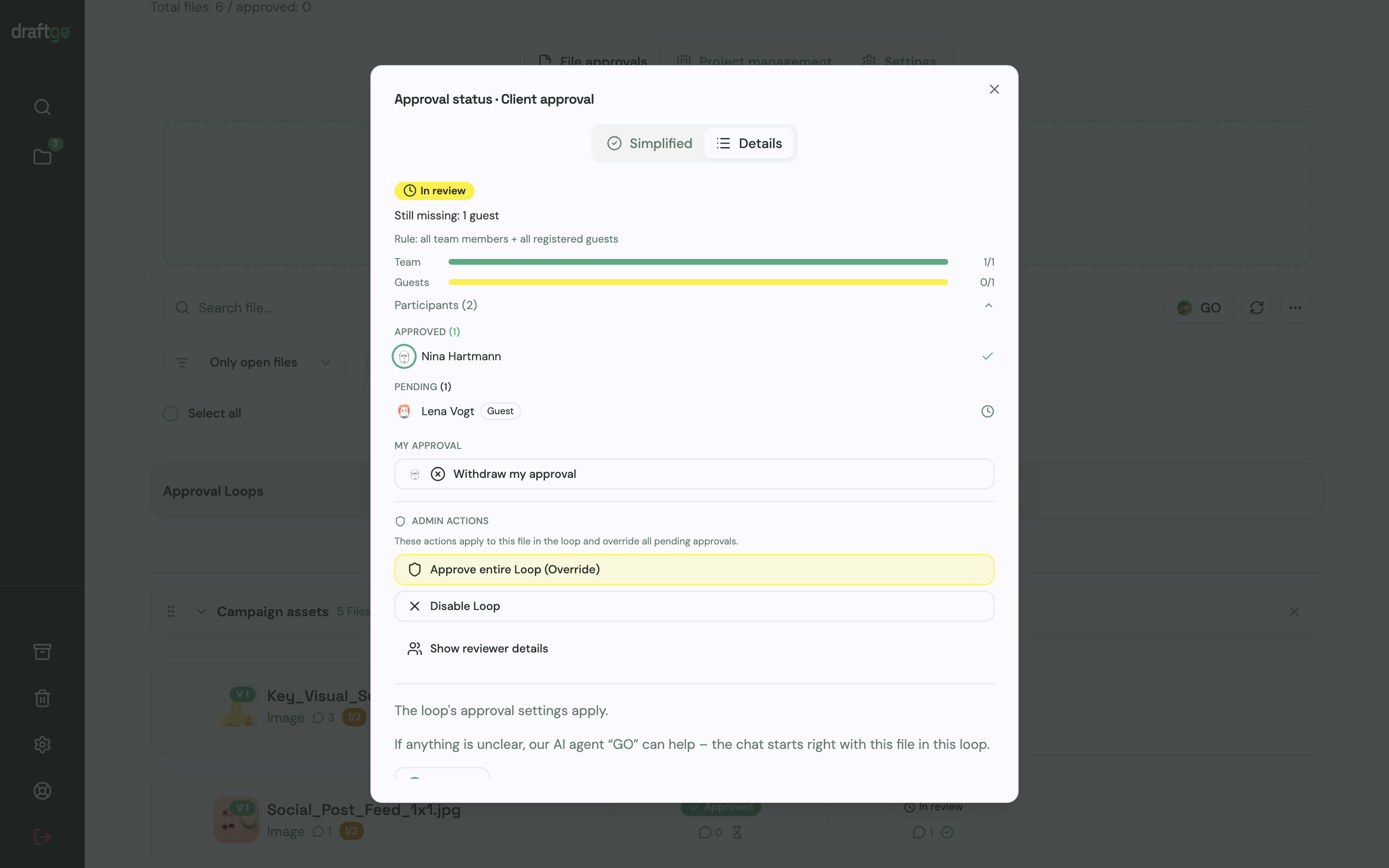
Approvals run in loops with named approvers. You can establish sequential stages, such as internal creative reviews followed by client product and compliance loops. Per loop, a rule sets whether everyone, a certain number or one person must approve, ensuring that necessary sign-offs from key compliance officers cannot be skipped.
Reviewers annotate images and PDFs with pins and rectangles, and leave comments at a point in time on video and audio files. When adjustments are made, new drafts become versions of the same file and restart the approvals. Earlier drafts remain accessible in the version history, allowing reviewers to check past feedback against current updates.

Every action is documented. The activity log records approvals, comments, versions and downloads with person and time, and can be exported as CSV, JSON or PDF. Stored data is kept on EU servers in the Frankfurt data centre. While draftgo documents each step systematically, whether the resulting record meets a firm's specific statutory retention duties is for its compliance team to confirm.
Find more about structured review workflows for regulated creative production on our legal and compliance solutions page.
FAQ
What constitutes a financial promotion?
A financial promotion is any communication that invites or induces someone to engage in financial or investment activity. This includes social media posts, print ads, website landing pages, video commercials, influencer endorsements, and email campaigns that reference financial products, interest rates, credit offers or investment services.
Can compliance approvals happen over email?
While small teams sometimes rely on email, approving financial marketing over message threads carries significant risks. Tracking whether an approval applied to an earlier draft or the final asset becomes difficult, version mix-ups are common, and assembling an audit trail for regulators requires manual, error-prone effort.
Why do influencer posts require financial compliance review?
Regulatory authorities treat influencer and partner content as extensions of the financial institution's own marketing. If an influencer promotes a financial product without adequate risk disclosures, makes exaggerated claims or misquotes rates, the sponsoring financial institution can face regulatory action and penalties.
Who must approve retail communications under FINRA rules?
Under FINRA Rule 2210, an appropriately qualified registered principal of the member firm must approve each retail communication before its use or filing with FINRA. The rule ensures that materials are balanced, fair and free from promissory or misleading claims.
What should happen when promotional interest rates change?
When underlying product rates change, every active ad and marketing asset citing the old rate must be paused or updated immediately. Running promotions displaying outdated rates violates standards for fair, clear and truthful advertising.
Conclusion
Managing financial marketing requires balancing creative speed with uncompromising compliance oversight. Clear review stages, defined roles between product specialists and compliance officers, and rigorous version control protect financial brands from regulatory penalties.
Try it free – draftgo is free for 14 days, no credit card needed.
Written by
Emilia
Content Producer
Ready to streamline your approval processes?
Get started with draftgo today and see how easy professional collaboration can be.