
Your studio has sold a rebrand, and a motion designer who works white label for several agencies is animating the logo. The designer shares a review link for the first cut, and you forward it to the client without opening it. The client sees another company's logo at the top of the page and writes back to ask who that is.
What is a white label agency?
A white label agency is a service provider that delivers work for other agencies, which sell it to their own clients under their own name. The end client sees one brand, the reselling agency's, and usually never learns that a partner did part of the job.
The term borrows from the white label on a product, the blank label a seller fills with its own brand. It is also used more loosely for the reselling agency and for software an agency shows its clients in its own look.
How a white label partnership works
Your agency sells the job and manages the client, while the partner produces the work behind the scenes. There are two separate agreements, client with agency and agency with partner, and the partner invoices your agency, never the client.
| Role | What they do | Whose name they see or use |
|---|---|---|
| End client | Briefs, gives feedback, approves, pays your agency | Only your agency's |
| Your agency | Sells, briefs the partner, checks quality, handles all client contact | Its own |
| White label partner | Produces the work, invoices your agency | Your agency's, on everything that goes out |
You set the client's price, the partner sets yours, and the difference is your margin. Every question and every round of feedback passes through you.
Types of white label work
White label work falls into two groups: services a partner delivers and software you show in your own look. Typical services are:
- SEO and content writing
- paid search and paid social campaigns
- social media management, with your client's sign-off in a social media approval tool
- web design and development
- design, illustration, animation and video editing
The software group covers reporting dashboards, client portals and review tools. With online proofing, the client comments on a draft in the browser and approves it there, on a page that carries either your name or someone else's.
Try it yourself: In the demo you work in a real draftgo workspace with sample data.
Benefits and limits of white labelling
White labelling lets a small agency sell more than it can staff. In return, it depends on a partner it has to keep out of sight.
| Benefits | Limits |
|---|---|
| You offer services you do not staff yourself | Your margin depends on the partner's rates |
| You take on busy months without hiring | You answer for the partner's quality and delays |
| You keep the whole client relationship | The client starts asking questions once the partner's name shows up |
The last limit is the one you control best. A partner's name rarely sits in the design itself; it turns up in a file name, the author field of a PDF, an email signature or the page a review link opens.
How to keep your brand in front of the client: 5 steps
You keep your brand in front of the client by owning every step between the partner's file and the client's approval. The steps follow the path of a draft.
1. Brief the partner in your own format
Send the partner the brief you agreed with the client before any work starts. A creative brief template with a section on who approves what stops the partner from guessing.
2. Clean every file before it goes out
Check file names, the author and company fields in the document properties of PDFs and Office files, and any credits left on the artboard. Rename files to your own scheme.
3. Review internally first
Look at the draft with your team before the client does, and send changes back to the partner yourself. The partner's questions never reach the client's inbox.
4. Let the client review in your look
Give the client a review page with your logo and colours that opens from a link, without an account. A client who has to sign up for a tool first meets a second brand before even seeing the draft.
5. Answer every comment yourself
Reply to the client's comments yourself and pass the changes on to the partner, who stays out of client threads. Put this rule into your client onboarding process, so new clients know from day one where feedback goes.
Practical example: a branding studio with a motion partner
A three-person branding studio rebrands a regional bakery chain, and a white label motion designer produces the animated logo. The studio sets up one project with two loops, internal review first and client approval second, and uploads every cut the designer sends as a new version of the same file.
Once the team is happy with a cut, the client's marketing lead gets a personal link to a review page in the studio's logo and colours. She comments at the second where the logo should settle and later approves the final cut. The designer's name appears nowhere she looks.
How it works in draftgo
In draftgo, clients comment on images, PDFs, videos and other files via a link and approve them in loops. A white label setup takes four steps, and draftgo for agencies shows the rest of the agency workflow.
- Add your branding: On the Agency and Team plans, the app and the guest view show your own logo and colours, and the “powered by draftgo” notice disappears.
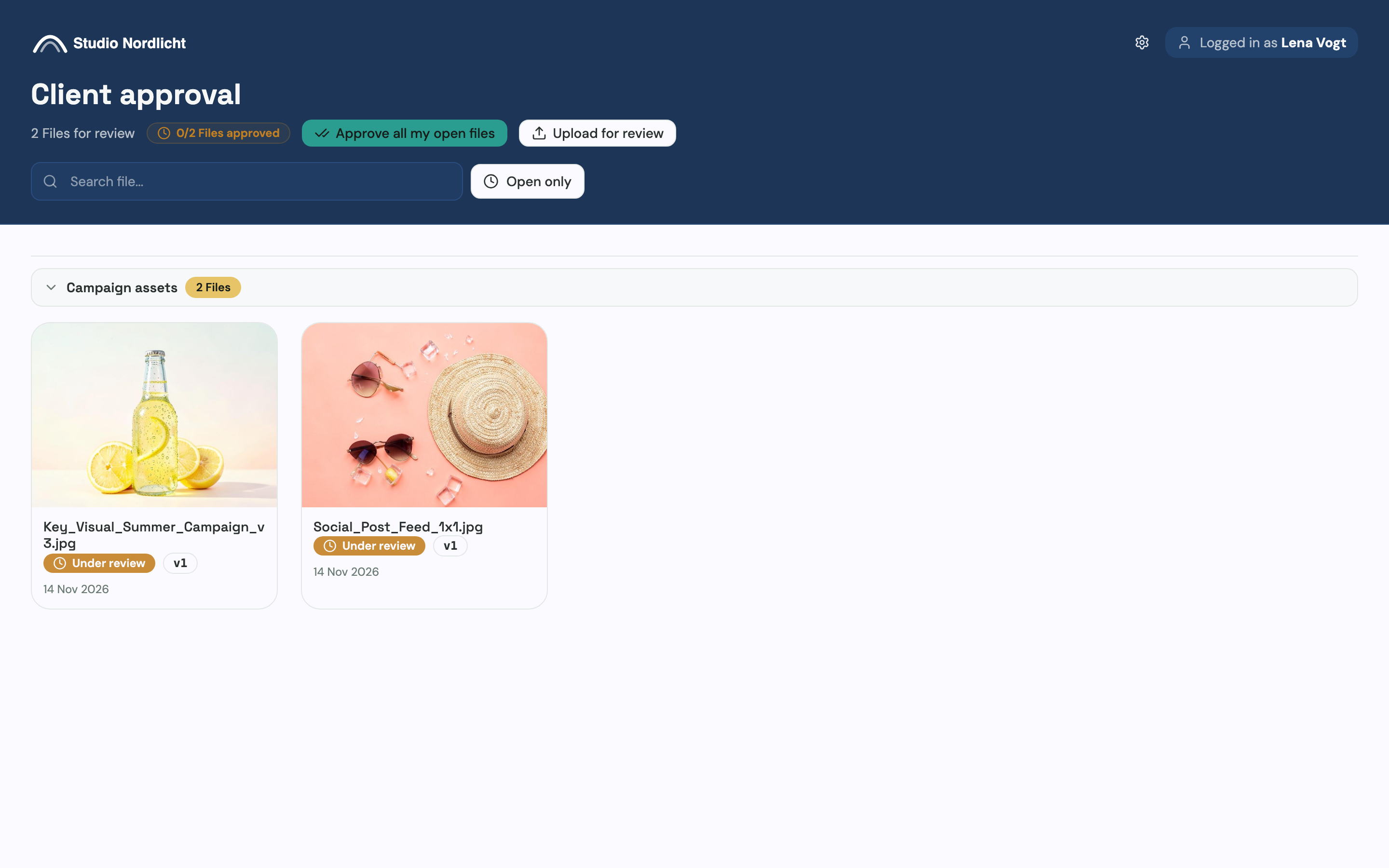
- Set up two loops: Upload the partner's files and create an internal loop and a client loop. A rule per loop decides whether everyone, a set number or any one of them must approve.
- Invite the client by link: Approver guests get a personal link and approve without an account; a viewer link lets others comment without approving.
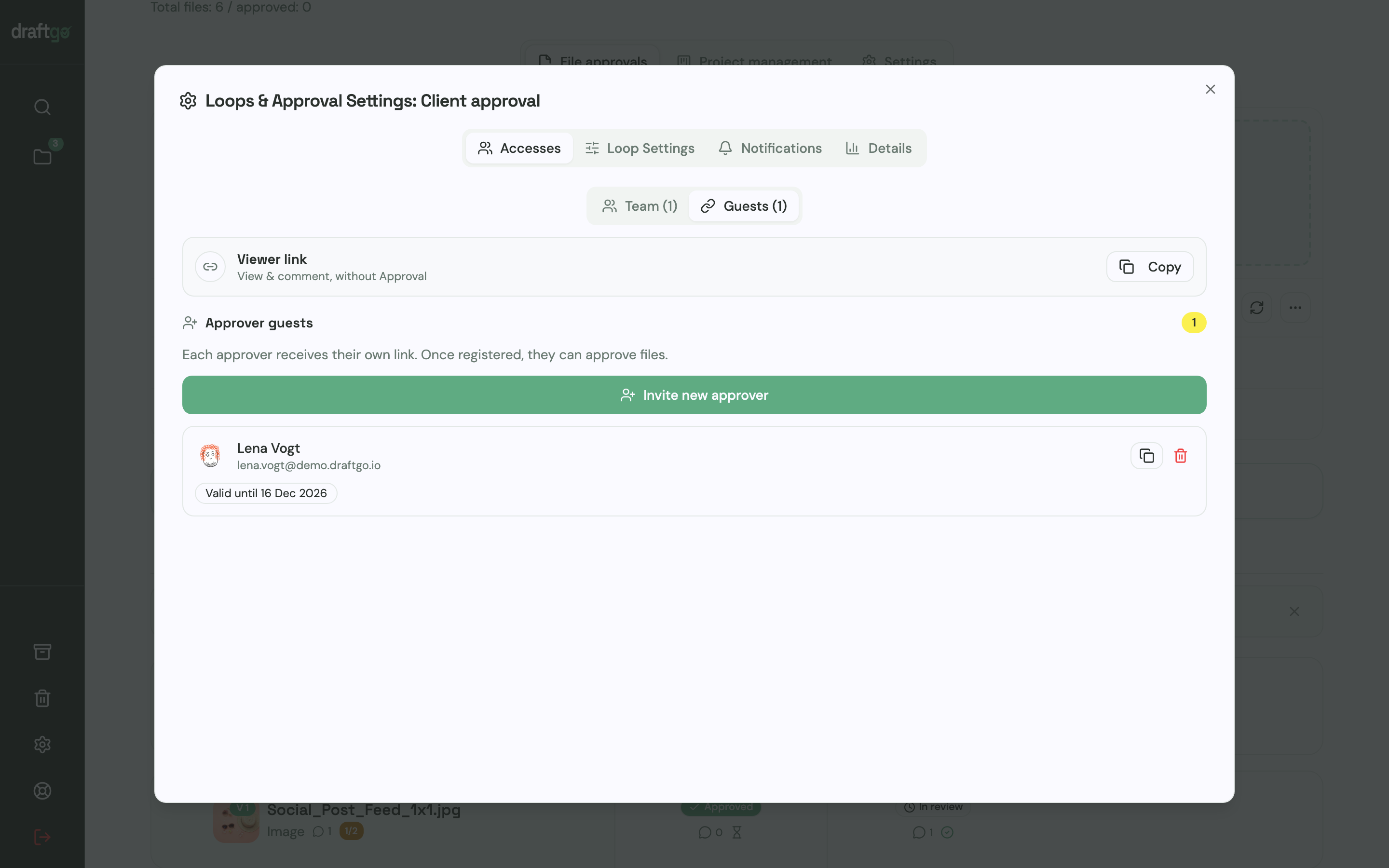
- Upload each cut as a version: A new version restarts the approvals, and draftgo logs every approval, comment and version with a timestamp.
Emails that draftgo sends to guests come in draftgo's design. Which plan includes what is on the pricing page.
FAQ
What is the difference between a white label agency and a subcontractor?
A white label agency is a subcontractor whose work goes out under your brand only. An ordinary subcontractor may be known to the client and may show the project in its portfolio; a white label partner does neither. Agree on this in writing before the first job.
How do I find a reliable white label agency?
Ask for work samples in your field and start with one small paid job before you hand over a whole client. Watch how the partner deals with the brief: questions before the first draft are a better sign than quick promises.
How do I stop a white label partner from contacting my client?
Agree in writing that the partner will not contact your clients or name them as references. Share drafts through a review page in your name, so the partner never needs the client's email address.
Which draftgo plans include your own branding?
The Agency and Team plans: the app and the guest view show your logo and colours, without the “powered by draftgo” notice. Free and Freelancer keep the draftgo look.
Conclusion
A white label partnership stays invisible only if the client sees your brand wherever the work reaches them, from the file name to the approval. Brief the partner in your own format, and set up an internal loop and a client loop in your logo and colours before the first draft arrives.
Try it free – draftgo is free for 14 days, no credit card needed.
Written by
Emilia
Content Producer
Ready to streamline your approval processes?
Get started with draftgo today and see how easy professional collaboration can be.